Representative Pedro Guevara
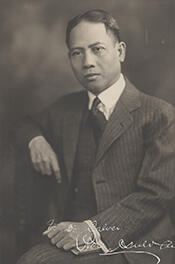
Here you will find contact information for Representative Pedro Guevara, including email address, phone number, and mailing address.
| Name | Pedro Guevara |
| Position | Representative |
| State | Philippine Islands |
| District | At-Large |
| Party | Unknown |
| Status | Former Representative |
| Term Start | December 3, 1923 |
| Term End | January 3, 1937 |
| Terms Served | 7 |
| Born | February 23, 1879 |
| Gender | Male |
| Bioguide ID | G000518 |
About Representative Pedro Guevara
Pedro Guevara y Valenzuela (February 23, 1879 – January 19, 1938) was a Filipino soldier, lawyer, legislator, Spanish‑language writer, and Resident Commissioner of the Philippines to the United States Congress during the American occupation. He was born on February 23, 1879, in Santa Cruz, Laguna, Philippines, to Miguel Guevara and María Valenzuela. His early life unfolded against the backdrop of late Spanish colonial rule in the Philippines, a period marked by growing nationalist sentiment and political unrest that would shape his later military and political career.
Guevara received his early education at Ateneo Municipal de Manila and later attended the Colegio de San Juan de Letran in Manila, from which he graduated in 1896. His formative years in these institutions provided him with a classical education and a grounding in the humanities and law, as well as exposure to the intellectual currents that accompanied the rise of Filipino nationalism. He would later pursue legal studies at La Jurisprudencia in Manila, qualifying as a lawyer and entering private legal practice, a profession he combined with journalism and public service.
With the outbreak of the Philippine Revolution against Spain, Guevara joined the Filipino forces and became actively involved in the struggle for independence. In 1897 he assisted in promoting the peace agreement of the Pact of Biak‑na‑Bato at San Miguel, Bulacan, an accord that temporarily halted hostilities between Spanish authorities and Filipino revolutionaries. He subsequently rejoined the Filipino forces and served throughout the Spanish–American War and the Philippine–American War, ultimately attaining the rank of lieutenant colonel. During this period he served as aide and private secretary to General Juan Cailles, gaining both military and administrative experience that would inform his later political work.
After the consolidation of American rule in the Philippines, Guevara transitioned from military to civic and political life. He worked as a journalist for the Spanish‑language newspapers Soberanía Nacional and Vidas Filipinas, contributing to public discourse in the colonial capital. In 1907 he entered elective office as a municipal councilor of San Felipe Neri, Rizal (present‑day Mandaluyong City). Building on his legal training from La Jurisprudencia, he practiced law privately while rising through the ranks of Philippine politics. He served as a member of the Philippine House of Representatives from the 2nd district of La Laguna from 1909 to 1912, and later as a member of the Philippine Senate from the 4th senatorial district from 1916 to 1923. In 1921 he chaired the Philippine delegation to the Far Eastern Bar Conference in Beijing, China, reflecting his prominence in both legal and political circles.
Guevara’s national career led naturally to his role as the Philippines’ representative in Washington. He gave up his Philippine Senate seat in 1923, less than two years before his second term expired, after being elected as a Nationalist Resident Commissioner to the House of Representatives of the United States Congress. According to the congressional record, Pedro Guevara served as a Representative from the Philippine Islands (PI) in the United States Congress from March 4, 1923, to February 14, 1936. A member of the Unknown Party in the context of U.S. congressional party classification, he nonetheless aligned with Filipino nationalist objectives and served for what the existing record describes as seven terms in office, during which he contributed to the legislative process and participated in the democratic deliberations of the House of Representatives.
Guevara’s service in Congress occurred during a significant period in American and Philippine history, as the United States debated the future political status of its overseas territories. As Resident Commissioner, he represented the interests of his Filipino constituents before the U.S. Congress, though the position did not carry voting rights on the House floor. During his four three‑year terms as Resident Commissioner, he worked tirelessly for the passage of legislation that would advance Philippine self‑government. Most notably, he played an important role in advocating for the Tydings–McDuffie Act, approved in 1934, which established the Commonwealth of the Philippines and set a timetable of ten years for eventual Philippine independence. His term as Resident Commissioner ended on February 14, 1936, when a successor was selected in accordance with the new political framework of the Commonwealth of the Philippines.
Even while engaged in his duties in Washington, Guevara remained involved in the constitutional development of his homeland. He served as a delegate from Laguna to the Constitutional Convention of 1934, which framed the 1935 Constitution of the Philippines, the foundational charter of the Commonwealth government. Through this role he helped shape the legal and institutional structure of the soon‑to‑be self‑governing Philippine state, complementing his earlier efforts in the U.S. Congress to secure the legal basis for independence.
Following the conclusion of his congressional service, Pedro Guevara retired from formal political office and resumed his law practice in the Philippines. He spent his final years in Manila, remaining a respected figure in legal and political circles. Guevara died of a heart attack in Manila on January 19, 1938. He was originally buried at Manila North Cemetery, one of the principal burial grounds of the capital. In 1993, his remains were transferred to Loyola Memorial Park in Marikina, underscoring the continued recognition of his contributions as a soldier, legislator, and representative of the Philippine Islands in the United States Congress during a formative era in both American and Philippine history.