Representative Pedro Perea
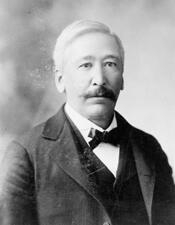
Here you will find contact information for Representative Pedro Perea, including email address, phone number, and mailing address.
| Name | Pedro Perea |
| Position | Representative |
| State | New Mexico |
| District | -1 |
| Party | Republican |
| Status | Former Representative |
| Term Start | December 4, 1899 |
| Term End | March 3, 1901 |
| Terms Served | 1 |
| Born | April 22, 1852 |
| Gender | Male |
| Bioguide ID | P000225 |
About Representative Pedro Perea
Pedro Perea (April 22, 1852 – January 11, 1906) was a sheep rancher, banker, and Republican politician in the Territory of New Mexico who served as a delegate to the United States Congress from 1899 to 1901. A member of a prominent Hispano Catholic family whose ancestors had lived in the region since the Spanish colonial era, he was a younger cousin of Francisco Perea, who had also represented New Mexico in Congress during the nineteenth century. Over the course of his career, Pedro Perea combined extensive interests in ranching and banking with a steady rise in territorial politics, culminating in his single term as New Mexico’s delegate to the Fifty-sixth Congress.
Perea was born on April 22, 1852, in Bernalillo, in what was then the Territory of New Mexico. Raised in a longstanding local family, he grew up in a community shaped by Hispanic, Catholic, and frontier traditions. Seeking formal education beyond his home town, he attended St. Michael’s College in Santa Fe, a boys’ seminary that served as one of the principal institutions of learning in the territory. His family then sent him east, reflecting both their means and their ambitions for his advancement.
Continuing his education outside the territory, Perea studied at Georgetown College in Washington, D.C., at a time when the institution was still relatively young but already emerging as a leading Catholic college in the United States. He later enrolled at St. Louis College in St. Louis, Missouri, from which he graduated in 1871. This combination of regional and national schooling provided him with exposure to broader political and economic currents in the United States, experience that would later inform his public service on behalf of New Mexico.
After completing his education, Perea returned to New Mexico and established himself as a rancher and stockman. He owned and operated a ranch where he raised agricultural crops and maintained a large sheep herd, participating in one of the territory’s most important economic sectors. His success in stock raising and agriculture helped build the financial base and local prominence that underpinned his later political and business activities. In addition to ranching, he became involved in banking, reflecting the growing complexity of the territorial economy in the late nineteenth century.
Perea’s formal political career began in his late thirties. A committed Republican, he was elected to the council of the New Mexico Territorial Legislature, serving three terms in 1889, 1891, and 1895. During this period he took part in shaping territorial laws and policies at a time when New Mexico was seeking greater development and eventual statehood. Parallel to his legislative service, he held a leading role in the territorial financial sector as president of the First National Bank of Santa Fe from 1890 to 1894, further cementing his position as an influential figure in both business and public affairs. His growing stature within the Republican Party led to his selection as a delegate to the Republican National Convention in 1896, where he participated in national party deliberations.
Building on this record, Perea was elected in 1898 as a Republican delegate to the Fifty-sixth Congress, serving from March 4, 1899, to March 3, 1901. As a delegate from the Territory of New Mexico, he sat in the United States House of Representatives, where he contributed to the legislative process and represented the interests of his constituents, although, like other territorial delegates of the era, he did not possess a vote on final passage of legislation. His term in Congress coincided with a significant period in American history marked by the aftermath of the Spanish-American War and debates over expansion, governance of new territories, and economic development. Perea participated in the democratic process on behalf of New Mexico during this transformative time but chose not to run for another term after his service concluded.
Following his departure from Congress in 1901, Perea returned to his private pursuits in New Mexico. He continued to engage in banking and stock raising, maintaining his involvement in the economic life of the territory. In early 1906 he was appointed Territorial insurance commissioner, a position that reflected continued confidence in his administrative abilities and knowledge of financial matters. His tenure in this office was brief, however, as he served only a matter of days before his death.
Pedro Perea died in Bernalillo, New Mexico, on January 11, 1906. He was interred in the Perea Cemetery—identified on some modern maps as the Bernalillo Cemetery—in Bernalillo, Sandoval County, New Mexico. His life and career, spanning ranching, banking, territorial legislation, and service as New Mexico’s delegate to Congress, placed him among the notable Hispanic American figures in the political history of the United States and the development of the Territory of New Mexico.