Representative Pehr Gustaf Holmes
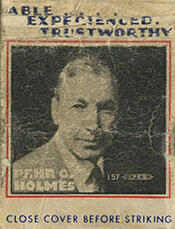
Here you will find contact information for Representative Pehr Gustaf Holmes, including email address, phone number, and mailing address.
| Name | Pehr Gustaf Holmes |
| Position | Representative |
| State | Massachusetts |
| District | 4 |
| Party | Republican |
| Status | Former Representative |
| Term Start | December 7, 1931 |
| Term End | January 3, 1947 |
| Terms Served | 8 |
| Born | April 9, 1881 |
| Gender | Male |
| Bioguide ID | H000741 |
About Representative Pehr Gustaf Holmes
Pehr Gustaf Holmes (April 9, 1881 – December 19, 1952) was a United States Representative from Massachusetts who served eight consecutive terms in Congress from 1931 to 1947 as a member of the Republican Party. His long public career, which spanned municipal, state, and federal office, reflected the political ascent of an immigrant who became a prominent figure in Worcester, Massachusetts, and in the Commonwealth’s Republican politics during the first half of the twentieth century.
Holmes was born in Mölnbacka in Forshaga Municipality in Värmland, Sweden, on April 9, 1881. In 1886, when he was four years old, he immigrated to the United States with his parents. The family settled in Worcester, Massachusetts, which would remain the center of his personal, business, and political life. He attended the Millbury Street School, a Worcester public school, until the age of fourteen. His formal education ended at that point, and his subsequent rise in business and politics was grounded in practical experience rather than advanced schooling.
At fourteen, Holmes left school and entered the workforce, taking a job with the Reed and Prince Manufacturing Company of Worcester, where he tended machines and gained early experience in industrial labor. He later worked at the Brunell Electroplating plant, where he learned the electroplating trade in detail. In 1909 he established his own electroplating and electrotype enterprise, the Holmes Electrotype Foundry, marking his transition from wage earner to business owner. In addition to his manufacturing interests, Holmes became engaged in the banking and insurance business, broadening his involvement in Worcester’s commercial life and building the economic base that supported his entry into public service.
Holmes’s political career began at the local level in Worcester. He was elected a member of the Worcester Common Council from Ward 6, where he gained experience in municipal governance and constituent service. In 1913 he advanced to the Worcester Board of Aldermen and served as its president, a position that placed him at the forefront of city legislative affairs. On January 1, 1917, he was inaugurated mayor of Worcester. He served as mayor until January 5, 1920, guiding the city through the final years of World War I and the immediate postwar period. His mayoralty enhanced his public profile and solidified his reputation as a capable administrator and Republican leader.
After his tenure as mayor, Holmes continued his public service at the state level. He served as a member of the Massachusetts Executive Council from the Seventh Councilor District from 1925 to 1928. In this role, he participated in advising the governor and in the confirmation of certain state appointments, contributing to the oversight of executive actions and state administration. His service on the Executive Council further extended his influence in Massachusetts politics and prepared him for national office.
Holmes was elected as a Republican to the Seventy-second United States Congress and to the seven succeeding Congresses, serving from March 4, 1931, to January 3, 1947, as a Representative from Massachusetts. His sixteen years in the House of Representatives encompassed the Great Depression, the New Deal era, and World War II, a significant period in American history during which he participated in the legislative process and represented the interests of his Massachusetts constituents. As a member of the House, Holmes took part in the democratic process at the national level, contributing to debates and votes on major economic, social, and wartime measures. A loyal Republican, he aligned with his party’s positions while addressing the concerns of Worcester and the surrounding region. He was an unsuccessful candidate for reelection in 1946 to the Eightieth Congress, bringing his congressional service to a close in January 1947.
Following his departure from Congress, Holmes returned to Worcester and resumed active involvement in his electrotype business, reflecting his longstanding connection to the trade that had first established his standing in the community. He continued to reside in Worcester during his later years, maintaining ties to the city’s civic and business life. Holmes died in Venice, Florida, on December 19, 1952. His remains were returned to Worcester, where he was interred in the Old Swedish Cemetery, a resting place that underscored both his Swedish origins and his lifelong association with the city that had been his home since childhood.