Representative Peter Johnston Otey
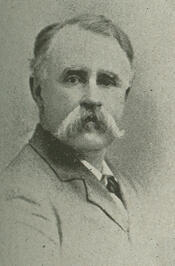
Here you will find contact information for Representative Peter Johnston Otey, including email address, phone number, and mailing address.
| Name | Peter Johnston Otey |
| Position | Representative |
| State | Virginia |
| District | 6 |
| Party | Democratic |
| Status | Former Representative |
| Term Start | December 2, 1895 |
| Term End | May 4, 1902 |
| Terms Served | 4 |
| Born | December 22, 1840 |
| Gender | Male |
| Bioguide ID | O000126 |
About Representative Peter Johnston Otey
Peter Johnston Otey (December 22, 1840 – May 4, 1902) was a Confederate States Army officer and later prisoner of war during the American Civil War who became a businessman, land developer, and railroad executive before retiring and winning election to the United States House of Representatives as a Democrat from Lynchburg, Virginia. He served as a Representative from Virginia in the United States Congress from March 4, 1895, until his death in 1902, completing four consecutive terms in office and contributing to the legislative process during a significant period in American history.
Otey was born on December 22, 1840, in Lynchburg, Virginia, to Lucy (née Norvell) and banker John Mathews Otey (1792–1859). He came from a prominent Virginia family with deep roots in the early history of the United States. He was a nephew of Episcopal Bishop James Hervey Otey, and among his ancestors were John Floyd, a privateer, and John Otey, who commanded Kent County riflemen during the American Revolutionary War. He had at least three elder brothers—Col. Kirkwood Otey (1832–1897), Capt. George Gaston Otey (1834–1862), and Capt. Walter Hays Otey (1837–1890)—all of whom would also serve as Confederate officers. In 1850 his father owned seven enslaved females and five enslaved males, including two Black men aged about 20 and 30, reflecting the family’s participation in the slaveholding society of antebellum Virginia.
Otey attended private schools in Lynchburg before enrolling, like his brothers, at the Virginia Military Institute (VMI). As a cadet he was among those sent to respond to John Brown’s raid on Harpers Ferry in 1859, an episode that underscored the mounting sectional tensions preceding the Civil War. He graduated from VMI on July 1, 1860, with a degree in civil engineering. After graduation he worked on the Virginia and Kentucky Railroad, applying his engineering training in the expanding railroad sector. On April 14, 1863, in Wytheville, Virginia, he married Mary Malvina Floyd, a niece of former Virginia governor and Confederate general John B. Floyd. The couple had a son, John Floyd Otey, who died as a teenager, and three daughters who survived their parents.
With the outbreak of the Civil War, Otey left his railroad employment and entered Confederate service. He was reputed to have fired a cannon at Sewell’s Point after Virginia’s secession, striking a Union vessel and engaging the U.S. ship Monticello on May 19, 1861. He became a lieutenant in Company S of the 51st Virginia Infantry in the Army of the Kanawha under Colonel Gabriel C. Wharton, former VMI mathematics professor Lieutenant Colonel James W. Massie, and former Governor John B. Floyd. Serving as a staff officer, Otey took part in the regiment’s efforts to defend the Kanawha Valley and its strategically important salt and mineral resources, though the unit suffered setbacks at Carnifex Ferry and Cotton Hill in 1861 and at Fort Donelson, Tennessee, in February 1862. While most of the regiment, including Otey, escaped capture at Fort Donelson and retreated to defend Nashville, his brothers were engaged in other theaters: Kirkwood Otey commanded the 11th Virginia Infantry, including at Gettysburg, where he was wounded; George Gaston Otey organized the “Otey Battery” of light artillery, later the 13th Virginia Light Artillery, and died of wounds received at the Battle of Lewisburg; and Walter Hays Otey served with the 16th and 56th Virginia Infantry before resigning for health reasons and organizing a local defense artillery company at the Danville Arsenal.
On October 5, 1862, Peter Otey was promoted to major of the 30th Virginia Sharpshooters Battalion in General Robert E. Lee’s Army of Northern Virginia. With this command he saw extensive service, including participation in major engagements and the defense of Lynchburg as his unit was assigned to General Jubal Early’s Army of the Valley. Although the Battle of Shiloh is sometimes associated with his service in later accounts, his principal operations were in the eastern and Valley campaigns. He was wounded in the arm at the Battle of New Market and sent to Lynchburg to recover. Later, among those who surrendered after the Battle of Waynesboro in March 1865, Major Otey was taken prisoner and confined at Fort Delaware, where he remained until the end of the war. During his imprisonment he was held alongside other Confederate officers, including future Speaker of the U.S. House of Representatives Charles F. Crisp.
Following the war, Otey returned to Lynchburg and embarked on a business career that would make him a notable figure in the city’s commercial development. He first worked as a cashier for the Lynchburg National Bank and also engaged in the insurance business. He later became general manager of the Rivermont Land Company, a major real estate and development enterprise in Lynchburg. In the railroad industry he worked with former Confederate General William Mahone on the Atlantic, Mississippi and Ohio Railroad. After that line’s bankruptcy and reorganization, Otey parted ways with Mahone, who had become a controversial political figure in Virginia. Beginning in 1887, Otey organized and built the Lynchburg & Durham Railroad, serving as its president and overseeing its construction and operation. He remained president until June 21, 1891, when he retired shortly before the line was merged into the Norfolk and Western Railway, marking the culmination of his railroad executive career.
Otey’s entry into elective politics came in the 1890s, when he sought to represent his home region in Congress. First running for public office in 1894, he was elected as a Democrat to the Fifty-fourth Congress and three succeeding Congresses, serving from March 4, 1895, until his death on May 4, 1902. In the 1894 election he won the seat with 47.14 percent of the vote, defeating Republican J. Hampton Hoge and Independents O. C. Rucker and Frank Smith. He was re-elected in 1896 with 57 percent of the vote, defeating N. T. DuVal Radford, Republican J. Hampton Hoge, and Populist Joseph Johnston; in 1898 with 66.93 percent of the vote, defeating Republicans Daniel Butler and Charles A. Heermans and Independents Ira W. Kimmell and D. G. Revere; and in 1900 with 77.54 percent of the vote, defeating Republican J. B. Stovall Jr. and Populist A. E. Fairweather. A loyal Democrat, he served as a delegate to the Democratic National Convention in 1896. During his tenure in the House of Representatives, Otey participated actively in the legislative process and represented the interests of his Lynchburg-area constituents during a period marked by industrial expansion, sectional reconciliation, and the entrenchment of Jim Crow in the South.
Among his legislative initiatives, Otey is particularly noted for introducing H.R. 277 on February 1, 1900, a bill proposing the purchase of land at Manassas, Virginia, to establish a national battlefield park on the site of the First Battle of Manassas (First Bull Run). Although the park was not created immediately, the concept he advanced was implemented and expanded approximately three decades later, during the Great Depression, when the federal government developed Manassas National Battlefield Park as part of a broader program of historic preservation and public works. His congressional service, spanning the Fifty-fourth through Fifty-seventh Congresses, coincided with debates over currency, tariffs, and the United States’ emerging role on the world stage following the Spanish-American War.
Peter Johnston Otey died in Lynchburg, Virginia, on May 4, 1902, while still serving in Congress, placing him among the members of the United States Congress who died in office in the early twentieth century. He was survived by his wife, Mary Malvina Floyd Otey, and their daughters, and was interred in Lynchburg’s Presbyterian Cemetery. His life and public service were later commemorated in memorial addresses delivered in the House of Representatives and the Senate in 1902, reflecting the esteem in which he was held by his colleagues and constituents.