Representative Peter Smith
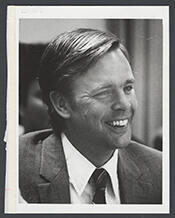
Here you will find contact information for Representative Peter Smith, including email address, phone number, and mailing address.
| Name | Peter Smith |
| Position | Representative |
| State | Vermont |
| District | At-Large |
| Party | Republican |
| Status | Former Representative |
| Term Start | January 3, 1989 |
| Term End | January 3, 1991 |
| Terms Served | 1 |
| Born | October 31, 1945 |
| Gender | Male |
| Bioguide ID | S000601 |
About Representative Peter Smith
Peter Plympton Smith (born October 31, 1945) is an American educator and politician who served as a member of the United States House of Representatives from the state of Vermont, the 76th lieutenant governor of Vermont, and a prominent education administrator. Over the course of his career, he became known both for his public service as a Republican officeholder and for his leadership in the development and administration of higher education institutions in the United States and abroad.
Smith was born on October 31, 1945, and came of age during a period of expanding access to higher education and growing public interest in community-based learning. These broader social and educational trends would later shape his professional focus on community colleges and innovative university models. Details of his early life before college, including his family background and primary schooling, are less widely documented in public sources, but his subsequent academic and professional choices reflect a sustained commitment to public service and educational reform.
Smith pursued higher education with an emphasis on the liberal arts and public affairs, preparing for a career that would bridge politics and education. His academic training provided the foundation for his later work in designing and leading new institutions of higher learning, as well as for his entry into Vermont state politics. This combination of education and early professional experience positioned him to engage with both policy and administration at a relatively young age.
Smith’s political career in Vermont began at the state level and culminated in his service as the 76th lieutenant governor of Vermont. As lieutenant governor, he played a role in presiding over the state senate and participating in statewide policy discussions, aligning with the Republican Party’s positions while also reflecting Vermont’s tradition of independent-minded politics. His tenure in statewide office helped establish his reputation as a public servant and provided a platform for his subsequent election to federal office.
Peter P. Smith served as a Representative from Vermont in the United States Congress from 1989 to 1991. A member of the Republican Party, he was elected to the U.S. House of Representatives for one term, during which he represented the interests of his Vermont constituents and contributed to the legislative process. His service in Congress occurred during a significant period in American history marked by the final years of the Cold War, the transition in U.S. foreign policy at the end of the 1980s, and domestic debates over economic and social policy. As a member of the House of Representatives, Peter P. Smith participated in the democratic process through committee work, floor votes, and constituent services, fulfilling the responsibilities of a federal legislator during his 1989–1991 term in office.
Parallel to and following his political service, Smith built a substantial career as an education administrator. He served as the founding president of the Community College of Vermont, helping to create and shape an institution designed to expand access to postsecondary education across the state through flexible, community-based offerings. His leadership in Vermont’s community college system reflected his belief in broadening educational opportunity for nontraditional and geographically dispersed students, and it established his national reputation as an innovator in higher education.
Smith later extended his work in higher education to the national stage as the founding president of California State University, Monterey Bay. In that role, he oversaw the development of a new public university campus within the California State University system, guiding its early academic planning, institutional mission, and community engagement. His efforts at CSU Monterey Bay emphasized access, diversity, and the integration of new pedagogical approaches, reinforcing his longstanding interest in educational reform and institutional design.
Smith’s career ultimately took on an international dimension when he joined the United Nations Educational, Scientific, and Cultural Organization (UNESCO) as assistant director general for education. In this senior leadership position, he was involved in global education policy, working on initiatives aimed at improving educational access, quality, and equity worldwide. His service at UNESCO reflected the culmination of decades of experience in both domestic and international education, linking his earlier work in Vermont and California to broader efforts to advance learning and human development across nations.