Representative Peter Francis Tague
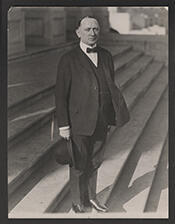
Here you will find contact information for Representative Peter Francis Tague, including email address, phone number, and mailing address.
| Name | Peter Francis Tague |
| Position | Representative |
| State | Massachusetts |
| District | 10 |
| Party | Democratic |
| Status | Former Representative |
| Term Start | December 6, 1915 |
| Term End | March 3, 1925 |
| Terms Served | 5 |
| Born | June 4, 1871 |
| Gender | Male |
| Bioguide ID | T000014 |
About Representative Peter Francis Tague
Peter Francis Tague (June 4, 1871 – September 17, 1941) was an American businessman and Democratic politician who served as a member of the United States House of Representatives from Boston, Massachusetts, representing a district in Massachusetts in Congress from 1915 to 1925. Over the course of five terms in office, he participated actively in the legislative process and represented the interests of his constituents during a period of significant political and social change in the United States.
Tague was born in Boston, Massachusetts, to Peter and Mary (Shaw) Tague, immigrants from Ireland. His father worked as a cooper, and the family’s background in the city’s working-class Irish community helped shape his early outlook and political sympathies. He attended Frothingham Grammar School and the English High School in Boston, receiving a practical education that prepared him for both business and public life.
After completing his schooling, Tague entered business, initially supplying blacksmiths and building contractors. He later worked as a bookkeeper and served as the Northeast representative of the Never Slip Manufacturing Company. Over time he became a manufacturing chemist and a supplier of chemicals to businesses, building a commercial career that he would return to between and after his periods of public service. On January 31, 1900, he married Josephine T. Fitzgerald; the couple had two sons.
Tague’s political career began at a notably young age. In 1894, at just 23 years old, he was elected to the Boston Common Council, where he served for two years. He subsequently won election to the Massachusetts House of Representatives, serving in 1897 and 1898, and then advanced to the Massachusetts Senate, where he served for two years following his election in 1899. After this early period of rapid political ascent, he stepped back from elective office for a time to concentrate on his business interests. He returned to state politics in 1913, winning another term in the Massachusetts House of Representatives and reestablishing himself as a Democratic leader in Boston.
Tague next entered national politics as a Democrat in the Sixty-fourth and Sixty-fifth Congresses, serving from March 4, 1915, to March 3, 1919. His initial service in the House of Representatives coincided with the First World War and major domestic debates over preparedness, wartime mobilization, and postwar adjustment. As a member of the House, he participated in the democratic process and contributed to the legislative work of Congress on behalf of his Boston and Massachusetts constituents.
In 1918, Tague faced a major intra-party challenge from former Boston mayor John F. Fitzgerald. Tague lost the Democratic primary to Fitzgerald by 50 votes and contested the result before the election commissioners, but his appeal was initially denied and Fitzgerald was declared the party’s nominee. Tague then ran in the general election as a sticker and write-in candidate and at first narrowly lost to Fitzgerald by 238 votes. He again contested the election, and after the House Committee on Elections canvassed more than 1,300 votes, Fitzgerald’s plurality was reduced to 10. The committee determined that one-third of the votes in three precincts of Boston’s Ward 5 were fraudulent, citing illegal registrations and other irregularities, and threw out the votes from those precincts. On October 2, 1919, by a vote of 5 to 2, the committee declared that Tague had in fact won the election by 525 votes and recommended unseating Fitzgerald. On October 23, 1919, the full House of Representatives voted to unseat Fitzgerald and seat Tague, restoring him to Congress.
Following his return, Tague was reelected as a Democrat to the Sixty-seventh and Sixty-eighth Congresses and served from October 23, 1919, to March 3, 1925. His decade-long tenure in the House thus extended from 1915 to 1925, encompassing five terms in office. During this period, he is particularly noted for having introduced a bill in 1921 to investigate the Ku Klux Klan at a time when the organization was expanding its influence nationwide, reflecting his concern with civil rights and the integrity of American institutions. In addition to his congressional service, he sought higher local office and was an unsuccessful candidate for mayor of Boston in the December 1917 election, finishing fourth in a field of four candidates in a contest ultimately won by Andrew James Peters. Tague was defeated for reelection to Congress in 1924 and left the House at the conclusion of his term in March 1925.
After his congressional career ended, Tague resumed his business activities in Boston. He remained a figure in public affairs, however, and in 1930 he was appointed an assessor of the city of Boston. That same year he was also named chairman of the Boston election commission, a position that drew on his long experience with electoral processes and political contests. In 1936, he received a further federal appointment as postmaster of Boston, a post he held until his death.
Peter Francis Tague died in Boston on September 17, 1941, at the age of 70. He was interred in Holy Cross Cemetery in Malden, Massachusetts.