Representative Peter J. Visclosky
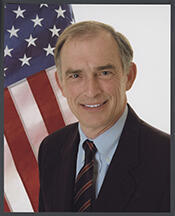
Here you will find contact information for Representative Peter J. Visclosky, including email address, phone number, and mailing address.
| Name | Peter J. Visclosky |
| Position | Representative |
| State | Indiana |
| District | 1 |
| Party | Democratic |
| Status | Former Representative |
| Term Start | January 3, 1985 |
| Term End | January 3, 2021 |
| Terms Served | 18 |
| Born | August 13, 1949 |
| Gender | Male |
| Bioguide ID | V000108 |
About Representative Peter J. Visclosky
Peter John Visclosky (vih-SKLOSS-kee; born August 13, 1949) is an American politician who served as the U.S. representative for Indiana’s 1st congressional district from January 3, 1985, until his retirement on January 3, 2021. A member of the Democratic Party, he represented a district in Northwest Indiana that includes most of the Indiana side of the Chicago metropolitan area. Over 18 consecutive terms in office, he participated actively in the legislative process, represented the interests of his constituents, and, from 2013 until his retirement, served as the dean of the Indiana congressional delegation.
Visclosky was born in Gary, Indiana, a heavily industrial city in Lake County that would shape much of his political outlook, particularly his focus on steel, manufacturing, and organized labor. Growing up in a region dominated by the steel industry and other heavy manufacturing, he became closely attuned to the concerns of blue-collar workers and labor unions, influences that later informed his pro-union and economic policy positions in Congress.
After completing his early education in Indiana, Visclosky pursued higher education and professional training that prepared him for a career in law and public service. He earned a Bachelor of Science degree from Indiana University Northwest, located in Gary, Indiana. He went on to receive a Juris Doctor (J.D.) from the University of Notre Dame Law School in Notre Dame, Indiana, and later obtained a Master of Laws (LL.M.) in International and Comparative Law from Georgetown University Law Center in Washington, D.C. His legal education, particularly in international and comparative law, provided a foundation for his later work on trade, national security, and economic policy.
Before his election to Congress, Visclosky worked in legal and governmental roles that introduced him to the workings of federal policy and constituent service. He served on the staff of Congressman Adam Benjamin Jr., who also represented Indiana’s 1st congressional district, gaining direct experience with the legislative process and the needs of Northwest Indiana. Visclosky later practiced law and continued his involvement in local and regional issues, building a base of support that would underpin his first successful run for Congress in 1984.
Visclosky entered the U.S. House of Representatives at the start of the 99th Congress on January 3, 1985, beginning a congressional career that would span more than three and a half decades. Representing Indiana’s 1st congressional district, he served through major shifts in American political, economic, and foreign policy. The district, centered in Northwest Indiana, historically encompassed much of the Indiana side of the Chicago metropolitan area. Following redistricting enacted by the Indiana General Assembly in 2011 and effective in January 2013, the district’s boundaries were adjusted to include all of Lake and Porter counties as well as the western and northwestern townships of LaPorte County, while Benton, Newton, and Jasper counties were shifted out of the district. Throughout these changes, Visclosky remained focused on the industrial and working-class character of his constituency.
In Congress, Visclosky developed a reputation as a staunch advocate for organized labor, domestic manufacturing, and the steel industry. He is pro-union and anti-free trade in the sense that he consistently opposed trade arrangements and practices he believed harmed American workers and undermined domestic industry. Reinstating steel tariffs and combating “steel dumping”—the practice by which foreign producers, often subsidized or operating through nationalized companies, undercut American steel prices in violation of trade agreements and free-market principles—were long-standing priorities. He served as Chair of the Congressional Steel Caucus when Democrats controlled the House of Representatives and as Vice Chair when they did not, using these positions to press for policies that would protect American steel producers and workers. He was also a prominent supporter of high-tech and advanced manufacturing solutions as a means to revive the American blue-collar workforce and reduce crime through expanded economic opportunity.
Visclosky’s committee work further amplified his influence on national policy. He became a senior member of the House Appropriations Committee and served as Chair of the Appropriations Subcommittee on Energy and Water Development when Democrats held the majority, later serving as the subcommittee’s Ranking Member. In these roles, he helped shape federal spending on energy infrastructure, water resources, and related research and development, with implications for both national policy and local projects in Northwest Indiana. He opposed efforts to shift production of critical components of advanced U.S. military weapons and hardware to foreign countries, particularly China. One notable case involved the closure of Magnequench, a manufacturing facility in Valparaiso, Indiana, that produced sophisticated high-tech magnets made of rare earth metals. These magnets were integral components of U.S. smart bombs and guided missile systems, including the Joint Direct Attack Munition (JDAM). Visclosky’s opposition to the offshoring of such production, widely covered in local media such as The Times and The Post-Tribune, reflected his broader concerns about national security, industrial capacity, and local employment.
On foreign policy and national security, Visclosky was among the 126 House Democrats who voted against the Iraq War Resolution in 2002, signaling his skepticism about the use of military force in that conflict. At the same time, he consistently supported maintaining a strong national defense and ensuring that critical defense-related manufacturing remained within the United States. Domestically, he worked to secure federal investment in infrastructure and economic development in Northwest Indiana. He was a prime proponent of expanding the runway at Gary/Chicago International Airport and played a key role in securing $58 million in federal funding for the project in 2006, viewing it as a catalyst for regional economic growth and improved transportation links for his district.
Visclosky’s long tenure in Congress coincided with significant economic and political changes in the United States, including deindustrialization, globalization, and shifting trade patterns. Throughout these developments, he consistently framed his legislative priorities around protecting and creating American manufacturing jobs, strengthening unions, and leveraging technology to support working families. On November 6, 2019, he announced that he would not seek re-election in 2020, bringing to a close 18 terms of service in the House of Representatives. He retired from Congress on January 3, 2021, after more than 36 years representing Indiana’s 1st congressional district and serving as a prominent voice for the steel industry, organized labor, and the broader economic interests of Northwest Indiana.