Representative Peter Dinwiddie Wigginton
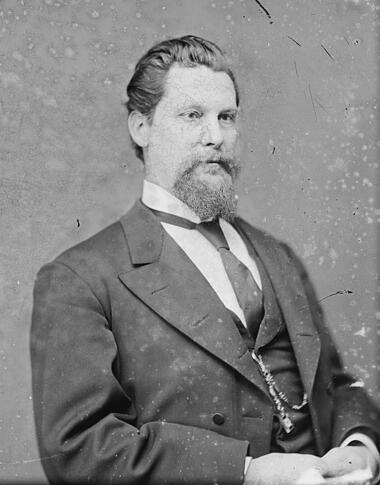
Here you will find contact information for Representative Peter Dinwiddie Wigginton, including email address, phone number, and mailing address.
| Name | Peter Dinwiddie Wigginton |
| Position | Representative |
| State | California |
| District | 4 |
| Party | Democratic |
| Status | Former Representative |
| Term Start | December 6, 1875 |
| Term End | March 3, 1879 |
| Terms Served | 2 |
| Born | September 6, 1839 |
| Gender | Male |
| Bioguide ID | W000449 |
About Representative Peter Dinwiddie Wigginton
Peter Dinwiddie Wigginton (September 6, 1839 – July 7, 1890) was an American lawyer and politician who served as a U.S. Representative from California during the 1870s. A member of the Democratic Party during his congressional career, he represented California in the United States House of Representatives from 1875 to 1879, contributing to the legislative process during two terms in office and participating in the democratic governance of a rapidly changing post–Civil War nation.
Wigginton was born in Springfield, Illinois, on September 6, 1839. In 1843 he moved with his parents to Wisconsin, which was then a developing region in the Upper Midwest. He completed preparatory studies there and subsequently attended the University of Wisconsin–Madison, an emerging institution of higher learning in the state. His early relocation from Illinois to Wisconsin and his university education helped shape his professional ambitions and prepared him for a career in law and public life.
After his studies, Wigginton read law and was admitted to the bar in 1859. He began the practice of law in Wisconsin and also became involved in journalism as editor of the Dodgeville (Wisconsin) Advocate, a local newspaper. His dual experience as a lawyer and newspaper editor placed him at the intersection of law, politics, and public opinion at a time when national tensions over slavery, union, and expansion were intensifying in the years leading up to the Civil War.
In 1862 Wigginton moved west to Snelling, California, where he continued the practice of law. He soon entered public service in his adopted state, serving as district attorney of Merced County from 1864 to 1868. In this role he gained prominence as a legal officer in a growing agricultural region of California’s Central Valley, building a reputation that would later support his entry into national politics. His legal and prosecutorial work during this period established him as a significant local figure within the Democratic Party in California.
Wigginton was elected as a Democrat to the Forty-fourth Congress, serving from March 4, 1875, to March 3, 1877, as a Representative from California. His service in Congress occurred during a significant period in American history, in the decade following the Civil War and during the waning years of Reconstruction. As a member of the House of Representatives, Peter Dinwiddie Wigginton participated in the legislative process and represented the interests of his California constituents in debates over economic development, western expansion, and federal policy.
In the 1876 election Wigginton initially appeared to lose his bid for re-election to Romualdo Pacheco. He contested the result, however, and after a formal challenge to the House of Representatives, he successfully overturned Pacheco’s election. Wigginton was seated in Pacheco’s place in the Forty-fifth Congress and served from February 7, 1878, to March 4, 1879. After completing this contested term, he did not seek renomination. Over the course of these two terms, from 1875 to 1879, he contributed to the work of Congress during a transitional era marked by disputes over reconstruction policy, economic issues, and the political realignment of the late nineteenth century.
Following his congressional service, Wigginton settled in San Francisco in 1880 and resumed the practice of law. He remained active in public affairs and became involved in the era’s nativist political currents. In 1886 he founded the American Party, a nativist third party that reflected growing anti-immigrant sentiment and concerns over the political and economic impact of immigration, particularly on the West Coast. The party nominated him as its candidate for Vice President in the 1888 national election, underscoring his continuing prominence in political circles and his shift from mainstream Democratic politics to third-party activism.
Peter Dinwiddie Wigginton died in Oakland, California, on July 7, 1890. He was interred in Mountain View Cemetery in Oakland, a burial place for many notable Californians. His career spanned law, journalism, county office, two contested and eventful terms in the U.S. House of Representatives, and later leadership in a national third party, marking him as a distinctive figure in California and American political life in the late nineteenth century.