Representative Phillip Francis Thomas
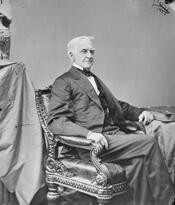
Here you will find contact information for Representative Phillip Francis Thomas, including email address, phone number, and mailing address.
| Name | Phillip Francis Thomas |
| Position | Representative |
| State | Maryland |
| District | 1 |
| Party | Democratic |
| Status | Former Representative |
| Term Start | December 2, 1839 |
| Term End | March 3, 1877 |
| Terms Served | 2 |
| Born | September 12, 1810 |
| Gender | Male |
| Bioguide ID | T000182 |
About Representative Phillip Francis Thomas
Philip Francis Thomas (September 12, 1810 – October 2, 1890) was an American lawyer and Democratic politician who served Maryland in a wide range of state and federal offices, including two nonconsecutive terms in the United States House of Representatives and a brief tenure as the 23rd United States Secretary of the Treasury. He was a member of the House of Representatives from Maryland in the United States Congress from 1839 to 1877, serving two terms in office separated by what is regarded as the longest interval between congressional terms in American history, with 34 years elapsing between his first and second periods of service.
Thomas was born in Easton, Talbot County, Maryland, on September 12, 1810. He pursued classical studies and attended Dickinson College in Carlisle, Pennsylvania, from which he graduated in 1830. After completing his collegiate education, he studied law, was admitted to the bar, and commenced practice in Easton. Early in his career he became involved in public affairs, serving as a delegate to Maryland’s constitutional convention in 1836, an experience that introduced him to statewide politics and constitutional questions that would recur throughout his later public life.
Thomas entered elective office as a member of the Maryland House of Delegates, first serving in 1838 and returning in later sessions in 1843 and 1845. A Democrat, he was elected in 1838 to represent Maryland’s 2nd Congressional District in the 26th Congress. He served in the U.S. House of Representatives from March 4, 1839, to March 3, 1841, contributing to the legislative process during a period marked by economic and sectional tensions in the pre–Civil War United States. He declined to be a candidate for renomination in 1840 and returned to the practice of law in Easton, stepping back temporarily from national politics while maintaining his role in Maryland’s public life.
Thomas reemerged on the statewide stage in 1847, when he was elected the 28th Governor of Maryland. He served as governor from 1848 to 1851, overseeing state affairs in the midst of national debates over slavery and territorial expansion. During his governorship, in 1849 he commissioned Maryland’s contribution to the Washington Monument in the nation’s capital, a marble building stone engraved with the colonial Sparrow Seal of Maryland, symbolizing the state’s colonial heritage. After leaving the governorship, he became the first Comptroller of Maryland, serving from 1851 to 1853, where he was responsible for supervising the state’s fiscal affairs. He was then appointed collector of the port of Baltimore, a significant federal customs post he held from 1853 to 1860. For part of 1860, from February through December, he also served as United States Commissioner of Patents, further broadening his experience in federal administration.
On December 12, 1860, President James Buchanan appointed Thomas as the 23rd United States Secretary of the Treasury, succeeding Howell Cobb, who had resigned amid the escalating secession crisis. Thomas reluctantly accepted the Cabinet post at a moment of acute financial and political instability. Immediately upon entering office, he was compelled to market a federal bond issue to meet interest payments on the public debt. With Southern secession looming and war widely anticipated, Northern bankers were reluctant to subscribe to the loan, fearing that funds might aid the seceding states. Thomas’s inability to secure the necessary financing, combined with deepening disagreements over Buchanan’s emerging policy toward South Carolina and the enforcement of federal customs laws at Charleston, led to his resignation. He left office on January 14, 1861, after barely more than a month in the Cabinet. In his resignation letter, he cited the administration’s intention to enforce the collection of customs at the port of Charleston as a principal reason for his departure. President Buchanan, in accepting the resignation, publicly stated that Thomas had discharged his duties “in a manner highly satisfactory,” a judgment reprinted in the New York Times in January 1861.
During the Civil War era, Thomas’s political fortunes were complicated by allegations of Southern sympathy. In 1863 he again served in the Maryland House of Delegates, reflecting his continued influence in state politics. He later presented credentials as a senator-elect to the United States Senate for the term beginning March 4, 1867, but the Senate refused to seat him on the ground that he had “given aid and comfort” to the Confederate cause, including by providing funds to his son to assist him in joining the Confederate army. The controversy drew national attention: some newspapers, such as The New York Times, criticized the decision as “partisan intolerance,” while others, including The Chicago Times, denounced it as “lawless despotism.” In Senate debate in February 1868, Senator Jacob Howard of Michigan cataloged what he described as Thomas’s assistance to the rebellion, including his conduct as Secretary of the Treasury during the seizure of the sub-treasury at Charleston shortly before his resignation. These disputes effectively ended Thomas’s immediate prospects for service in the upper chamber of Congress.
Despite these setbacks, Thomas returned to national office in the postwar period. He was elected as a Democrat to the 44th Congress from Maryland’s 1st Congressional District, serving in the U.S. House of Representatives from March 4, 1875, to March 3, 1877. This second term in Congress, following his initial service from 1839 to 1841, created a 34-year gap between his two periods of congressional service, the longest break between nonconsecutive terms in the history of the House of Representatives. During this later term he again represented the interests of his Maryland constituents during the turbulent Reconstruction era. He declined to be a candidate for renomination in 1876, bringing his federal legislative career to a close.
In the final phase of his public life, Thomas remained active in Maryland politics. He was an unsuccessful candidate for election to the United States Senate in 1878. That same year he returned once more to the Maryland House of Delegates, and he served another term there in 1883, underscoring his long-standing role in state government that had begun nearly half a century earlier. After his last legislative service, he resumed the practice of law in Easton. Philip Francis Thomas died in Baltimore, Maryland, on October 2, 1890. He was interred in Spring Hill Cemetery in Easton, closing a career that had spanned local, state, and national office during some of the most consequential decades in American history.