Senator Pierre Soulé
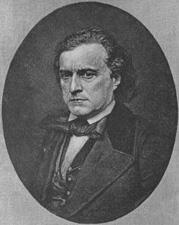
Here you will find contact information for Senator Pierre Soulé, including email address, phone number, and mailing address.
| Name | Pierre Soulé |
| Position | Senator |
| State | Louisiana |
| Party | Democratic |
| Status | Former Representative |
| Term Start | December 6, 1847 |
| Term End | December 31, 1853 |
| Terms Served | 2 |
| Born | August 31, 1801 |
| Gender | Male |
| Bioguide ID | S000682 |
About Senator Pierre Soulé
Pierre Soulé (August 31, 1801 – March 26, 1870) was a French-born American attorney, politician, and diplomat who became a leading Democratic figure in Louisiana and served in the United States Senate and in the diplomatic corps during the mid-nineteenth century. Best known for his role in drafting the 1854 Ostend Manifesto, he was a prominent advocate of Southern expansionism and a controversial representative of U.S. interests abroad. A member of the Democratic Party, he served as a U.S. senator from Louisiana during a significant period in American history, holding office in 1847 in a special term and then from 1849 to 1853 in a full term before resigning to become U.S. Minister to Spain, a post he held from 1853 until 1855.
Soulé was born on August 31, 1801, in Castillon-en-Couserans, a village in the French Pyrenees, into an educated family; his father was a prominent justice of the peace. He received a rigorous early education, studying at a Jesuit college in Toulouse and later at an academy in Bordeaux. From a young age he embraced anti-royalist views, favoring freedom of conscience and secularism. His political convictions brought him into conflict with the restored Bourbon monarchy, and in 1816, while still a youth, he was exiled to Navarre. He later went to Paris, where he studied law, passed the bar, and began practicing in the capital. In Paris he became involved with secret societies devoted to civil rights and opposition to the government, and he published a political newspaper, Le Nouveau nain jaune (“The New Yellow Dwarf”), whose title alluded to a well-known French fairy tale. Convicted of opposition to the government, he was sentenced to three years in prison but managed to escape custody.
In 1825 Soulé fled France, first taking refuge in Great Britain and then traveling briefly to Haiti, the former French colony of Saint-Domingue. He was impressed by the new Black republic, though he was also aware of the widespread massacres that had occurred during the Haitian Revolution. Around the age of twenty-five he emigrated to the United States and settled in New Orleans, Louisiana, the principal city of another former French colony that still maintained a large French-speaking population. In New Orleans he read law, became a lawyer, and established himself professionally. He married and had at least one son. After gaining prominence at the bar, he became a naturalized citizen of the United States and helped to found a bank. A subsequent financial panic disrupted the bank’s operations, and by about 1839 he had returned full-time to legal practice, representing cotton planters and brokers in the city’s thriving commercial sector. He also moved in elite social circles and was a founding member of The Boston Club, one of New Orleans’s most exclusive gentlemen’s clubs.
Soulé’s success at the bar and his oratorical skills led him into politics as a Democrat. He joined the Democratic Party and quickly became active in Louisiana public life. In 1844 he served as a delegate to the Louisiana state constitutional convention, participating in the reshaping of the state’s fundamental law. Two years later, in 1846, he was elected to the Louisiana State Senate, where he further developed his reputation as a skilled debater and an advocate of states’ rights and Southern interests. His rising profile in state politics positioned him for national office at a time when Louisiana’s political leadership was deeply engaged in the sectional controversies of the era.
In 1847 Soulé was elected by the Louisiana legislature to the United States Senate in a special election to fill a vacancy, serving briefly in that capacity as a Democrat. He was subsequently returned to the Senate for a full term, serving from 1849 to 1853 and thus holding two terms in office between 1847 and 1853. As a senator from Louisiana, he participated in the legislative process during a period marked by debates over slavery, territorial expansion, and the Compromise of 1850, and he represented the interests of his constituents in a rapidly changing national landscape. His tenure coincided with the intensification of sectional tensions, and he aligned himself with the Southern wing of the Democratic Party, which favored the protection and possible expansion of slavery into new territories.
In 1853 Soulé resigned from the Senate after being nominated by President Franklin Pierce as U.S. Minister to Spain, a diplomatic post he held until 1855. His service in Madrid was marked by assertive and often controversial conduct, contributing, in the words of one critic, to the “tragicomic character of American diplomacy” in Europe. During his tenure he wounded the French ambassador in a duel, issued an unauthorized ultimatum, and sought to provoke a confrontation with Spain over the seizure of the American ship Black Warrior. He became most widely known for his central role in drafting the Ostend Manifesto in 1854, along with U.S. ministers James Buchanan and John Y. Mason. The document urged that the United States should purchase Cuba from Spain and suggested that, if Spain refused, the United States would be justified in taking the island by force. The proposal reflected the ambitions of Southern slaveholders and expansionists who wished to extend slaveholding territory into the Caribbean and Central America at a time when Cuba still permitted slavery. The Ostend Manifesto was roundly denounced in the United States, particularly by anti-slavery forces, and Soulé was personally criticized for exceeding his diplomatic authority and compromising his role as Minister to Spain, which still governed Cuba.
While in Washington, D.C., in late 1852, during his senatorial service and just before his departure for Spain, Soulé provided support and assistance to the agent who successfully rescued Solomon Northup, a free Black man from Saratoga Springs, New York, who had been kidnapped and sold into slavery in Louisiana. Northup had been held as a slave for twelve years by planters in the Red River region before his freedom was restored. This episode, later made famous by Northup’s memoir “Twelve Years a Slave,” illustrated the complex and sometimes contradictory positions Soulé occupied within the politics of slavery and freedom in the antebellum South.
In the years leading up to the American Civil War, Soulé opposed Southern secession and aligned himself with the Unionist wing of the Democratic Party. At the 1860 Democratic National Convention he supported Senator Stephen A. Douglas and resisted the efforts of secessionist delegates to split the party along sectional lines. In the subsequent 1860 presidential election, he was one of the few prominent politicians from the Deep South to campaign actively for Douglas. However, once Louisiana seceded and war began in 1861, Soulé shifted his allegiance to his adopted state and supported the Confederacy. That year he helped organize the Allen Rifles, which became Company I of the 26th Louisiana Infantry Regiment, and delivered an impassioned speech at a large barbecue in Thibodaux in Lafourche Parish, encouraging support for the Confederate cause.
On May 18, 1861, Soulé was captured by federal troops and charged with “plotting treason against the United States government.” He was imprisoned at Fort Warren in Boston Harbor, Massachusetts, one of the principal Union facilities for political and military prisoners. He subsequently escaped from confinement and made his way back into Confederate territory, where he remained aligned with the Southern war effort until the conflict’s end. After the Confederacy’s defeat in 1865, Soulé went into exile in Havana, Cuba, reflecting both his longstanding interest in the island and the precarious position of former Confederate leaders in the immediate postwar period.
In his later years Soulé eventually returned to the United States and resumed life in New Orleans, the city that had first given him a platform for his legal and political career. He lived there until his death on March 26, 1870. His life spanned revolutionary politics in France, the rise of American sectionalism, and the upheavals of the Civil War, and his career left a complex legacy as a jurist, legislator, diplomat, and ardent, if sometimes contradictory, champion of Southern and expansionist causes.