Representative Pius Louis Schwert
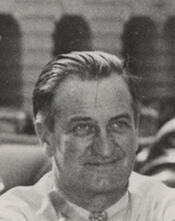
Here you will find contact information for Representative Pius Louis Schwert, including email address, phone number, and mailing address.
| Name | Pius Louis Schwert |
| Position | Representative |
| State | New York |
| District | 42 |
| Party | Democratic |
| Status | Former Representative |
| Term Start | January 3, 1939 |
| Term End | January 3, 1943 |
| Terms Served | 2 |
| Born | November 22, 1892 |
| Gender | Male |
| Bioguide ID | S000162 |
About Representative Pius Louis Schwert
Pius Louis Schwert (November 22, 1892 – March 11, 1941) was an American politician, banker, civic leader, and professional baseball player who represented New York in the United States House of Representatives from 1939 to 1941. A member of the Democratic Party, he served two terms in Congress from New York’s 42nd congressional district and was previously county clerk of Erie County. Before entering public life, he played as a catcher for the New York Yankees of Major League Baseball.
Schwert was born in Angola, Erie County, New York, on November 22, 1892, the only child of Julius and Louisa Schwert. His father served as town supervisor of Evans, New York, giving the younger Schwert an early view of local public service. He attended Angola High School in his hometown before transferring in 1909 to Lafayette High School in Buffalo, New York. At both schools he distinguished himself as a catcher on the baseball team and also played semi-professional baseball on weekends. He graduated from Lafayette High School in 1910.
Following high school, Schwert enrolled at the Wharton School of Commerce at the University of Pennsylvania. At Penn he joined the Sigma Phi Epsilon fraternity and continued his baseball career as catcher for the Penn Quakers. In his senior year he was elected team captain by his teammates. Although he posted a .183 batting average in 26 games for the Quakers in 1914, his strong defensive play earned him selection to the “All-Consensus” team, a precursor to the College Baseball All-America Team. Schwert received a Bachelor of Science degree in economics from the University of Pennsylvania in 1914.
Immediately after graduation in 1914, Schwert was signed by manager Frank Chance of the New York Yankees. He made his major league debut on August 20, 1914, and appeared in three games that season, going hitless in eight plate appearances. During the 1914–1915 offseason he asserted that a contractual error had made him a free agent and drew interest from the Cincinnati Reds, but ultimately signed a new contract with the Yankees under their new manager, Bill Donovan. In 1915 he served as the Yankees’ third-string catcher behind Jeff Sweeney and Les Nunamaker. He played in four games before being sent to the Jersey City Skeeters of the Class AA International League, where he batted .214 in 31 games, then returned to the Yankees late in the season and appeared in five additional games. His final major league appearance came on October 7, 1915; in total, he played in 12 major league games, batting .208 in 24 at-bats.
After the 1915 season, Schwert was named athletic director of the University of the South in Sewanee, Tennessee, but soon returned to western New York. He opened a general store in Angola in 1916 while still attempting to continue his baseball career. Competing with Les Nunamaker, Roxy Walters, and Walt Alexander for a roster spot in 1916, he was assigned to the Newark Indians of the International League, where he batted .232 in 84 games. Before the 1917 season he informed professional clubs that he was retiring from baseball. The Mobile Sea Gulls of the Class A Southern Association purchased his contract from Newark, but Schwert refused to report, leading Mobile to suspend him while reserving his rights for the 1918 season.
In March 1918, during World War I, Schwert enlisted in the United States Navy. He first served as a yeoman at the Bremerton Navy Yard in Washington State, and later was commissioned an ensign at the Philadelphia Naval Shipyard. While in Philadelphia he played on the 4th Naval District baseball team, managed by former major leaguer Harry Davis and featuring players such as Morrie Rath, Jing Johnson, and Bob Shawkey. Schwert was discharged from the Navy at the end of the war and returned to civilian life.
Schwert went back to Angola in 1920, where he resumed playing semi-professional baseball. That same year, when all three catchers for the Buffalo Bisons of the International League were injured, he was signed as an emergency replacement and compiled a remarkable .496 batting average in 14 games. He returned to the Bisons in 1921 under an arrangement that he would play only in home games, batting .262 in 29 appearances. He was released in April 1922 after failing to report to the team, effectively ending his professional baseball career. He then embarked on a career in banking at the Bank of Angola, beginning as a clerk and cashier and eventually rising to become its president. At the same time, he remained active in regional sports, serving as president of the Western New York League in 1929.
Alongside his business activities, Schwert became increasingly involved in civic and veterans’ organizations in his community. He was elected vice commander of the American Legion, president of the Angola volunteer fire department, and president of the Southwestern Volunteer Firemen’s Association. He also served as master of the Masonic lodge in Evans, New York. These roles enhanced his public profile and laid the groundwork for his entry into elective office. In 1933, running as a Democrat, he sought the post of county clerk of Erie County. He won election to a three-year term, was reelected in 1936, and served as county clerk from 1934 to 1938, gaining administrative experience and building a political base in the Buffalo area.
In 1938, when Representative James M. Mead of New York’s 42nd congressional district was nominated for the United States Senate, Democrats needed a replacement candidate for the House seat. Party leaders selected Schwert as their nominee. In the general election he defeated Republican John Cornelius Butler and entered the Seventy-sixth Congress on January 3, 1939. He was reelected in 1940 to the Seventy-seventh Congress, defeating Edward F. Moss, and thus served continuously in the House of Representatives from 1939 until his death in 1941. His tenure coincided with a critical period in American history, as the nation emerged from the Great Depression and confronted the onset of World War II.
As a member of the House of Representatives, Schwert participated actively in the legislative process and represented the interests of his constituents in western New York. He opposed the development of the Saint Lawrence Seaway, reflecting regional concerns about its economic impact, and instead advocated for the development of harbors for small boats in the Southtowns area along Lake Erie. He supported welfare programs and vocational training for youth, emphasizing social support and job preparation during a time of economic recovery. In foreign policy, he favored providing aid to France and Great Britain during World War II, aligning with interventionist sentiment that sought to support Allied nations before direct American entry into the conflict. He also pressed for local infrastructure improvements, writing to Governor Herbert H. Lehman to urge completion of McKinley Parkway, an important roadway project for his district.
Schwert married Harriet “Hattie” Elizabeth Schwert, a distant cousin and a schoolteacher in Buffalo and Eden, New York, on February 12, 1923. The couple had no children. His wife would later play a brief role in electoral politics following his death, reflecting the esteem in which his name was held in the district.
Pius Louis Schwert died in office in Washington, D.C., on March 11, 1941. He had attended a dinner party at the Annapolis Hotel and collapsed shortly after delivering a speech in which he announced his candidacy for mayor of Buffalo. Rushed to a hospital, he was pronounced dead of a heart attack. His death occurred less than a year after he had survived a previous heart attack in 1940 while exercising in the United States Capitol gymnasium. He was buried in Forest Avenue Cemetery in Angola, New York. In the special election to fill the remainder of his congressional term, his widow, Harriet Schwert, became the Democratic candidate against John Cornelius Butler. Still in mourning, she did not campaign personally, and former Representative James M. Mead spoke on her behalf; Butler defeated her in the election.