Senator Powell Clayton
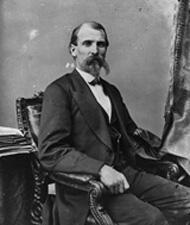
Here you will find contact information for Senator Powell Clayton, including email address, phone number, and mailing address.
| Name | Powell Clayton |
| Position | Senator |
| State | Arkansas |
| Party | Republican |
| Status | Former Representative |
| Term Start | March 4, 1871 |
| Term End | March 3, 1877 |
| Terms Served | 1 |
| Born | August 7, 1833 |
| Gender | Male |
| Bioguide ID | C000498 |
About Senator Powell Clayton
Powell Foulk Clayton (August 7, 1833 – August 25, 1914) was an American politician, soldier, diplomat, and businessman who played a prominent role in Arkansas and national politics during and after the Civil War. A member of the Republican Party, he served as the ninth governor of Arkansas from 1868 to 1871, represented Arkansas in the United States Senate from 1871 to 1877, and was United States Ambassador to Mexico from 1897 to 1905. His congressional service in the Senate encompassed a single term during the turbulent Reconstruction era, when he participated in the legislative process and represented the interests of his Arkansas constituents at a time of intense political and social conflict.
Clayton was born on August 7, 1833, in Bethel Township, Delaware County, Pennsylvania, into a family of Quaker background. He was educated in local schools and trained as a civil engineer, a profession he pursued in his early adulthood. Before the Civil War he worked on railroad and canal projects, gaining experience in infrastructure development that later informed his interest in railroads and urban improvement. Like many young professionals of his generation, he moved through several states in search of opportunity, eventually settling in Kansas on the eve of the sectional crisis.
With the outbreak of the American Civil War, Clayton entered the Union Army. In May 1861 he was mustered into the United States Volunteers as a captain of Company E, 1st Kansas Infantry. He saw early action in Missouri and received commendation for his leadership at the Battle of Wilson’s Creek in August 1861. In December 1861 he was promoted to lieutenant colonel of the 5th Kansas Cavalry, and in March 1862 he became its colonel. Serving primarily in Arkansas and Missouri in the Trans-Mississippi Theater, he commanded cavalry forces in numerous engagements. At the Battle of Helena in Arkansas on July 4, 1863, he commanded the cavalry brigade on the Union right flank and was again commended for his conduct. In August and September 1863, his regiment accompanied Major General Frederick Steele’s campaign against Little Rock.
In October 1863 Clayton took command of federal troops occupying Pine Bluff, Arkansas, using the Boone-Murphy House as his headquarters. During the Battle of Pine Bluff on October 25, 1863, he successfully repulsed a three-pronged Confederate attack led by Brigadier General John S. Marmaduke, famously ordering his men to pile cotton bales around the Jefferson County Courthouse and surrounding streets to form defensive barricades. He also led several forays around Little Rock, including operations in support of Steele during the Camden Expedition in the spring of 1864. Clayton was widely respected as a cavalry commander; Confederate officer John Edwards of Joseph O. Shelby’s command described him as “an officer of activity and enterprise, clear-headed, quick to conceive, and bold and rapid to execute,” and considered him the ablest Federal cavalry commander west of the Mississippi. Clayton was appointed a brigadier general of volunteers on August 1, 1864, and at the time he was mustered out of service in August 1865 he commanded the cavalry division of the Seventh Army Corps. While still in command at Pine Bluff he invested in cotton, accumulating sufficient funds to purchase a plantation in Jefferson County, Arkansas, where he settled after the war. He later became a Companion of the First Class of the Missouri Commandery of the Military Order of the Loyal Legion of the United States.
After the war Clayton married an Arkansas woman and established himself as a planter and businessman in Jefferson County. He quickly became active in the emerging Arkansas Republican Party during Reconstruction. When military rule was lifted and a new Arkansas state constitution was ratified by Congress, he was elected governor and took office in 1868. As a Northern-born Republican who had come to Arkansas during the war, he was widely viewed by his opponents as a “carpetbagger.” His governorship coincided with a surge of Ku Klux Klan activity and widespread violence against African Americans and white Republicans. In response, Clayton declared martial law in several counties for a period of about four months and used state militia forces in an effort to suppress paramilitary violence and protect Republican officeholders and Black citizens.
Clayton’s Reconstruction governorship was marked by deep factionalism within the Arkansas Republican Party. He and his supporters, who controlled federal patronage in the state and enjoyed recognition from the national Republican organization, were known as the “Minstrels.” In 1868 Joseph Brooks, who had initially been a partner with Clayton in organizing the state Republican Party, broke with him and led a rival faction known as the “Brindletails.” Brooks’s opposition stemmed in part from Clayton’s increasingly moderate stance toward former Confederates and from Clayton’s displacement of Brooks as party leader. In 1869 Lieutenant Governor James M. Johnson accused Clayton of corruption in the issuance of railroad bonds and of abusing his authority in the suppression of violence. Johnson’s supporters, largely white Republicans from northwest Arkansas, called themselves Liberal Republicans and joined with the Brindletails in challenging Clayton. The Brindletails succeeded in impeaching him in 1871, but the legislature never brought the case to trial, and he remained in office. The prolonged struggle between these factions contributed to the broader conflict known as the Brooks–Baxter War, a violent dispute over the governorship that erupted after Clayton left the statehouse but had its roots in the divisions that emerged during his administration.
In March 1871 Clayton was elected as a Republican United States Senator from Arkansas, beginning a single term that lasted until 1877. His service in Congress took place during the final phase of Reconstruction, a significant period in American history in which questions of civil rights, federal authority, and the reintegration of the former Confederate states dominated the national agenda. Shortly after he entered the Senate, a Joint Select Committee of that body investigated allegations by his political rivals that he had issued fraudulent election credentials while governor. After formal inquiry he was acquitted of these charges and retained his seat. In the Senate he participated in the legislative process on issues central to Reconstruction and represented Arkansas’s interests until the end of his term. In 1877, as Reconstruction ended and Democrats gained control of the Arkansas legislature, they voted to replace him, and his Senate service concluded. He then returned from Washington, D.C., to Arkansas, though he continued to be active in national Republican politics.
Clayton’s post-senatorial career combined business development with sustained political involvement. In 1882 he established a residence in the developing resort town of Eureka Springs in Carroll County, in northwestern Arkansas, where he and his wife lived in a house now known as the Crescent Cottage Inn. As president of the Eureka Springs Improvement Company, he oversaw the development of commercial and residential structures, many of which endured as part of the town’s historic fabric. The company sponsored the construction of the Eureka Springs Railroad, which was essential to making the resort accessible to tourists. In 1883 Clayton became president of the Eureka Springs Railway, which provided passenger and freight service to the community and later became part of the Missouri and North Arkansas Railroad after a merger in 1889. The line ultimately connected Joplin, Missouri, with Helena in Phillips County, eastern Arkansas. The Improvement Company also built the Crescent Hotel, which became one of Eureka Springs’ most notable landmarks; a poem on the fireplace in the hotel’s lobby is attributed to Clayton.
Throughout these years Clayton remained a significant figure in the Republican Party at both the state and national levels. He became a member of the Republican National Committee in 1872 and continued to be consulted on federal patronage appointments as late as 1912. In the presidential election cycle of 1896 he was instrumental in delivering the votes of the entire Arkansas delegation for William McKinley’s nomination at the Republican National Convention and also directed the Republican speakers’ bureau for the East Coast. After McKinley’s victory, Clayton’s loyalty and organizational work were rewarded with his appointment as United States Ambassador to Mexico. He was named the first ambassador to that country after the legation was elevated to embassy status and served in that post from 1897 to 1905, representing U.S. interests during a period of expanding economic and diplomatic ties between the two nations.
After resigning as ambassador, Clayton resided in Washington, D.C., while continuing to manage his various business and real estate interests in Arkansas and to maintain his influence within the Republican Party. He remained active in political circles and in the affairs of the party almost until his death. Clayton died in Washington, D.C., on August 25, 1914. He was interred with military and public honors at Arlington National Cemetery in Arlington, Virginia, closing a career that had spanned military command, state governance, congressional service, diplomatic representation, and regional economic development.