Senator Powhatan Ellis
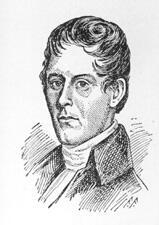
Here you will find contact information for Senator Powhatan Ellis, including email address, phone number, and mailing address.
| Name | Powhatan Ellis |
| Position | Senator |
| State | Mississippi |
| Party | Jackson |
| Status | Former Representative |
| Term Start | December 5, 1825 |
| Term End | March 3, 1833 |
| Terms Served | 2 |
| Born | January 17, 1790 |
| Gender | Male |
| Bioguide ID | E000136 |
About Senator Powhatan Ellis
Powhatan Ellis (January 17, 1790 – March 18, 1863) was a justice of the Mississippi Supreme Court, a United States senator from Mississippi, and a United States district judge of the United States District Court for the District of Mississippi. Born at Red Hill Farm in Amherst County, Virginia, he was reported in one contemporary account in The Green Bag to be a descendant of Pocahontas, a claim that formed part of his family’s tradition. His early years in Virginia laid the foundation for a career that would span law, judicial service, national politics, and diplomacy during a formative period in the history of the United States.
Ellis received a thorough classical education. He graduated from Washington Academy (now Washington and Lee University) in 1809, then earned an Artium Baccalaureus degree from Dickinson College in 1810. He subsequently attended the College of William & Mary, from which he graduated in 1814 after studying law. While completing his legal training, he was admitted to the bar and entered private practice in Lynchburg, Virginia, where he practiced from 1813 to 1814 and again from 1815 to 1816. During the War of 1812 era, in 1814, he served as a lieutenant in the Prevost Guards of Virginia, reflecting an early involvement in public service alongside his developing legal career.
After his initial years of practice in Virginia, Ellis moved to the Mississippi Territory, where he quickly established himself in the legal profession. He resumed private practice in Natchez in 1816 and also practiced in Winchester in the Mississippi Territory from 1816 to 1817, continuing there as the region transitioned to statehood when Mississippi was admitted to the Union on December 10, 1817. His legal acumen led to his appointment as a justice of the Mississippi Supreme Court, on which he served from 1817 to 1818 and again from 1818 to 1825. In this role, he participated in shaping the early jurisprudence of the new state, helping to interpret and apply its laws during the critical first years of Mississippi’s statehood.
Ellis’s judicial service in Mississippi brought him into the broader political life of the state and the nation. A supporter of Andrew Jackson, he became affiliated with the Jackson Party, later known as the Jacksonian Democrats. He was first appointed as a Jacksonian Democrat to the United States Senate from Mississippi to fill the vacancy caused by the resignation of Senator David Holmes. In this capacity, he served from September 28, 1825, to January 28, 1826, when a successor was elected and qualified, and he was an unsuccessful candidate for election to complete that term. He later won election in his own right as a Jacksonian Democrat and served in the Senate from March 4, 1827, to July 16, 1832. During these two periods in the Senate, from 1825 to 1833, Ellis represented Mississippi in the United States Congress during a significant period in American history, participating in the legislative process and the democratic governance of the nation while advancing the interests of his constituents in a time marked by debates over federal power, economic policy, and territorial expansion. He resigned from the Senate in July 1832 to accept a federal judicial appointment.
On July 13, 1832, President Andrew Jackson nominated Ellis to a seat on the United States District Court for the District of Mississippi, filling the vacancy created by the death of Judge Peter Randolph. The United States Senate confirmed him on July 14, 1832, and he received his commission the same day. As a United States district judge, Ellis presided over federal cases in Mississippi during a period of rapid growth and increasing complexity in the region’s legal and commercial affairs. His service on the federal bench continued until January 5, 1836, when he resigned, marking the close of his formal judicial career and the beginning of his service in American diplomacy.
Ellis next entered the diplomatic corps of the United States. President Jackson appointed him chargé d’affaires to Mexico for the United States Department of State, a post he held from January 1836 to December 1836, during which time he closed the American legation amid mounting tensions between the two countries. Later, President Martin Van Buren appointed him Envoy Extraordinary and Minister Plenipotentiary to Mexico, a position he held from February 1839 to April 1842. In these roles, Ellis represented American interests in Mexico during a volatile era in bilateral relations, contributing to the conduct of U.S. foreign policy in North America.
Following his diplomatic service, Ellis returned to private legal practice. He resumed practice in Natchez, Mississippi, beginning in 1842, and later relocated to Richmond, Virginia, where he continued to practice law until his death. In his personal life, he married Eliza Rebecca Winn in 1833; she died in the spring of 1835. The couple had two children. Ellis remained active in professional and civic life through his later years, dividing his time between Mississippi and Virginia as his career and circumstances required.
Powhatan Ellis died on March 18, 1863, in Richmond, Virginia. He was interred in Shockoe Hill Cemetery in that city. His legacy in Mississippi is reflected in the naming of Ellisville, Mississippi, in his memory, and in his long record of service as a state supreme court justice, United States senator, federal district judge, and diplomat during a transformative era in American political and legal history.