Senator Prentiss Marsh Brown
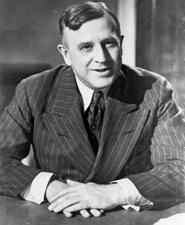
Here you will find contact information for Senator Prentiss Marsh Brown, including email address, phone number, and mailing address.
| Name | Prentiss Marsh Brown |
| Position | Senator |
| State | Michigan |
| Party | Democratic |
| Status | Former Representative |
| Term Start | March 9, 1933 |
| Term End | January 3, 1943 |
| Terms Served | 4 |
| Born | June 18, 1889 |
| Gender | Male |
| Bioguide ID | B000941 |
About Senator Prentiss Marsh Brown
Prentiss Marsh Brown (June 18, 1889 – December 19, 1973) was an American lawyer and Democratic politician who served three full and one partial term as a U.S. Representative and Senator from the state of Michigan from 1933 to 1943. Born in St. Ignace, Mackinac County, Michigan, he attended the public schools there before pursuing higher education. He studied at the University of Illinois at Urbana–Champaign and subsequently graduated from Albion College in Albion, Michigan, in 1911. After college he studied law, was admitted to the bar in 1914, and commenced the practice of law in his hometown of St. Ignace.
Brown quickly established himself in public legal service at the local level. He served as prosecuting attorney of Mackinac County from 1914 to 1926 and as city attorney of St. Ignace from 1916 to 1928, holding the two posts concurrently for many years. During this period he also became active in state legal affairs, serving as a member of the Michigan State Board of Law Examiners from 1930 to 1942. He sought higher office as a Democrat but was initially unsuccessful, losing a bid for election to the United States House of Representatives in 1924 and a campaign for justice of the Michigan Supreme Court in 1928. In his personal life, Brown married Marion Walker in 1916; the couple had seven children: Mariana Rudolph, Ruth Evashevski, James J. Brown, Barbara Laing, Patricia Watson, Prentiss M. Brown, Jr., and Paul Walker Brown.
Brown’s national political career began with his election as a Democrat from Michigan’s 11th congressional district to the United States House of Representatives for the 73rd Congress. He took office on March 4, 1933, at the outset of the New Deal era, and was reelected to the 74th Congress. He served in the House from March 4, 1933, until his resignation effective November 18, 1936, during which time he participated in the legislative process at a moment of profound economic and political transformation in the United States. His House service constituted the first part of what would be three full and one partial term in Congress, as he moved from the House to the Senate in 1936.
Brown advanced to the United States Senate in 1936. On November 3, 1936, he was elected as a Democrat to the Senate for the term beginning January 3, 1937. Shortly thereafter, he was appointed to fill the vacancy caused by the death of Senator James Couzens for the remainder of the term ending January 3, 1937. In total, he served in the Senate from November 19, 1936, to January 3, 1943. During his Senate tenure, he was chairman of the Senate Committee on Claims in the Seventy-seventh Congress and also served on the Committee on Banking and Currency. In that capacity he was instrumental in helping President Franklin D. Roosevelt secure wage and farm price controls, measures that were central to wartime economic policy. A member of the Democratic Party throughout his congressional career, Brown represented the interests of his Michigan constituents during a significant period in American history that encompassed the Great Depression and the early years of World War II. He was an unsuccessful candidate for reelection to the Senate in 1942.
Even before leaving the Senate, Brown was called to an important wartime administrative role. In December 1942, President Roosevelt selected him to serve as administrator of the Office of Price Administration (OPA), succeeding Leon Henderson, whose controversial tenure was widely regarded as one of the factors contributing to Democratic losses in the 1942 elections. Brown’s leadership at the OPA placed him at the center of federal efforts to control inflation and stabilize the home-front economy during World War II. After concluding his service in federal administration, he resumed the practice of law in 1943, maintaining offices in both Washington, D.C., and Detroit, Michigan. In the private sector he also served as chairman of the Detroit Edison Company, extending his influence into the state’s utility and business affairs.
Brown’s later public service was marked by his central role in one of Michigan’s most significant infrastructure projects. In 1951 he was named chairman of the newly created Mackinac Bridge Authority, a position he held until his death in 1973. Under his leadership, the authority oversaw the planning, financing, and construction of the Mackinac Bridge, the monumental span connecting Michigan’s Upper and Lower Peninsulas. Brown later recalled in a radio interview that he conceived the idea of the bridge after an unusually bitter winter disrupted his ferry commute and forced him to cross the strait over brittle lake ice. His sustained advocacy and stewardship of the project earned him the sobriquet “father of the Mackinac Bridge,” and his importance to the bridge’s history was commemorated by the Mackinac Bridge Authority with a special memorial bridge token bearing his likeness.
Brown’s family continued his tradition of public service in Michigan politics and civic life. His son Prentiss M. Brown, Jr., was active in Democratic Party politics, running unsuccessfully for Congress in 1952, 1956, 1958, and 1960, and serving as city attorney of St. Ignace for fifty years. Another son, Paul Walker Brown, served as a member of the Board of Regents of the University of Michigan from 1971 until 1994 and was an unsuccessful candidate for lieutenant governor in 1974. Brown’s legacy has been honored in multiple ways: Albion College, his alma mater, renamed its Honors Institute the Prentiss M. Brown Honors Institute in 2004; the stretch of Interstate 75 between the Mackinac Bridge and Sault Ste. Marie was designated the Prentiss M. Brown Memorial Highway from 1976 to 2001, and since 2001 that designation has applied to I‑75 in Mackinac County on the north side of the Mackinac Bridge. His accomplishments are also commemorated as a “Michigan Legal Milestone” by the State Bar of Michigan, and he is prominently featured in the PBS documentary “Building the Mighty Mac” by filmmaker Mark Howell.
Prentiss Marsh Brown died in St. Ignace, Michigan, on December 19, 1973, at the age of 84. He was interred in Lakeside Cemetery in St. Ignace, not far from the straits whose crossing he helped transform through the Mackinac Bridge.