Senator Prentiss Mellen
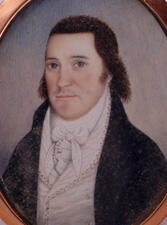
Here you will find contact information for Senator Prentiss Mellen, including email address, phone number, and mailing address.
| Name | Prentiss Mellen |
| Position | Senator |
| State | Massachusetts |
| Party | Federalist |
| Status | Former Representative |
| Term Start | January 1, 1818 |
| Term End | March 3, 1821 |
| Terms Served | 1 |
| Born | October 11, 1764 |
| Gender | Male |
| Bioguide ID | M000636 |
About Senator Prentiss Mellen
Prentiss Mellen (October 11, 1764 – December 31, 1840) was a lawyer, politician, and jurist from Massachusetts and Maine who served as a United States Senator from Massachusetts and later as the first chief justice of the Maine Supreme Judicial Court. He was born in 1764 in the second parish of Lancaster, Massachusetts, an area that is now the town of Sterling. He was the eighth of nine children of Rev. John Mellen, the local minister, and Rebecca (Prentiss) Mellen, the daughter of the first parish minister, thus growing up in a family closely tied to the Congregational clergy and the civic life of colonial Massachusetts.
Mellen was educated at Harvard College, from which he graduated in 1784. After leaving Harvard, he moved to Barnstable, Massachusetts, where he worked as a tutor in the family of prominent patriot and lawyer James Otis Jr. While in Barnstable he studied law under Shearjashub Bourne. He was admitted to the bar in 1788 and first established a law practice in his native Sterling. That practice proved unsuccessful, and he subsequently opened a practice in Bridgewater, Massachusetts. During his time in Bridgewater he met Sally Hudson of Hartford, Connecticut; they were married in 1795 and had six children, four of whom survived him.
Still not achieving financial success in Massachusetts, Mellen briefly joined his brother’s law practice in Dover, New Hampshire, before relocating to the District of Maine, then part of Massachusetts. He settled first in Biddeford, where he began to build a more stable legal career. Around 1806 he moved to Portland, in the Massachusetts District of Maine, which became the principal base of his professional and political life. His prominence in the city was later commemorated by the naming of Mellen Street in Portland.
Mellen’s public career began in Massachusetts state politics. A member of the Federalist Party, he served on the Massachusetts Governor’s Council from 1808 to 1809 and again in 1817, participating in the executive advisory body during a period of intense partisan division in New England. He also served as a presidential elector in 1817. In addition to his political work, he was active in educational affairs, serving as a trustee of Bowdoin College in Brunswick, Maine, from 1817 to 1836, thereby contributing to the governance and development of one of the region’s leading institutions of higher learning.
Mellen was elected to the United States Senate as a Federalist from Massachusetts to fill the vacancy caused by the resignation of Senator Eli P. Ashmun. He took his seat on June 5, 1818, and served until May 15, 1820, when he resigned. His service in Congress thus ran from 1817 to 1821 in the broader context of his Federalist political career, and he served one term in office during a significant period in American history marked by the aftermath of the War of 1812 and the debates that culminated in the Missouri Compromise. As a member of the Senate, Mellen participated in the legislative process, represented the interests of his Massachusetts constituents, and took part in the evolving democratic institutions of the early republic.
Mellen’s resignation from the Senate was closely tied to the reorganization of the region’s political geography. In 1820 Maine was admitted to the Union as a separate state, having previously been the District of Maine within Massachusetts. Following statehood, Mellen was appointed Maine’s first chief justice, becoming the inaugural head of the Maine Supreme Judicial Court. He held that office from 1820 until 1834, when he resigned after age disqualified him under the state’s constitutional or statutory provisions. During his fourteen years on the bench, he helped establish the foundations of Maine’s judicial system and contributed to the early development of its jurisprudence.
In addition to his judicial service, Mellen remained engaged in public affairs in Maine. In 1833 he became the first president of a newly formed abolitionist society in Portland, reflecting his involvement in the emerging antislavery movement. The society’s vice presidents included Samuel Fessenden and Methodist Reverend Gershom A. Cox, indicating the breadth of local leadership committed to abolitionist principles. Mellen’s last major act of public service was as chairman of a commission to revise and codify the public statutes of Maine, a substantial undertaking in which he drew on his long legal and judicial experience. The commission’s work was completed in 1840, the year of his death.
Prentiss Mellen died in Portland, Maine, on December 31, 1840. He was buried in Portland’s Western Cemetery. At the time of his death, four of his six children survived him, and he was remembered as a central figure in the legal and political life of both Massachusetts and the newly formed state of Maine, having served as a United States Senator, a state executive counselor, an educator and trustee, an abolitionist leader, and the first chief justice of Maine’s highest court.