Representative Prince Hulon Preston
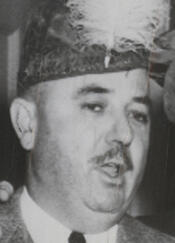
Here you will find contact information for Representative Prince Hulon Preston, including email address, phone number, and mailing address.
| Name | Prince Hulon Preston |
| Position | Representative |
| State | Georgia |
| District | 1 |
| Party | Democratic |
| Status | Former Representative |
| Term Start | January 3, 1947 |
| Term End | January 3, 1961 |
| Terms Served | 7 |
| Born | July 5, 1908 |
| Gender | Male |
| Bioguide ID | P000516 |
About Representative Prince Hulon Preston
Prince Hulon Preston Jr. (July 5, 1908 – February 8, 1961) was an American politician, educator, and lawyer who served as a Democratic Representative from Georgia in the United States Congress from 1947 to 1961. Over the course of seven consecutive terms, he represented Georgia’s 1st congressional district in the U.S. House of Representatives, participating in the legislative process during a significant period in American history and representing the interests of his constituents in coastal and southeastern Georgia.
Preston was born on July 5, 1908, in Monroe, Walton County, Georgia. Details of his early schooling are not extensively documented, but he pursued higher education in law, reflecting an early commitment to a professional career in public service and the legal field. He moved to Athens, Georgia, to attend the University of Georgia School of Law, the state’s flagship law institution, where he completed his legal studies.
Upon graduating from the University of Georgia School of Law in Athens, Preston was admitted to the Georgia state bar in 1930. He then established himself as a practicing lawyer in Statesboro, Bulloch County, Georgia. In Statesboro, he built a legal career that anchored him in the civic and political life of the community, gaining experience that would later inform his work as both a state legislator and a member of Congress. His professional background as an attorney and educator helped shape his understanding of the legal system and public policy.
Preston entered elective office at the state level when he served in the Georgia House of Representatives from 1935 through 1938. During these years in the state legislature, he gained practical legislative experience and developed political connections within the Georgia Democratic Party at a time when the party dominated state politics. With the onset of World War II, Preston joined the armed forces; in 1942 he enlisted as a private in the United States Army. Over the course of his military service, he was promoted through the ranks and attained the rank of captain by the time of his discharge on October 13, 1945. His wartime service added to his public profile and leadership credentials in the postwar political environment.
After leaving the Army, Preston returned to Statesboro and was elected as a judge for the Statesboro city courts. However, before he could assume the bench, he successfully ran for national office. In 1946 he was elected as a Democrat to the United States House of Representatives to serve in the 80th Congress, representing Georgia’s 1st congressional district. Because of his election to Congress, he never took up his judicial post. He began his congressional service on January 3, 1947, entering the House at the start of the postwar era, when the nation was transitioning from wartime mobilization to peacetime economic and social adjustments.
Preston served continuously in the House of Representatives from 1947 to 1961, being reelected for six additional terms after his initial victory, for a total of seven terms in office. His tenure in Congress spanned the Truman, Eisenhower, and early Kennedy eras, a period marked by the early Cold War, the beginning of the civil rights movement, and significant domestic policy debates. As a member of the Democratic Party, he contributed to the legislative process and participated in the democratic governance of the country, advocating for the interests of his Georgia constituents. A staunch segregationist, Preston aligned with many Southern Democrats in opposition to federal civil rights initiatives; in 1956 he signed the “Southern Manifesto,” a document in which a group of Southern members of Congress condemned the Supreme Court’s decision in Brown v. Board of Education and pledged to resist school desegregation. He continued to serve until he was defeated in his bid for reelection in 1960, ending his congressional career on January 3, 1961.
Following his departure from Congress, Preston’s public career was cut short. Only weeks after leaving office, he died in Savannah, Georgia, on February 8, 1961. He was interred in Eastside Cemetery in Statesboro, Georgia, the community where he had practiced law and from which he had launched his political career. His life and service reflected the political and social currents of mid-twentieth-century Georgia and the broader South, including both his contributions as a long-serving representative and his firm adherence to segregationist policies during a transformative era in American history.