Representative Quintin Paredes
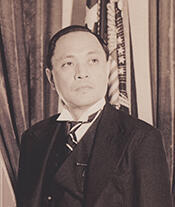
Here you will find contact information for Representative Quintin Paredes, including email address, phone number, and mailing address.
| Name | Quintin Paredes |
| Position | Representative |
| State | Philippine Islands |
| District | At-Large |
| Party | Unknown |
| Status | Former Representative |
| Term Start | January 3, 1935 |
| Term End | January 3, 1939 |
| Terms Served | 2 |
| Born | September 9, 1884 |
| Gender | Male |
| Bioguide ID | P000050 |
About Representative Quintin Paredes
Quintín Paredes y Babila (September 9, 1884 – January 30, 1973) was a Filipino lawyer, legislator, and statesman who served as Resident Commissioner of the Philippines in the United States House of Representatives from 1936 to 1938, effectively acting as a Representative from the Philippine Islands in the United States Congress from 1935 to 1939. A member of the Philippine Liberal Party in his later career, Paredes contributed to the legislative process during two terms as Resident Commissioner, participating in the democratic process and representing the interests of his Filipino constituents during a significant period in American and Philippine history.
Paredes was born in Bangued, Abra, Philippines, on September 9, 1884, to Don Juan Félix Paredes y Pe Benito and Regine Babila, the daughter of an Itneg tribal leader. He obtained his elementary education at a school established by his father and later studied at the Colegio Seminario de Vigan and the Colegio de San Juan de Letran. He pursued legal studies at the Escuela de Derecho de Manila, from which he graduated in 1907. That same year he took and passed the Philippine bar examinations and began a private law practice in Manila. In addition to his early legal work, he later served as dean of the law school (Escuela de Derecho) of Manila from 1913 to 1917, helping to train a rising generation of Filipino lawyers during the American colonial period.
Paredes quickly entered public service. He was appointed fourth prosecuting attorney of Manila on July 9, 1908, and rose to first prosecuting attorney on November 1, 1913, serving in that capacity until March 1, 1917. He then became Philippine Solicitor General from March 1, 1917, to 1918, and subsequently Attorney General from 1918 to July 1, 1920. As Attorney General, he was a member of the first parliamentary mission to the United States in 1919, which sought greater autonomy and ultimately independence for the Philippines. He served as Secretary of Justice from 1920 to 1921, after which he resumed the private practice of law in Manila. These roles established him as a leading legal authority in the islands and gave him early experience in representing Philippine interests before American officials.
Turning to elective office, Paredes was elected to the Philippine House of Representatives to represent Abra’s lone district in 1925, 1928, 1931, and 1934. Within the House he advanced rapidly in leadership, serving as Speaker pro tempore from 1929 to 1931 and as Speaker of the House from 1934 to 1935. In 1935 he was elected as a member of the Philippine Assembly under the new Commonwealth framework, but he resigned that post in order to accept appointment as the Philippines’ Resident Commissioner to the United States. Under the Tydings–McDuffie Act, which created the Philippine Commonwealth Government and laid down a timetable for independence, Paredes became the first Resident Commissioner of the Commonwealth, taking office on February 14, 1936.
As Resident Commissioner, Paredes sat in the United States House of Representatives, where he served from 1936 until his resignation on September 29, 1938. During this period, he functioned as a nonvoting delegate and Representative from the Philippine Islands in the U.S. Congress, working within the legislative process on behalf of his constituents. His efforts centered on two principal objectives. First, he sought revisions to the Tydings–McDuffie Act, which he believed would damage the Philippine economic structure, and he pressed for changes that would allow the islands to adapt more effectively to the global economy. Second, he worked to preserve a substantial line of credit with the U.S. Treasury Department intended to stabilize the Philippine economy. The Philippine government had invested heavily in U.S. banks and, having missed an opportunity to convert assets to gold, suffered significant losses. To offset these, Congress had authorized a $24 million credit line, which later came under threat of repeal. Paredes presented the Philippine case to the Senate Banking and Currency Committee in March 1936, but the committee ultimately moved to repeal the measure, asserting that the credit line had been “misunderstood” by Congress. His tenure in Washington coincided with growing isolationist and anti-Filipino sentiment in the U.S. Congress, with many lawmakers favoring withdrawal from the Pacific and expressing prejudice toward the Philippines. Accused in some quarters of ingratitude and facing increasing hostility, Paredes resigned in 1938. Upon his resignation, President Manuel L. Quezon, despite their political rivalry, publicly commended Paredes for his role in securing favorable legislation for the Philippines and in resisting measures harmful to the islands economically and politically. In 1938, after returning home, he was again elected a member of the Philippine Assembly and served as Majority Floor Leader.
Paredes continued his legislative career in the Commonwealth era and during the Second World War. He was elected to the Philippine Senate for the term 1941 to 1945, although the Senate did not sit in regular session because of the Japanese invasion and occupation. Under the Japanese-sponsored government of President José P. Laurel, he served as commissioner of public works and was again appointed Secretary of Justice. In his capacity as commissioner of public works, he oversaw the Agno River Control Project, which sought to address chronic flooding and inadequate irrigation that impeded agricultural development. Utilizing available manpower, the government constructed dikes along the Agno River to prevent flooding and to harness its waters for irrigation in provinces including Pangasinan, La Union, Ilocos Norte, Pampanga, and Nueva Ecija. After the return of American forces and the restoration of the Commonwealth government, Paredes was arrested by the U.S. military and charged with up to 21 counts of treason as an alleged Japanese collaborator. He was tried in Philippine courts and acquitted in 1948.
Following his acquittal, Paredes resumed his political career in the newly independent Republic of the Philippines. He was elected once more to represent Abra in the Philippine House of Representatives, serving from 1946 to 1949. In the 1949 national elections he ran for the Senate as a candidate of the Liberal Party and topped the senatorial race. He served as a senator from 1949 and was briefly President of the Philippine Senate in 1952. He was reelected to the Senate in 1955 and completed his second senatorial term in 1961. Despite the controversy surrounding his wartime service, he remained a prominent figure in the Philippine Legislature throughout the 1950s, participating in the consolidation of the post-independence political order.
Paredes retired from active politics in 1963 and turned to business and civic pursuits. From 1963 to 1969 he served as president of the General Bank & Trust Company, reflecting his continuing involvement in national economic affairs. He spent his later years in Manila, where he remained a respected, if sometimes controversial, elder statesman whose career had spanned the late Spanish period, American colonial rule, the Commonwealth, wartime occupation, and the early decades of the independent republic. Quintín Paredes died in Manila on January 30, 1973, closing a long public life that had included service as a lawyer, cabinet member, legislative leader, Resident Commissioner in the United States Congress, and senior senator of the Philippines.