Representative Ralph Julian Rivers
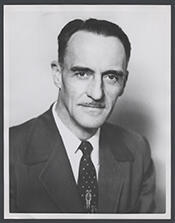
Here you will find contact information for Representative Ralph Julian Rivers, including email address, phone number, and mailing address.
| Name | Ralph Julian Rivers |
| Position | Representative |
| State | Alaska |
| District | At-Large |
| Party | Democratic |
| Status | Former Representative |
| Term Start | January 7, 1959 |
| Term End | January 3, 1967 |
| Terms Served | 4 |
| Born | May 23, 1903 |
| Gender | Male |
| Bioguide ID | R000282 |
About Representative Ralph Julian Rivers
Ralph Julian Rivers (May 23, 1903 – August 13, 1976) was an American lawyer and Democratic politician who became the first United States Representative from Alaska, serving from statehood in 1959 until his resignation in 1966 following his defeat by Republican Howard W. Pollock. Born in Seattle, Washington, he was the son of Louisa Zenaide (née Lavoy) and Julian Guy Rivers. He spent part of his childhood in Alaska, attending grammar school in Flat, Alaska, before returning to Seattle, where he graduated from Franklin High School. From 1921 to 1923 he worked as a gold miner in Flat, gaining early firsthand experience of the territory whose interests he would later represent in public office.
Rivers pursued a legal education after his early work in mining. He earned an LL.B. from the University of Washington School of Law in 1929 and was admitted to the bar, beginning a career in private legal practice. His training as a lawyer laid the foundation for a long career in public service, in which he combined legal expertise with a growing commitment to the political and constitutional development of Alaska. During these years he established himself professionally in the Pacific Northwest and Alaska, building the legal and political connections that would lead to a succession of public offices.
A lifelong civil servant, Rivers held a series of important territorial and federal positions before Alaska achieved statehood. He served as United States Attorney for the District of Alaska from 1933 to 1944, representing the federal government in legal matters throughout the territory during the New Deal and World War II era. In 1945 he was elected attorney general of Alaska, a post he held until 1949, playing a central role in the administration of territorial law. He continued his public service as chair of the Employment Security Commission of Alaska from 1950 to 1952, overseeing labor and employment issues during a period of economic transition. From 1952 to 1954 he served as mayor of Fairbanks, Alaska, and in 1954 he was president of the League of Alaskan Cities, reflecting his growing prominence in municipal and territorial affairs.
Rivers also played a significant role in Alaska’s legislative and constitutional development in the years immediately preceding statehood. He was elected to the Alaska Territorial Senate in 1955 and participated in the Alaska Constitutional Convention held at College, Alaska, in 1955 and 1956, serving as second vice president of the convention. In this capacity he helped shape the fundamental governing document that would guide Alaska as it moved from territorial status to statehood. His work at the convention and in the territorial legislature positioned him as a leading advocate for Alaska’s admission to the Union and for the establishment of its state institutions.
In the mid-1950s Rivers began to represent Alaska’s interests in Washington, D.C., even before statehood was formally achieved. From 1956 to 1959 he served as the shadow U.S. Representative from Alaska Territory, and in 1957 and 1958 he was a United States representative-elect under the Alaska-Tennessee Plan, working on a provisional basis in the nation’s capital to press for statehood and to familiarize Congress with Alaska’s needs. Upon the admission of Alaska as a state into the Union, he was elected as a Democrat to the Eighty-sixth Congress and to the three succeeding Congresses, serving from January 3, 1959, until December 30, 1966. Over the course of these four terms, he represented Alaska’s at-large congressional district and contributed to the legislative process during a significant period in American history, including the early years of statehood and the height of the civil rights era.
As a member of the U.S. House of Representatives, Rivers participated actively in the democratic process and represented the interests of his Alaskan constituents. He voted in favor of the Civil Rights Act of 1960 and the Civil Rights Act of 1964, supported the 24th Amendment to the U.S. Constitution abolishing the poll tax in federal elections, and voted for the Voting Rights Act of 1965, aligning himself with major national civil rights legislation. A member of the Democratic Party, he was also a delegate to the Democratic National Conventions in 1960, 1964, and 1968, reflecting his continuing influence within the party at both the state and national levels. After losing his bid for reelection to the Ninetieth Congress in 1966 to Republican Howard W. Pollock, he resigned his seat on December 30, 1966, just days before the end of his term.
In addition to his formal political roles, Rivers occasionally appeared in popular media. Notably, he appeared on the television game show “To Tell the Truth” as contestant number one in the second group of contestants on June 2, 1959, shortly after Alaska attained statehood and he entered Congress, bringing national attention to the new state’s first representative. In his later years, Rivers resided in Washington State. He died at his home in Chehalis, Washington, on the morning of August 13, 1976, closing a career that had spanned territorial administration, constitutional formation, and the early congressional representation of the State of Alaska.