Representative Ralph Eugene Updike
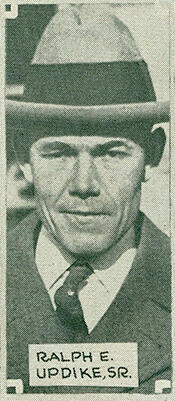
Here you will find contact information for Representative Ralph Eugene Updike, including email address, phone number, and mailing address.
| Name | Ralph Eugene Updike |
| Position | Representative |
| State | Indiana |
| District | 7 |
| Party | Republican |
| Status | Former Representative |
| Term Start | December 7, 1925 |
| Term End | March 3, 1929 |
| Terms Served | 2 |
| Born | May 27, 1894 |
| Gender | Male |
| Bioguide ID | U000020 |
About Representative Ralph Eugene Updike
Ralph Eugene Updike (May 27, 1894 – September 16, 1953) was an American lawyer, jurist, World War I and World War II veteran, and politician who served two terms as a U.S. Representative from Indiana from 1925 to 1929. A member of the Republican Party, he contributed to the legislative process during a significant period in American history, participating in the democratic process and representing the interests of his constituents in the House of Representatives.
Updike was born in Brookville, Franklin County, Indiana, on May 27, 1894. He attended the public schools of Whitcomb and Brookville before pursuing further preparatory education at Dodds Army and Navy Academy in Washington, D.C. He subsequently undertook studies at Columbia University in New York City and at Purdue University in Lafayette, Indiana. This combination of Midwestern and East Coast educational experiences provided him with a broad academic foundation prior to his military and legal careers.
During the First World War, Updike served overseas as a sergeant with the Seventy-fourth Company, Sixth Regiment, Second Division, United States Marine Corps, from 1916 to 1919. His service included deployment abroad during the major American engagements of the conflict, and his experience as a noncommissioned officer in the Marine Corps helped shape his later public service. Following his return from military duty, he turned to the study of law, reflecting a transition from military to civilian leadership.
Updike was admitted to the bar in 1920 and subsequently enrolled in the law department of Indiana University, from which he graduated in 1923. After receiving his law degree, he commenced the practice of law in Indianapolis, Indiana. Almost immediately, he became active in public affairs and the legal profession, building a reputation as a practicing attorney while also beginning to assume judicial and legislative responsibilities at the state and local levels.
In Indiana state and local government, Updike served as a member of the Indiana House of Representatives from 1923 to 1925. Concurrently, he held judicial responsibilities as a special judge of the city of Indianapolis in 1923 and 1924. He went on to serve as a special judge of the superior court of Marion County in 1925 and 1926. During this period, he was also associated with the Ku Klux Klan in Indiana and was identified as a Grand Dragon in the organization, reflecting the influence the Klan exerted in state and local politics in Indiana during the 1920s.
Updike was elected as a Republican to the Sixty-ninth and Seventieth Congresses, serving as a U.S. Representative from Indiana from March 4, 1925, to March 3, 1929. His two terms in Congress coincided with the mid-1920s, a time of economic expansion, social change, and contentious national debates over issues such as Prohibition, immigration, and the role of the federal government. He sought reelection in 1928 to the Seventy-first Congress but was unsuccessful, bringing his period of federal legislative service to a close after four years.
Following his congressional service, Updike continued his work in federal affairs as a special attorney in the Bureau of Internal Revenue from 1929 to 1933. After leaving that post, he resumed the practice of law in Indianapolis and in Washington, D.C., maintaining a bi-local practice that connected him to both his home state and the nation’s capital. His legal career continued until the United States entered World War II, when he again answered the call to military service.
On March 2, 1942, Updike was commissioned a captain in the United States Marine Corps Reserve. During World War II he served overseas in the South Pacific with the First Marine Division, Fleet Marine Force. His service in this theater placed him in one of the most active and strategically important commands of the Marine Corps during the war. He was inactivated on June 15, 1945, following the conclusion of his wartime duties, and subsequently returned to civilian life.
After World War II, Updike resumed the practice of law in Indianapolis and Washington, D.C., continuing in the legal profession until his retirement. He spent his later years in the Washington area and died in Arlington, Virginia, on September 16, 1953. In recognition of his military service, he was interred in Arlington National Cemetery, where his grave marks the resting place of a figure who combined careers in law, politics, and military service across two world wars and a turbulent era in American public life.