Representative Ransom Williams Dunham
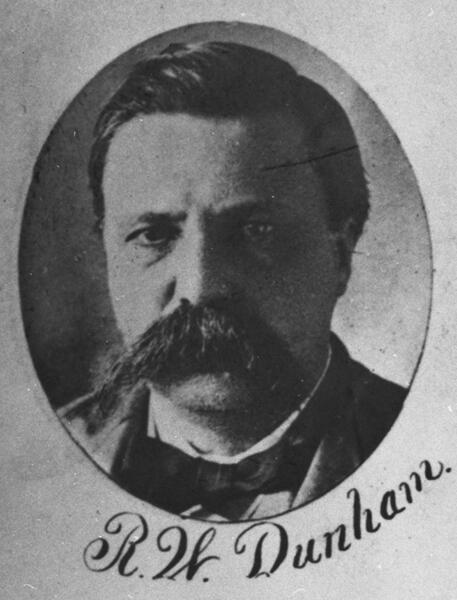
Here you will find contact information for Representative Ransom Williams Dunham, including email address, phone number, and mailing address.
| Name | Ransom Williams Dunham |
| Position | Representative |
| State | Illinois |
| District | 1 |
| Party | Republican |
| Status | Former Representative |
| Term Start | December 3, 1883 |
| Term End | March 3, 1889 |
| Terms Served | 3 |
| Born | March 21, 1838 |
| Gender | Male |
| Bioguide ID | D000541 |
About Representative Ransom Williams Dunham
Ransom Williams Dunham (March 21, 1838 – August 19, 1896) was an American businessman and Republican politician from Chicago who served three terms as a United States Representative from Illinois from 1883 to 1889. Over the course of his career he became a prominent figure in the grain and provision trade and held leadership positions on the Chicago Board of Trade, including its presidency, before representing Illinois’s 1st congressional district in the U.S. House of Representatives.
Dunham was born in Savoy, Berkshire County, Massachusetts, on March 21, 1838. He was educated in the local schools of Savoy and later attended high school in Springfield, Massachusetts. His early years in New England provided him with a basic formal education that prepared him for clerical and commercial work at a time when the region was developing rapidly in finance and industry.
After completing his schooling, Dunham began his professional career in Springfield. From 1855 to 1857 he was employed as a clerk for the Massachusetts Mutual Life Insurance Company (MassMutual), gaining experience in business administration and finance. This early clerical work introduced him to the organizational and record-keeping skills that would later support his success in commerce and public life.
In 1857 Dunham moved west to Chicago, Illinois, which was emerging as a major commercial and transportation hub. There he entered the grain and provision trade, becoming a grain and provision merchant at a time when Chicago was consolidating its role as a center of agricultural commerce. His business activities brought him into close association with the Chicago Board of Trade, the city’s leading commercial institution for commodities trading.
Dunham rose steadily within the Chicago Board of Trade. In 1880 he served as the board’s second vice president, and in 1881 he advanced to first vice president. In 1882 he was elected president of the Board of Trade. During his presidency, the cornerstone was laid for a new Board of Trade building, a significant project in the city’s commercial development; construction of the building was ultimately completed in 1885. His leadership on the board reflected both his prominence in Chicago’s business community and his organizational abilities.
In 1882 Dunham was elected as a Republican to the United States House of Representatives. He represented Illinois’s 1st congressional district and took his seat in the Forty-eighth Congress on March 4, 1883. He was reelected in 1884 and 1886, serving consecutively in the Forty-eighth, Forty-ninth, and Fiftieth Congresses from March 4, 1883, to March 3, 1889. As a member of the House of Representatives during a significant period in American history marked by industrial expansion and complex economic issues, Ransom Williams Dunham participated in the legislative process, contributed to the work of Congress, and represented the interests of his Chicago-area constituents. A member of the Republican Party, he took part in debates and votes on matters affecting commerce, infrastructure, and the broader economic development of the nation.
After leaving Congress in 1889, Dunham retired from both politics and business. He withdrew from public life and did not seek further elective office, concluding a career that had combined commercial leadership in Chicago with national legislative service. In his later years he maintained ties to his native region in Massachusetts while remaining identified with Chicago, where his business and political reputation had been established.
Dunham died in Springfield, Massachusetts, on August 19, 1896, while en route to attend the centennial celebration of his birthplace, Savoy. He was interred at Mount Hope Cemetery in Chicago, Illinois, reflecting the enduring connection between his New England origins and the Midwestern city where he achieved prominence as a businessman, civic leader, and member of the United States Congress.