Representative Ray Park Chase
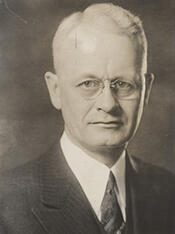
Here you will find contact information for Representative Ray Park Chase, including email address, phone number, and mailing address.
| Name | Ray Park Chase |
| Position | Representative |
| State | Minnesota |
| District | At-Large |
| Party | Republican |
| Status | Former Representative |
| Term Start | March 9, 1933 |
| Term End | January 3, 1935 |
| Terms Served | 1 |
| Born | March 12, 1880 |
| Gender | Male |
| Bioguide ID | C000331 |
About Representative Ray Park Chase
Raymond Park Chase (March 12, 1880 – September 18, 1948) was an American politician and attorney who served as a United States Representative from Minnesota and as Minnesota State Auditor. A member of the Republican Party, he represented Minnesota in the U.S. House of Representatives for one term from 1933 to 1935, contributing to the legislative process during a significant period in American history and participating in the democratic process on behalf of his constituents.
Chase was born in Anoka County, Minnesota, on March 12, 1880. He was educated in the local public schools before enrolling at the University of Minnesota in Minneapolis, from which he graduated in 1903. He subsequently attended the University of Minnesota Law School in 1904, 1905, 1915, and 1916, though he did not complete a degree there at that time. Shortly after his university studies, he entered the publishing and printing business in Anoka, Minnesota, an enterprise in which he was engaged from 1904 to 1914.
While active in business, Chase also began a career in public service at the local level. He served as municipal judge of Anoka from 1911 to 1916, gaining experience in the administration of justice and local governance. In 1916 he moved into state government as deputy state auditor and land commissioner of Minnesota, positions he held from 1916 through 1920. During this period he resumed his legal education at the St. Paul College of Law, later known as William Mitchell College of Law, from which he graduated in 1919. He was admitted to the bar that same year, although he did not immediately enter into active legal practice.
Chase’s statewide prominence increased when he was elected Minnesota State Auditor as a Republican in 1920. He held that office through 1931, overseeing the state’s fiscal accounts and financial administration for more than a decade. In 1930 he sought higher office as the Republican candidate for Governor of Minnesota, but his bid was unsuccessful. Nonetheless, his long tenure as state auditor established him as a significant figure in Minnesota Republican politics during the 1920s and early 1930s.
In 1932, amid the political and economic upheaval of the Great Depression, Chase was elected as a Republican to the Seventy-third Congress. He served from March 4, 1933, to January 3, 1935, during a period when Minnesota elected all of its U.S. Representatives at-large rather than from individual districts. As a member of the House of Representatives, Ray Park Chase participated in the legislative deliberations of the early New Deal era and represented the interests of Minnesota constituents in national affairs. When Minnesota returned to single-member districts, he sought renomination in 1934 but was unsuccessful, bringing his congressional service to a close after one term.
After leaving Congress, Chase turned more fully to the practice of law. From 1935 through 1943 he worked as an attorney, specializing in legal research rather than courtroom practice. He remained active in public affairs and, from 1944 through 1948, served as a member of the Minnesota Railroad and Warehouse Commission, a regulatory body overseeing transportation and warehousing within the state.
Chase also played a controversial role in Minnesota politics in the late 1930s. During the 1938 gubernatorial race, he authored a book titled “Are They Communists or Catspaws: A Red Baiting Article,” in which he attempted to establish a connection between the incumbent Farmer–Labor Party administration and the Communist Party. The work, however, introduced overt anti-Semitism into Minnesota political discourse, as all of his illustrative examples focused on Jews. While the publication aided his political allies in winning the election, it also provoked concern and resistance, contributing to the formation and mobilization of the Jewish Community Relations Council to combat local anti-Semitism.
Raymond Park Chase died in Anoka, Minnesota, on September 18, 1948. He was interred in Forest Hill Cemetery in Anoka, closing a long career that spanned local judicial service, statewide fiscal administration, a term in the United States Congress, and later regulatory and legal work in his home state.