Representative Ray J. Madden
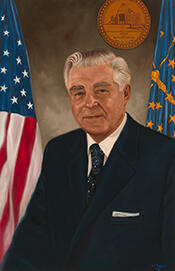
Here you will find contact information for Representative Ray J. Madden, including email address, phone number, and mailing address.
| Name | Ray J. Madden |
| Position | Representative |
| State | Indiana |
| District | 1 |
| Party | Democratic |
| Status | Former Representative |
| Term Start | January 6, 1943 |
| Term End | January 3, 1977 |
| Terms Served | 4 |
| Born | February 25, 1892 |
| Gender | Male |
| Bioguide ID | M000039 |
About Representative Ray J. Madden
Ray John Madden (February 25, 1892 – September 28, 1987) was an American lawyer, World War I veteran, and long-serving Democratic member of the United States House of Representatives from Indiana, serving 17 consecutive terms from 1943 to 1977. Over the course of more than three decades in Congress, he participated actively in the legislative process during a significant period in American history, representing the interests of his constituents while holding key committee leadership positions.
Madden was born in Waseca, Minnesota, where he attended the public schools and Sacred Heart Academy. He pursued legal studies at Creighton University in Omaha, Nebraska, graduating from its law department with an LL.B. in 1913. That same year he was admitted to the bar and commenced the practice of law in Omaha, marking the beginning of a legal career that would later underpin his work in public office.
In 1916, Madden was elected as a municipal judge in Omaha. He resigned from this judicial post during the First World War in order to serve in the United States Navy, reflecting his commitment to national service. Following the war, he relocated to Gary, Indiana, where he resumed the practice of law. In Gary, he became increasingly involved in local government and finance, building a political base that would eventually lead to national office.
Madden’s early public service in Indiana included key fiscal positions in municipal and county government. He served as city comptroller of Gary from 1935 to 1938, overseeing the city’s financial affairs during the later years of the Great Depression. From 1938 to 1942, he was treasurer of Lake County, Indiana, further solidifying his reputation as a capable administrator. During this period, he also emerged as an influential figure within the Democratic Party, serving as a delegate to every Democratic National Convention from 1940 through 1968.
In 1942, Madden was elected as a Democrat to the Seventy-eighth Congress and to the sixteen succeeding Congresses, serving from January 3, 1943, to January 3, 1977. As a member of the House of Representatives, he participated in the democratic process over a period that spanned World War II, the early Cold War, the civil rights era, and the Vietnam War, consistently representing the interests of his Indiana constituents. Within the House, he rose to positions of significant influence. He served as co-chairman of the Joint Committee on the Organization of Congress during the Eighty-ninth and Ninetieth Congresses, where he helped examine and recommend reforms to improve the efficiency and structure of the legislative branch. Later, he served as chairman of the powerful House Committee on Rules in the Ninety-third and Ninety-fourth Congresses, a role that gave him substantial authority over the flow of legislation to the House floor. In 1976, after more than three decades in office, he was an unsuccessful candidate for renomination to the Ninety-fifth Congress.
Madden also played a prominent role in one of the most notable congressional investigations of the early Cold War. On September 18, 1951, the House of Representatives established the Select Committee to Conduct an Investigation and Study of the Facts, Evidence, and Circumstances of the Katyn Forest Massacre, which became known as the Madden Committee after its chairman. The committee’s mandate was to determine which nation was responsible for the mass executions of Polish officers and intellectuals in the Katyn Forest during World War II and to assess whether any American officials had engaged in a cover-up of the massacre. After extensive hearings and review of evidence, the committee unanimously concluded that the Soviet Union was responsible for the executions and recommended that the matter be brought before the International Court of Justice. On the question of an American cover-up, the committee found that U.S. officials had failed to properly evaluate and act upon evidence of Soviet responsibility as early as 1942 and determined that American policy toward the Soviet Union might have been different had information not been deliberately withheld from the public.
After leaving Congress in 1977, Madden remained in Washington, D.C., where he lived as a private citizen while retaining the perspective and experience of a long-serving legislator. He died in Washington on September 28, 1987. In recognition of his military service and long public career, he was buried in Arlington National Cemetery.