Representative Reuben Ellwood
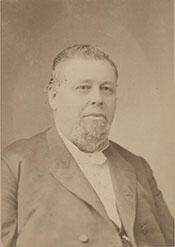
Here you will find contact information for Representative Reuben Ellwood, including email address, phone number, and mailing address.
| Name | Reuben Ellwood |
| Position | Representative |
| State | Illinois |
| District | 5 |
| Party | Republican |
| Status | Former Representative |
| Term Start | December 3, 1883 |
| Term End | March 3, 1887 |
| Terms Served | 2 |
| Born | February 21, 1821 |
| Gender | Male |
| Bioguide ID | E000151 |
About Representative Reuben Ellwood
Reuben Ellwood (February 21, 1821 – July 1, 1885) was a U.S. Representative from Illinois and a member of the Republican Party who served in the United States Congress from 1883 to 1887. He was born in Minden, Montgomery County, New York, on February 21, 1821, to Abraham and Sarah Ellwood. He attended the public schools of New York before his family moved west to DeKalb County, Illinois, when he was fifteen years old. Soon after arriving in Illinois, he worked for a year as a farmhand for William Miller in Kingston. The following year he traveled to Geneva, Illinois, where he assisted in the construction of a dam on the Fox River. He later found employment in a brickyard in Rockford, Illinois, and through these early labors accumulated enough savings to purchase a 160‑acre farm near Sycamore, Illinois, which he cultivated for four years.
After this initial period in Illinois, Ellwood returned to New York to further his education at Cherry Valley Seminary. Before completing his studies there, he moved to Glenville, New York, where he operated a mill. During this time he developed an interest in the cultivation and processing of broom corn. He established a broom manufacturing enterprise that became highly successful, eventually employing about 130 men. In 1849 he married Eleanor Vedder; the couple had six children. Ellwood’s growing prominence in business and local affairs led him into public service in New York, and he was elected as a Whig to the New York State Assembly, representing Schenectady County, in 1851.
Ellwood’s political alignment shifted with the national realignment of the 1850s. He became an early supporter of the newly formed Republican Party and served as a delegate to the 1856 Republican National Convention, thereafter identifying with the party for the remainder of his life. In 1857 he returned permanently to Sycamore, Illinois, where he entered the hardware trade with a particular focus on farm machinery. He invested in local manufacturers of agricultural implements and became one of the wealthiest men in DeKalb County. His business interests and civic engagement elevated his standing in the community, and he was appointed U.S. Assessor for the 4th Congressional District of Illinois. He also became the first mayor of Sycamore, helping to shape the early municipal development of the town.
Ellwood’s prominence in Illinois Republican politics and his record in local and federal administrative roles led to his election to the United States House of Representatives. A member of the Republican Party, he was elected as a Republican to the Forty‑eighth Congress and took his seat as a Representative from Illinois on March 4, 1883. He contributed to the legislative process during this significant period in American history, participating in the deliberations of the House of Representatives and representing the interests of his Illinois constituents. He was re‑elected to the Forty‑ninth Congress, securing a second term in office and extending his service in Congress from 1883 to 1887. His congressional career, however, was cut short when he died before the assembling of the Forty‑ninth Congress.
Ellwood died in Sycamore, Illinois, on July 1, 1885, after a long illness, while still in office as a member‑elect of the Forty‑ninth Congress. He was interred in Elmwood Cemetery in Sycamore. His family continued to play a notable role in the development of DeKalb County. His brothers followed him to the area: Isaac Ellwood became a prominent barbed‑wire entrepreneur, contributing to the growth of the region’s agricultural economy, and Chauncey Ellwood also served as mayor of Sycamore, extending the family’s civic legacy in northern Illinois.