Senator Reuel Williams
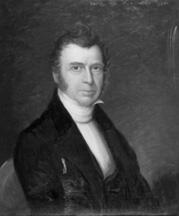
Here you will find contact information for Senator Reuel Williams, including email address, phone number, and mailing address.
| Name | Reuel Williams |
| Position | Senator |
| State | Maine |
| Party | Democratic |
| Status | Former Representative |
| Term Start | September 4, 1837 |
| Term End | December 31, 1843 |
| Terms Served | 2 |
| Born | June 2, 1783 |
| Gender | Male |
| Bioguide ID | W000532 |
About Senator Reuel Williams
Reuel Williams (June 2, 1783 – July 25, 1862) was an American lawyer and Democratic politician who served as a United States Senator from Maine from 1837 to 1843. He was born in Hallowell, then a part of Massachusetts (later Maine), to Seth Williams and Zilpha Ingraham. Raised in the Kennebec River valley during the closing years of the Revolutionary era and the early national period, he came of age in a community that would become an important commercial and political center in the District of Maine.
Williams received his early education at Hallowell Academy, one of the leading academies in the region, where he prepared for a professional career. He subsequently studied law and was admitted to the bar in 1804. Shortly after his admission, he commenced the practice of law in Augusta, Maine, which became his lifelong home and the base of his professional and political activities. His legal practice and growing prominence in local affairs laid the foundation for his long tenure in public service.
Williams entered public life in the years preceding Maine’s separation from Massachusetts. He served in the Maine Legislature, in both houses of the state’s bicameral body, from 1812 to 1829, participating in the formative period of Maine’s statehood after its admission to the Union in 1820. He returned to legislative service again in 1832 and later in 1848, reflecting his continued influence in state politics over several decades. In 1831 he was appointed commissioner of public buildings, a position that placed him at the center of efforts to develop and manage public infrastructure in the state capital. A committed member of the Democratic Party, he further demonstrated his party loyalty and standing by serving as a presidential elector on the Democratic ticket in 1836.
In 1837, Williams was elected as a Democrat to the United States Senate from Maine to fill the vacancy caused by the resignation of Senator Ether Shepley. He served in the Senate from March 4, 1837, to February 15, 1843, when he resigned. Although this period is sometimes described as two terms in office, it constituted one full Senate term. During his tenure, which coincided with a significant period in American history marked by the Panic of 1837, debates over banking and finance, and growing sectional tensions, Williams participated in the legislative process and represented the interests of his Maine constituents. As a member of the Senate, he took part in the democratic process at the national level and contributed to deliberations on key issues of the era. He served as chairman of the U.S. Senate Committee on Naval Affairs, a role that gave him particular responsibility for oversight of naval policy and maritime concerns, which were of special importance to a coastal and seafaring state such as Maine.
After leaving the Senate in 1843, Williams remained active in business and public affairs. He served as manager of the Kennebec and Portland Railroad for twelve years, helping to guide the development of one of the region’s important transportation links during the early railroad era. His work with the railroad reflected the broader mid-nineteenth-century effort to integrate Maine more closely into the commercial networks of New England and the nation, and it complemented his long record of service in state government and national politics.
Williams’s personal life was closely intertwined with other prominent New England families. In 1807, he married Sarah Lowell Cony, the daughter of Judge Daniel Cony of Maine, thereby aligning himself with a well-known legal and political household. The couple had several children who continued the family’s public and intellectual legacy. Their son, Joseph H. Williams, became a notable politician in his own right and was elected Governor of Maine. Their daughter Jane E. Williams married the Unitarian minister and author Sylvester Judd on August 31, 1841; the couple had three children and were active in religious and literary circles. Another daughter, Helen A. Williams, married John Taylor Gilman, originally of Exeter, New Hampshire; following Gilman’s death, she remarried Charles H. Bell of Exeter, New Hampshire, further extending the family’s connections into New England’s legal and political elite.
Reuel Williams spent his later years in Augusta, where he remained a respected figure in the community he had served for decades. He died in Augusta on July 25, 1862, at the age of 79. He was interred in his family’s cemetery on the banks of the Kennebec River in Augusta, a resting place that reflected both his deep roots in the region and his long association with the civic and political life of Maine.