Representative Rezin A. De Bolt
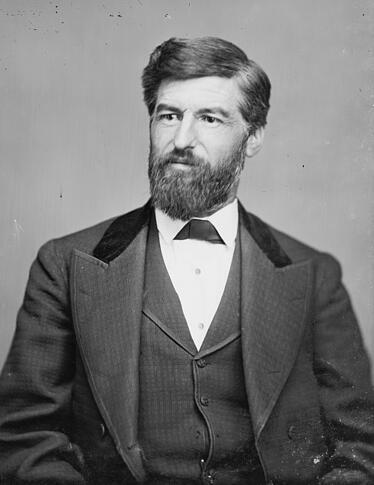
Here you will find contact information for Representative Rezin A. De Bolt, including email address, phone number, and mailing address.
| Name | Rezin A. De Bolt |
| Position | Representative |
| State | Missouri |
| District | 10 |
| Party | Democratic |
| Status | Former Representative |
| Term Start | December 6, 1875 |
| Term End | March 3, 1877 |
| Terms Served | 1 |
| Born | January 20, 1828 |
| Gender | Male |
| Bioguide ID | D000180 |
About Representative Rezin A. De Bolt
Rezin A. De Bolt (January 20, 1828 – October 30, 1891) was a Democratic U.S. Representative from Missouri who served one term in the Forty-fourth Congress from 1875 to 1877. He was born near Basil, in Fairfield County, Ohio, where he was raised in a rural setting and attended the common schools, receiving the basic formal education typical of mid-nineteenth-century America. In his youth he was employed as a tanner, working in a trade that was then an important part of local economies in small Ohio communities. This early experience in manual labor and local enterprise preceded and informed his later decision to pursue a professional career in the law.
De Bolt studied law in Ohio and was admitted to the bar in 1856. He commenced the practice of law in Lancaster, Ohio, where he began to establish himself as an attorney. As the nation’s western frontier continued to expand and new communities developed, he sought broader professional opportunities and, in 1858, moved to Trenton, Grundy County, Missouri, a growing town in north-central Missouri. There he continued the practice of his profession and quickly became involved in local public affairs. In 1859 he was appointed commissioner of common schools for Grundy County, and in 1860 he was elected to the same position, reflecting the confidence of local citizens in his abilities and his interest in public education and community development at a time when Missouri was undergoing rapid settlement and institutional formation.
With the outbreak of the Civil War, De Bolt entered the Union Army in 1861 as a captain in the Twenty-third Regiment, Missouri Volunteers. His service placed him in the Western Theater of the war, where he participated in some of its major campaigns. On April 6, 1862, he was captured at the Battle of Shiloh in Tennessee, one of the earliest and bloodiest large-scale engagements of the conflict. He was held as a prisoner of war until the following October, enduring the hardships common to captured Union officers. Owing in part to the effects of his imprisonment and the strain of military service, he resigned his commission in 1863 because of impaired health.
Despite these setbacks, De Bolt remained active in public life during and after the war. In November 1863 he was elected judge of the circuit court for the eleventh judicial circuit of Missouri, a position of considerable responsibility in a border state deeply affected by wartime divisions and the emerging challenges of postwar reconstruction. He was reelected and held this judgeship until January 1, 1875, presiding over civil and criminal matters during a period of legal and political transition in Missouri. In 1864, while still identified with the Union cause and serving as a prominent jurist, he again entered the United States service as a major in the Forty-fourth Regiment, Missouri Volunteer Infantry. He served in this capacity until he was mustered out in August 1865, contributing further to the Union war effort in the closing phase of the conflict.
De Bolt’s long tenure on the bench, combined with his Civil War record, helped to establish his standing within the Democratic Party in Missouri during the turbulent years following the war. In the aftermath of the conflict and during the later years of Reconstruction, he was elected as a Democrat to the Forty-fourth Congress, serving from March 4, 1875, to March 3, 1877. Representing a Missouri district in the U.S. House of Representatives, he participated in the legislative process at a time when Congress was addressing issues related to Reconstruction policy, veterans’ affairs, economic development, and the readjustment of relations between the federal government and the former Confederate states. His service in Congress occurred during a significant period in American history, and he represented the interests of his constituents while contributing to national deliberations. He chose not to be a candidate for renomination in 1876, thereby limiting his congressional career to a single term.
After leaving Congress, De Bolt resumed the practice of law in Trenton, Missouri. Drawing on his extensive experience as a lawyer, Civil War officer, circuit judge, and former Member of Congress, he remained a respected figure in his community and in the state’s legal circles. He continued his professional activities in Trenton until his death there on October 30, 1891. Rezin A. De Bolt was interred in Odd Fellows Cemetery in Trenton, Missouri, closing a life that spanned the antebellum era, the Civil War, Reconstruction, and the early years of the Gilded Age, and that combined military service, judicial leadership, and national legislative experience.