Representative Richard Lee Turberville Beale
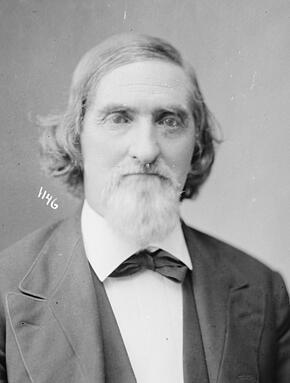
Here you will find contact information for Representative Richard Lee Turberville Beale, including email address, phone number, and mailing address.
| Name | Richard Lee Turberville Beale |
| Position | Representative |
| State | Virginia |
| District | 1 |
| Party | Democratic |
| Status | Former Representative |
| Term Start | December 6, 1847 |
| Term End | March 3, 1881 |
| Terms Served | 3 |
| Born | May 22, 1819 |
| Gender | Male |
| Bioguide ID | B000268 |
About Representative Richard Lee Turberville Beale
Richard Lee Turberville Beale (May 22, 1819 – April 21, 1893) was a Virginia lawyer, Democratic politician, three-term United States Representative, and a brigadier general in the Confederate States Army during the American Civil War. A substantial slaveholder who owned thirty-eight enslaved people along with significant farmland, he was closely identified with the antebellum planter class and the Democratic Party. Over the course of his public life he served in both state and national office, participated in Virginia’s constitutional debates, and later wrote a regimental history of his Civil War command.
Beale was born at Hickory Hill in Westmoreland County, Virginia. He attended local private schools, including Northumberland Academy and Rappahannock Academy, before pursuing higher education outside the state. He enrolled at Dickinson College in Carlisle, Pennsylvania, and subsequently studied law at the University of Virginia, from which he graduated in 1837. Two years later, in 1839, he was admitted to the bar and established a law practice at Hague, in Westmoreland County, where he built a career as an attorney and planter in Virginia’s Northern Neck.
Beale entered national politics as a Democrat and was first elected to the United States House of Representatives from Virginia’s 8th Congressional District to the Thirtieth Congress, serving from March 4, 1847, to March 3, 1849. In the 1847 election he won the seat with 51.86 percent of the vote, defeating Whig candidate Willoughby Newton. Although he contributed to the legislative process during this term and represented the interests of his constituents during a period of mounting sectional tension, he declined to be a candidate for renomination in 1848. He remained active in Virginia politics, serving as a member of the Virginia constitutional reform convention of 1850–1851, where, as part of the ruling “Richmond Junta,” he opposed proposed constitutional reforms that threatened the political dominance of eastern slaveholding interests. He later sought a return to Congress but was defeated in 1855 in a race for the U.S. House from Virginia’s 1st District by fellow Democrat Thomas Henry Bayly. Beale was elected to the Virginia Senate and served there from 1858 to 1860, further solidifying his role in state politics on the eve of the Civil War.
With the secession of Virginia in 1861, Beale entered Confederate military service. He accepted a commission in the cavalry as a lieutenant in the 9th Virginia Cavalry and was soon promoted to captain and then major. He was placed in command of Camp Lee near his hometown of Hague on the lower Potomac River, where he was commended for his intelligence and judgment. Beale subsequently served under Colonel W. H. F. “Rooney” Lee in the 9th Virginia Cavalry, part of what became the Army of Northern Virginia. When Rooney Lee was promoted to brigadier general, Beale was advanced to colonel on September 15, 1862, and given command of the regiment, which included some of his own sons. In December 1862 he led a notable expedition along the Rappahannock River, capturing the Federal garrison at Leeds without losing a man.
Beale’s cavalry service in 1863 brought him several written commendations. On April 16, 1863, he earned the praise of Major General J. E. B. Stuart for repelling a threatened raid by Major General George Stoneman’s Federal cavalry division, capturing several prisoners in a week of nearly continuous fighting. During the Gettysburg Campaign he led the 9th Virginia Cavalry in the charge on Fleetwood Hill at the Battle of Brandy Station in June 1863, took part in Stuart’s ride around the Army of the Potomac and the subsequent raid through Maryland and Pennsylvania, and fought at East Cavalry Field at Gettysburg and during the Confederate retreat to Virginia. He briefly assumed command of Rooney Lee’s brigade during the fighting at Culpeper Court House and participated in the Bristoe and Mine Run Campaigns later that year.
In March 1864, Beale made a forced march to intercept Union Colonel Ulric Dahlgren and his raiders. A detachment of his 9th Virginia Cavalry successfully ambushed the Federal force, and, in conjunction with other Confederate units, captured about 175 men and killed Dahlgren. Papers found on Dahlgren’s body, which outlined a plan to burn Richmond and kill President Jefferson Davis and his Cabinet, were forwarded through Major General Fitzhugh Lee to the Confederate government. These controversial documents, discovered by Beale’s troopers, later attracted considerable attention and have been cited by some historians as a possible influence on John Wilkes Booth’s decision to assassinate President Abraham Lincoln. Beale continued to lead his regiment during the Overland Campaign and captured two Union flags at the Second Battle of Ream’s Station during the Siege of Petersburg. After the death of Brigadier General John R. Chambliss in August 1864, Beale was assigned to command Chambliss’s brigade while still a colonel, and he was not formally promoted to brigadier general until February 6, 1865. He led the brigade through the closing operations of the war, was wounded and captured at Appomattox Station on April 9, 1865, and was paroled on April 27, 1865, at Ashland, Virginia.
Following the war, Beale resumed his legal and political career during Reconstruction. A Democrat, he returned to the United States House of Representatives as a member from Virginia’s 1st Congressional District. He was elected to the Forty-fifth Congress in a special election to fill the vacancy caused by the death of Representative Beverly B. Douglas, and he took his seat on January 23, 1879. In the 1878 general election he had secured the seat with 48.32 percent of the vote, defeating Republican George C. Round and Independent Democrat John Critcher. He was reelected to the Forty-sixth Congress, and in 1879 he also won a special election with 75.84 percent of the vote, defeating Republican U. W. Douglas and Independents George C. Round and John W. Parker. In all, he served three terms in the House of Representatives, from his initial service in the Thirtieth Congress (1847–1849) through his later service in the Forty-fifth and Forty-sixth Congresses (1879–1881), participating in the legislative process and representing Virginia constituents during both the antebellum and postwar eras.
After retiring from public office at the close of his final congressional term on March 3, 1881, Beale returned to Hague and resumed the practice of law. He also devoted time to writing and preserving the history of his wartime service. His principal published work, History of the Ninth Virginia Cavalry, in the War Between the States, appeared in 1899 in Richmond, Virginia, through B. F. Johnson Publishing Company, and remains a significant primary source on Confederate cavalry operations in the Eastern Theater. Richard Lee Turberville Beale died near Hague, Virginia, on April 21, 1893, and was buried at Hickory Hill Cemetery in Westmoreland County, close to the place of his birth.