Representative Richard Parks Bland
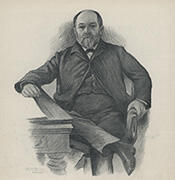
Here you will find contact information for Representative Richard Parks Bland, including email address, phone number, and mailing address.
| Name | Richard Parks Bland |
| Position | Representative |
| State | Missouri |
| District | 8 |
| Party | Democratic |
| Status | Former Representative |
| Term Start | December 1, 1873 |
| Term End | March 3, 1901 |
| Terms Served | 13 |
| Born | August 19, 1835 |
| Gender | Male |
| Bioguide ID | B000544 |
About Representative Richard Parks Bland
Richard Parks Bland (August 19, 1835 – June 15, 1899) was an American politician, lawyer, and educator from Missouri who served as a Representative from Missouri in the United States Congress from 1873 to 1901. A member of the Democratic Party, he served in the United States House of Representatives from 1873 to 1895 and from 1897 to 1899, representing at various times Missouri’s 5th, 8th, and 11th congressional districts. Over the course of 13 terms in office, Bland contributed significantly to the legislative process during a transformative period in American history. Nicknamed “Silver Dick” for his vigorous advocacy of bimetallism, he became nationally known as the principal sponsor of the Bland–Allison Act.
Bland was born in Kentucky, the son of a trained Presbyterian minister. Little is recorded in these sources about his early childhood, but as a young man he worked as a miner and schoolteacher, experiences that acquainted him with the economic hardships of working people and the volatility of frontier economies. These early occupations preceded his legal training and helped shape his later views on monetary policy and agrarian interests. His upbringing in a Protestant household would later contrast with his marriage into a Catholic family, a personal circumstance that became a point of political contention during his national prominence.
After studying law, Bland moved west and established a legal practice in Utah Territory. During this period he continued to work in mining regions and became closely associated with the developing communities of the American West. He served as treasurer of Carson County from 1860 to 1864, during the peak years of the Comstock Lode mining rush in what was then western Utah Territory (later Nevada). In that capacity he managed public funds in a rapidly expanding mining district, gaining firsthand experience with the financial and monetary issues that would later define his congressional career. In 1865 he left the Far West and settled in Lebanon, Missouri, where he established a legal practice and entered public life in his adopted state.
Bland’s formal political career began in Missouri, where he quickly emerged as a prominent Democrat. He was elected to the United States House of Representatives in 1872 and took his seat in March 1873. As a member of the House of Representatives, he participated actively in the democratic process and represented the interests of his Missouri constituents during the turbulent decades following the Civil War and Reconstruction. He soon distinguished himself as a leading advocate of the free silver movement, arguing that the restoration of silver coinage alongside gold would expand the money supply, ease debts, and benefit farmers and working people. His legislative work and public speeches made him one of the most recognizable congressional champions of bimetallism.
Bland’s most enduring legislative achievement was the Bland–Allison Act of 1878. As its principal sponsor, he authored a measure requiring the United States Department of the Treasury to purchase a specified quantity of silver each month and put it into circulation as silver dollars. Although President Rutherford B. Hayes vetoed the bill, Congress overrode the veto, and the act became a cornerstone of late nineteenth‑century monetary policy. Bland’s persistent advocacy of silver earned him his “Silver Dick” sobriquet and placed him at the center of national debates over currency, deflation, and the interests of farmers versus financial elites. Over his long tenure, he also established himself as an anti‑imperialist, opposing expansionist policies that he believed conflicted with American republican principles.
Bland’s service in Congress extended over 13 terms, reflecting sustained support from his Missouri districts. He served continuously from 1873 to 1895, during which time he represented the 5th, 8th, and 11th congressional districts at various stages of his career. His congressional service coincided with major developments in American economic and political life, including the Panic of 1873, the rise of the Populist movement, and intensifying disputes over the gold standard. In the 1894 election he was defeated for re‑election, a setback that reflected shifting political currents and the strength of his opponents, but he regained his seat in the 1896 election. Returning to the House in 1897, he continued to press for bimetallism and to oppose imperialist ventures until his death in 1899.
On December 19, 1873, Bland married Virginia Elizabeth Mitchell of Rolla, Missouri, the daughter of Confederate General Ewing Young Mitchell. Their marriage was notable in that Bland, a Protestant and son of a Presbyterian minister, married a Catholic woman at a time when interdenominational unions could provoke controversy. The couple had nine children, six of whom were living at the time of his death: Theodric, Ewing, Frances, John, George, and Virginia. The children were raised in the Catholic faith, and Bland’s family life became an issue in his political career, particularly during his 1896 bid for the Democratic presidential nomination. Responding to critics who attacked his wife’s religion, he stated, “Yes my wife is a Roman Catholic and I am a Protestant, and shall live and die one; but my regret is that I am not half such a Christian as the woman who bears my name and is the mother of my children.”
Bland rose to national prominence as a strong, if personally reluctant, candidate for the Democratic presidential nomination in 1896. He openly expressed misgivings about seeking the presidency, saying, “I have no desire in this direction. I have no ambition for this nomination and I am afraid my friends, thrusting my personality into this contest may confuse the greater question.” That “greater question,” as in most matters tied to Bland, was currency and bimetallism. Rather than travel to the Democratic National Convention in Chicago, Illinois, he chose to remain on his 160‑acre farm near Lebanon, Missouri, while the convention unfolded. On the first three ballots he led William Jennings Bryan, winning 236 to 137 on the first ballot, 281 to 197 on the second, and 291 to 219 on the third, though he failed each time to secure the necessary two‑thirds majority. As the impact of Bryan’s “Cross of Gold” speech took hold among the delegates, Bryan moved ahead on the fourth ballot, 280 to 241. Not wishing to risk a divided party, Bland sent a telegram to his supporters urging them to “Put the cause above the man,” and Bryan secured the nomination on the fifth ballot by 652 to 11. Bland was briefly considered for the vice‑presidential nomination and gained strength on successive ballots, but he declined further consideration, clearing the way for Arthur Sewall to join Bryan on the ticket.
In addition to his congressional and national political activities, Bland was active in civic and fraternal life. He was a Freemason and a member of Lodge 231 in Rolla, Missouri. Public service and the law were family traditions: his brother Charles C. Bland became a judge in the Missouri 18th Judicial Circuit, and his brother‑in‑law Ewing Young Mitchell Jr., with Bland’s assistance, secured a position as a U.S. Senate page in 1886 and later remained in public life, eventually serving as assistant Secretary of Commerce under President Franklin D. Roosevelt. Bland’s own career, marked by his long House service, his leadership in the free silver movement, and his opposition to imperialism, continued until his death in office on June 15, 1899.