Representative Richard Fulton
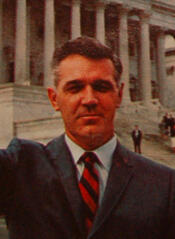
Here you will find contact information for Representative Richard Fulton, including email address, phone number, and mailing address.
| Name | Richard Fulton |
| Position | Representative |
| State | Tennessee |
| District | 5 |
| Party | Democratic |
| Status | Former Representative |
| Term Start | January 9, 1963 |
| Term End | January 3, 1977 |
| Terms Served | 7 |
| Born | January 27, 1927 |
| Gender | Male |
| Bioguide ID | F000424 |
About Representative Richard Fulton
Richard Harmon Fulton (January 27, 1927 – November 28, 2018) was an American Democratic politician who served as a member of the Tennessee State Senate, as a United States Representative from Tennessee, and as the second mayor of the Metropolitan Government of Nashville and Davidson County. Over the course of a public career that spanned more than three decades, he played a significant role in Tennessee politics and in the development of modern Nashville.
Fulton was born on January 27, 1927, in Nashville, Davidson County, Tennessee. He was educated in the city’s public schools and graduated from East Nashville High School. During World War II he served in the United States Navy, entering military service as a young man in the closing years of the conflict. After returning from his wartime service, Fulton enrolled at the University of Tennessee, where he continued his education and played football for the Tennessee Volunteers, reflecting both his academic ambitions and his interest in athletics.
Fulton’s formal political career began in the 1950s. In 1954, he was elected to the Tennessee State Senate to succeed his brother, Lyle Fulton, who had died from cancer shortly after receiving the Democratic nomination for that post. Richard Fulton was sworn in on January 3, 1955; however, because he was only 27 years old—below the minimum age for state senators under the Tennessee Constitution—the Senate voted unanimously, 28–0, to unseat him. He returned to the electorate two years later and, having reached the qualifying age, was elected to the Tennessee State Senate in 1956 at the age of 31. Fulton was reelected to the Senate in 1958, serving in that body during a period of postwar growth and political realignment in Tennessee. After this service, he stepped away from elective office and began a career in real estate, gaining private-sector experience that would later inform his approach to urban development and municipal governance.
In 1962, Fulton reentered politics by challenging incumbent Democrat Joseph Carlton Loser in the primary for Tennessee’s Nashville-based 5th Congressional District. The election commission initially declared Loser the winner, but allegations of irregularities emerged after The Tennessean reported corruption at the commission. A friend of Fulton successfully filed suit to invalidate the primary results, and in the court-ordered rerun of the primary Fulton defeated Loser. He went on to win the general election in November and took his seat in the U.S. House of Representatives in January 1963. A member of the Democratic Party, Richard Harmon Fulton served as a Representative from Tennessee in the United States Congress from 1963 to 1977, completing seven consecutive terms. His service in Congress occurred during a significant period in American history marked by the civil rights movement, the Great Society, the Vietnam War, and major social and political change. As a member of the House of Representatives, he participated in the democratic process and represented the interests of his Nashville-area constituents. Fulton voted in favor of the Civil Rights Act of 1964, the Voting Rights Act of 1965, and the Civil Rights Act of 1968, aligning himself with key federal legislation aimed at ending segregation and protecting voting rights. He resigned from the House after his election as mayor of the Metropolitan Government of Nashville and Davidson County.
Fulton was elected the second mayor of the consolidated Metropolitan Government of Nashville and Davidson County and served three terms as mayor from 1975 until 1987. His tenure coincided with a period of substantial urban change and growth in Nashville. As mayor, he was an influential voice in the development and revitalization of the city’s core, including work on key downtown streets and the creation of Riverfront Park along the Cumberland River. He played a central role in advancing the construction of the Nashville Convention Center and supported the building of Interstate 440, a major transportation artery intended to improve traffic flow around the city. Fulton also expanded the use of the Metro Development and Housing Agency to spur redevelopment and housing initiatives and oversaw the establishment of approximately 485 acres (196 hectares) of new parks in the city, reflecting a commitment to public spaces and quality of life. From 1983 until 1984, while still serving as mayor, Fulton held national municipal leadership responsibilities as president of the United States Conference of Mayors.
During and after his mayoral tenure, Fulton remained active in state and local politics. He sought higher statewide office as an unsuccessful candidate for the Democratic nomination for governor of Tennessee in both 1978 and 1986, campaigns that underscored his prominence within the state Democratic Party even though they did not result in election. After leaving the mayor’s office in 1987, he continued to be involved in civic and political affairs in Nashville. In 1999, he embarked on a political comeback by running again for mayor of Nashville. He advanced to the runoff election, demonstrating his enduring appeal among many voters, but subsequently withdrew from the race and endorsed his opponent, Bill Purcell, thereby helping to shape the city’s leadership transition.
Richard Harmon Fulton spent his later years in Nashville, where he remained a respected figure in the city whose modern identity he had helped to shape through his legislative work and mayoral leadership. He died on November 28, 2018, at a hospice in Nashville at the age of 91.