Representative Richard L. Ottinger
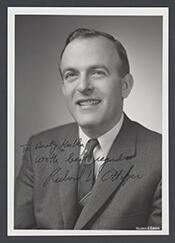
Here you will find contact information for Representative Richard L. Ottinger, including email address, phone number, and mailing address.
| Name | Richard L. Ottinger |
| Position | Representative |
| State | New York |
| District | 20 |
| Party | Democratic |
| Status | Former Representative |
| Term Start | January 4, 1965 |
| Term End | January 3, 1985 |
| Terms Served | 8 |
| Born | January 27, 1929 |
| Gender | Male |
| Bioguide ID | O000134 |
About Representative Richard L. Ottinger
Richard Lawrence Ottinger (born January 27, 1929) is an American retired lawyer, politician, and legal educator from New York. A member of the Democratic Party, he served as a Representative from New York in the United States House of Representatives for eight terms, from 1965 to 1971 and from 1975 to 1985, contributing to the legislative process during a significant period in American history. Over the course of his eight terms in office, he participated actively in the democratic process and represented the interests of his constituents while emerging as an early congressional leader on environmental issues.
Ottinger was born in New York City, the son of businessman Lawrence Ottinger, founder of U.S. Plywood, and Louise Ottinger. He was part of a politically engaged family; his uncle, Albert Ottinger, served as the Republican Attorney General of New York from 1925 to 1928. Raised in Westchester County, he attended the public schools of Scarsdale, New York, and later enrolled at the Loomis School in Windsor, Connecticut, from which he graduated in 1946. His family background, combining business and public service, helped shape his later interest in law, international affairs, and politics.
Ottinger pursued higher education at Cornell University, where he received a Bachelor of Arts degree in 1950. He then attended Harvard Law School, graduating with a law degree in 1953. Seeking further specialization, he undertook additional study in international law at Georgetown University. Following law school, he served in the United States Air Force from 1955 to 1957, rising to the rank of captain before his discharge. After his military service, he was admitted to the New York bar and practiced international and corporate law, gaining experience that would later inform his work on economic and international issues in Congress.
In the early 1960s, Ottinger joined the newly created Peace Corps and became one of its earliest staff members. He served as the second staff member of the organization and was appointed director of programs for the west coast of South America from 1961 to 1964. In that role, he oversaw the development and administration of Peace Corps initiatives in several Latin American countries, deepening his engagement with international development and public service. This experience, combined with his legal background, helped launch his subsequent political career.
Ottinger entered electoral politics in the 1964 elections, when he was elected as a Democrat to the 89th United States Congress from a New York district, and he was re-elected in 1966 and 1968. His 1964 campaign drew attention for its financing methods; he was criticized for using a loophole in election laws to spend approximately $193,000 of his own money to circumvent an $8,000 spending limit. Multiple committees were established to support his candidacy, including 22 committees set up by his mother, Louise, and his sister, Patricia Heath, each of which donated $6,000 to his campaign. Despite the controversy, he secured election and served three consecutive terms, participating in debates and legislation during a transformative era that included the Great Society programs and the Vietnam War.
In 1970, Ottinger chose not to seek re-election to the House and instead ran for the United States Senate from New York on the Democratic ticket. In the three-way 1970 Senate race, he faced incumbent Senator Charles Goodell, a Republican who also had the endorsement of the Liberal Party and had been appointed by Governor Nelson Rockefeller following the assassination of Senator Robert F. Kennedy, and Conservative Party nominee James L. Buckley. Ottinger and Goodell divided much of the liberal and moderate vote, and both were ultimately defeated by Buckley. Seeking to return to the House, Ottinger ran in 1972 for his former congressional seat but lost a closely contested race to the Republican incumbent, Representative Peter A. Peyser.
Ottinger successfully returned to Congress in the 1974 elections, this time representing a different New York district. He was re-elected to the four succeeding Congresses in 1976, 1978, 1980, and 1982, and he retired from the House of Representatives in 1985. During this second period of congressional service, he bolstered his reputation as a leading legislator on environmental and energy issues. In 1975, he founded the bipartisan Environmental Study Conference (ESC) in the House of Representatives, which quickly grew to a membership of more than 150 Members in less than a year. Through the ESC, he helped educate colleagues on environmental policy and promoted legislation on energy conservation, pollution control, and emerging environmental challenges, contributing significantly to the institutionalization of environmental concerns in congressional deliberations.
After retiring from Congress in 1985, Ottinger transitioned to a career in legal education. He joined the faculty of the Elisabeth Haub School of Law at Pace University in White Plains, New York, where he founded an environmental law program that became a central component of the law school’s curriculum and reputation. He served as dean of the law school from 1994 to 1999, guiding its academic development and strengthening its focus on environmental and energy law. Upon stepping down from the deanship, he was designated Dean Emeritus and continued to be associated with the institution as a senior figure in environmental legal education.