Senator Richard Franklin Pettigrew
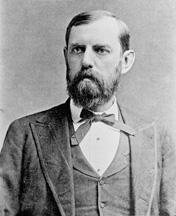
Here you will find contact information for Senator Richard Franklin Pettigrew, including email address, phone number, and mailing address.
| Name | Richard Franklin Pettigrew |
| Position | Senator |
| State | South Dakota |
| Party | Silver Republican |
| Status | Former Representative |
| Term Start | December 5, 1881 |
| Term End | March 3, 1901 |
| Terms Served | 3 |
| Born | July 23, 1848 |
| Gender | Male |
| Bioguide ID | P000271 |
About Senator Richard Franklin Pettigrew
Richard Franklin Pettigrew (July 23, 1848 – October 5, 1926) was an American lawyer, surveyor, land developer, and politician who represented Dakota Territory in the United States Congress and, after statehood, became the first United States Senator from South Dakota. Over a public career that spanned the late nineteenth and early twentieth centuries, he served in the U.S. House of Representatives and in the Senate, where he was initially a Republican and later a leading figure in the Silver Republican movement. His congressional service, which extended from 1881 to 1901, coincided with a significant period in American history marked by debates over monetary policy, imperial expansion, and the transformation of the Great Plains.
Pettigrew was born on July 23, 1848, in Ludlow, Windsor County, Vermont, in the home shared by his grandparents, parents, numerous aunts, uncles, cousins, and eight siblings. He was the sixth of nine children of Andrew Jr. Pettigrew and Hannah B. Sawtelle. His siblings included Hannah M., Alma Jane, Henrietta Adelaide, Luella Belle, Justin A., Frederick Wallace (“Fred”), Elizabeth Medora, and Harlan Page. In 1853, Andrew Pettigrew sold his Vermont store to the partnership of Emerson and Richards, and in 1854 the family moved to Rock County, near Union, Wisconsin. The move was prompted in part by the intense local conflict over slavery; Andrew Pettigrew’s store had been used to circulate anti-slavery literature, provoking a boycott and threats of violence from pro-slavery neighbors. Growing up in this environment of political and moral controversy helped shape Richard Pettigrew’s lifelong interest in public affairs and reform.
Pettigrew received his early education in Wisconsin, attending Evansville Academy in Evansville. In 1866 he went to Beloit, Wisconsin, to enroll in Beloit College, and in the winter of 1868 he entered law school at the University of Wisconsin–Madison. Although he did not complete a formal law degree in the modern sense, his legal studies equipped him for admission to the bar and for a professional life that combined law, surveying, and real estate development. His training in surveying and his familiarity with land law would later prove central to his work in the rapidly developing Dakota Territory.
In 1869 Pettigrew moved to Dakota Territory to work with a United States deputy surveyor and soon settled in Sioux Falls. There he practiced law, engaged in surveying, and became an active land developer. He quickly emerged as a prominent figure in local affairs, serving in the territorial House of Representatives and on the territorial council. His development activities extended beyond Sioux Falls itself; he was instrumental in founding several communities in the surrounding region by donating land. In 1886, he and his wife, Bessie, donated land to aid the founding and development of Granite, Iowa, in Lyon County. In 1888, he and S. L. Tate donated additional land that led to the establishment of South Sioux Falls, a community Pettigrew envisioned as a suburb to the south and west of Sioux Falls.
Pettigrew entered national politics as a Republican and was elected as the territorial delegate from Dakota Territory to the U.S. House of Representatives, serving from March 4, 1881, to March 3, 1883. This period of service in the House, from 1881 to 1883, marked his first tenure in the United States Congress. He was an unsuccessful candidate for reelection in 1882 and returned to territorial politics, serving again on the territorial council from 1885 to 1889. His experience as a territorial legislator and delegate gave him an intimate understanding of the issues facing settlers in the northern Plains, particularly land policy, infrastructure, and the drive for statehood.
When South Dakota was admitted to the Union on November 2, 1889, Pettigrew was elected as the state’s first United States Senator. He entered the Senate on November 2, 1889, and served until March 3, 1901, completing two full terms. During this period he was a member of the Republican Party until June 17, 1896, when he left to join the Silver Republicans, a faction that opposed the national party’s support for the gold standard and advocated the free coinage of silver. He was reelected to the Senate in 1894 but was an unsuccessful candidate for reelection in 1900. As a senator, he introduced a bill to fund the construction of South Dakota’s first federal building and recommended the use of native Sioux quartzite for the structure, reflecting his interest in promoting local resources. His Senate career unfolded during a transformative era in American politics, and he participated actively in the legislative process, representing the interests of his South Dakota constituents while engaging in national debates over currency, expansion, and federal Indian policy.
Pettigrew’s Senate record reflected both strong anti-imperialist convictions and controversial positions on Native American affairs. He was a vigorous opponent of President William McKinley’s efforts to annex the Republic of Hawaii against the wishes of many Native Hawaiian residents. In a notable speech on the Senate floor, he declared that “The American flag went up on Hawaii in dishonor; it came down in honor, and if it goes up again now it will go up in infamy and shame and this Government will join the robber nations of the world.” At the same time, he supported federal policies aimed at dismantling tribal sovereignty in the continental United States. He backed legislation to unilaterally dissolve tribal governments and force the allotment of Native lands, arguing in an 1897 Senate speech that Congress should “destroy” tribal governments, oust their courts, and impose a federal judicial system, which he described as a duty of the United States. In the presidential election of 1900, while still serving in the Senate and aligned with the Silver Republicans and agrarian reform movements, he was a delegate and major figure at the “Fusion” wing of the Populist Party’s national convention held in Sioux Falls from May 9 to May 11, 1900, where the party endorsed William Jennings Bryan for president.
After leaving the Senate in 1901, Pettigrew first practiced law in New York City, but he soon returned to Sioux Falls, where he remained active in politics, business, and public discourse. His later years were marked by outspoken criticism of American capitalism and imperialism. In December 1916 he published “Who Owns the United States?” in the International Socialist Review, articulating his view that concentrated wealth had come to dominate the nation’s political life. He expanded these themes in The Course of Empire (New York: Boni & Liveright, 1920), a collection of anti-imperialist speeches, and in Imperial Washington: The Story of American Public Life from 1870 to 1920 (Chicago: Charles H. Kerr & Co., 1922), originally published as Triumphant Plutocracy: The Story of American Public Life from 1870 to 1920. In these writings he advanced a radical critique of capitalism, asserting, for example, that “Capital is stolen labor and its only function is to steal more labor,” and lamenting that the gains of the nineteenth century’s struggle against hereditary aristocracy had been surrendered “to the more heartless tyranny of accumulated wealth.” He also offered caustic observations on the legal profession, remarking that “Under the ethics of his profession the lawyer is the only man who can take a bribe and call it a fee,” and condemned U.S. imperial ventures, arguing that instead of spending “hundreds of millions in conquering the Philippines,” it would have been better to invest in reclaiming the arid lands of the American West. He characterized the conquest of the Philippines as an effort “to find a field where cheap labor can be secured” for American trusts and predicted that the Republican Party, which he said had arisen as a protest against slavery and a champion of the Declaration of Independence, would “go out of being and out of power as the champion of slavery and the repudiator of the Declaration of Independence.” He praised the Russian Revolution as “the greatest event of our times,” forecasting an epoch in which workers would assume control of industry.
Pettigrew’s outspoken opposition to World War I brought him into direct conflict with federal authorities. In a 1917 interview published in the Argus Leader, he denounced the war as a capitalist scheme designed to further enrich the wealthy and publicly urged young men to evade the draft. The local United States Attorney indicted him under the Espionage Act of 1917, the same statute under which Socialist leader Eugene V. Debs received a ten-year federal prison sentence. Pettigrew assembled a prominent legal defense team headed by his close friend, noted attorney Clarence Darrow. The case was repeatedly delayed, and the charges were eventually dropped. Pettigrew had the formal indictment framed and displayed it in his home next to a framed copy of the United States Declaration of Independence, where it remains today as part of the exhibits of the Pettigrew Home & Museum in Sioux Falls.
Richard Franklin Pettigrew died in Sioux Falls, South Dakota, on October 5, 1926. He was interred in Woodlawn Cemetery in that city. In his will he left his home to the city of Sioux Falls, and it has been preserved as the Pettigrew Home & Museum, maintained by the city to emulate how a person of his stature would have lived at the turn of the twentieth century. The house contains antiques from the early 1900s and Pettigrew’s personal collection of artifacts, reflecting his interests as an amateur archaeologist and collector. His legacy in Sioux Falls is also commemorated in the naming of Richard F. Pettigrew Elementary School, announced on January 12, 2009, and opened in the fall of 2009 in southwest Sioux Falls.