Representative Richard Thomas
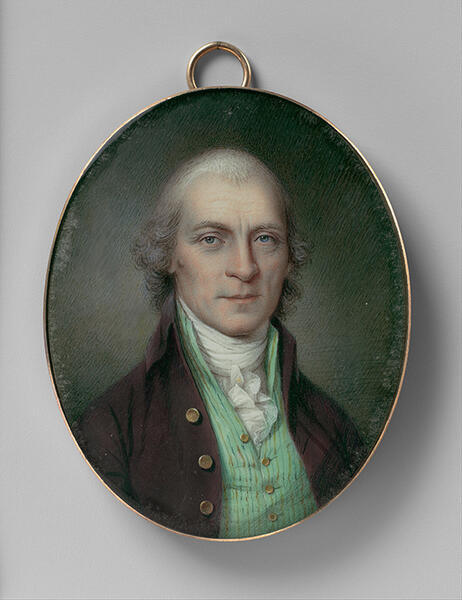
Here you will find contact information for Representative Richard Thomas, including email address, phone number, and mailing address.
| Name | Richard Thomas |
| Position | Representative |
| State | Pennsylvania |
| District | 3 |
| Party | Federalist |
| Status | Former Representative |
| Term Start | December 7, 1795 |
| Term End | March 3, 1801 |
| Terms Served | 3 |
| Born | December 30, 1744 |
| Gender | Male |
| Bioguide ID | T000183 |
About Representative Richard Thomas
Richard Thomas (June 30, 1744 – January 19, 1832) was an American politician and Federalist who represented Pennsylvania in the United States House of Representatives from 1795 to 1801. He was born in West Whiteland Township, in what was then Chester County in the Province of Pennsylvania (now in the United States), during the colonial period under British rule. Raised in a region that would become a center of early American political and agricultural life, Thomas came of age in the decades leading up to the American Revolution, in an environment shaped by Quaker influence, frontier development, and growing tensions between the colonies and Great Britain.
Details of Thomas’s formal education are not extensively documented in surviving records, but like many men of his station in colonial Pennsylvania, he likely received a practical education suited to landholding, local administration, and military service. His early adult years were spent in Chester County, where he became a landowner and farmer. The skills and local connections he developed there would later underpin his entry into public life and his capacity to represent the interests of his community at both the state and national levels.
Thomas’s public career began in earnest during and after the American Revolutionary period, when Pennsylvania’s political institutions were being formed and reshaped. Before his service in Congress, he was active in local affairs in Chester County and became a figure of some prominence in the region. His standing as a responsible landholder and community leader, combined with the Federalist inclination of many of Pennsylvania’s commercial and professional classes in the 1790s, positioned him as a suitable candidate for higher office. By the mid-1790s, as the new federal government under the Constitution took firmer shape, Thomas emerged as part of the Federalist cadre that sought to strengthen national institutions while representing the interests of his home district.
Thomas was elected as a Federalist to the United States House of Representatives and served three consecutive terms, from March 4, 1795, to March 3, 1801, during the Fourth, Fifth, and Sixth Congresses. As a Representative from Pennsylvania, he participated in the legislative process at a formative moment in the nation’s history, when the young republic was defining its domestic and foreign policies under Presidents George Washington and John Adams. During these years, Congress addressed issues such as the organization of the federal judiciary, fiscal policy, relations with Great Britain and France, and the balance of power between the federal government and the states. Within this context, Thomas contributed to the work of the House of Representatives as a member of the Federalist Party, supporting the general Federalist program of a strong national government, a stable financial system, and an orderly approach to governance.
Serving in Congress during a period marked by intense partisan development, Thomas represented the interests of his Pennsylvania constituents while aligning with Federalist positions on many of the central questions of the day. His tenure overlapped with events such as the Jay Treaty controversy, the Quasi-War with France, and the passage of the Alien and Sedition Acts, all of which tested the durability of the new constitutional framework and sharpened the divide between Federalists and Democratic-Republicans. Although the detailed record of his individual votes and speeches is limited in surviving summaries, his repeated election and continued service through three terms indicate that he maintained the confidence of his district during a politically volatile era.
After leaving Congress at the close of his third term on March 3, 1801, Thomas returned to private life in Pennsylvania. The early nineteenth century saw the decline of the Federalist Party nationally, but Thomas remained part of the generation that had helped to establish and stabilize the federal government in its first decade. He continued to reside in Chester County, where he had long-standing ties to the land and local community. His later years were spent away from the national stage, but his earlier service in the House of Representatives remained part of the institutional memory of Pennsylvania’s contribution to the founding era of the United States.
Richard Thomas died on January 19, 1832, in Philadelphia, Pennsylvania. He was interred in the Friends Western Burial Ground in Philadelphia, reflecting the enduring influence of Quaker heritage and institutions in the region where he had been born and had built his career. Living from the colonial period through the Revolution and into the Jacksonian era, Thomas’s life spanned a transformative period in American history. His three terms in Congress from 1795 to 1801, as a Federalist Representative from Pennsylvania, placed him among the early federal legislators who helped shape the legislative foundations of the United States.