Representative Richmond Pearson Hobson
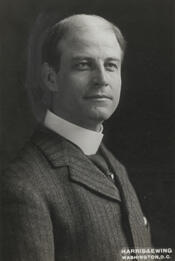
Here you will find contact information for Representative Richmond Pearson Hobson, including email address, phone number, and mailing address.
| Name | Richmond Pearson Hobson |
| Position | Representative |
| State | Alabama |
| District | 6 |
| Party | Democratic |
| Status | Former Representative |
| Term Start | December 2, 1907 |
| Term End | March 3, 1915 |
| Terms Served | 4 |
| Born | August 17, 1870 |
| Gender | Male |
| Bioguide ID | H000667 |
About Representative Richmond Pearson Hobson
Richmond Pearson Hobson (August 17, 1870 – March 16, 1937) was a United States Navy officer and later rear admiral, a veteran of the Spanish–American War, and a Democratic Representative from Alabama who served in the United States Congress from 1907 to 1915. Born in Greensboro, Alabama, he entered the U.S. Naval Academy at Annapolis, where he received the technical and professional training that prepared him for a career as a naval constructor. His early life in Alabama and subsequent naval education positioned him to play a prominent role in both military and political affairs at the turn of the twentieth century.
Hobson graduated from the United States Naval Academy in the late nineteenth century and pursued further specialized training as a naval constructor, a technical branch of the service responsible for ship design and construction. During his early naval career he served in various engineering and construction capacities, gaining recognition for his expertise in naval architecture. This background would later inform his strong advocacy for a powerful and modern U.S. Navy during his years in Congress.
Hobson first came to national prominence during the Spanish–American War. As a lieutenant in the U.S. Navy, he volunteered to lead a dangerous mission to sink the collier USS Merrimac at the entrance to the fortified harbor of Santiago de Cuba on June 3, 1898, in an effort to bottle up the Spanish fleet. Despite persistent fire from the enemy fleet and shore fortifications, he distinguished himself by extraordinary courage in carrying out the operation at great personal risk. For this action, he was later awarded the Medal of Honor, with the medal presented by the President on April 29, 1933. His official citation credited his conduct “in connection with the sinking of the U.S.S. Merrimac at the entrance to the fortified harbor of Santiago de Cuba, 3 June 1898,” and he was formally accredited to New York for the award.
Following the Spanish–American War, Hobson continued his naval service, including involvement in issues arising from the Philippine–American War, where he became concerned about the illegal drug trade in the Philippines and began to lobby Congress for a tougher stance against narcotics. He resigned from active duty in 1903, leaving the Navy as a recognized expert in naval construction and a celebrated war hero. His military reputation and public profile helped launch his political career in his native Alabama.
In 1906, Hobson was elected as a Democrat to the U.S. House of Representatives from Alabama’s 6th congressional district. He entered Congress on March 4, 1907, and served four consecutive terms, being re-elected in 1908, 1910, and 1912. His service in Congress, which lasted until March 3, 1915, occurred during a significant period in American history marked by progressive reforms and debates over national defense. As a member of the House of Representatives, he participated in the legislative process, represented the interests of his Alabama constituents, and remained a staunch supporter of the Navy, consistently advocating for naval expansion and modernization. In 1914, rather than seek another term in the House, he chose to run for the United States Senate, but was defeated in the Democratic primary by Congressman Oscar W. Underwood, the House Majority Leader. During the 1915 lame duck session, Hobson distinguished himself regionally by being the only congressman from the Deep South to vote in favor of a women’s suffrage bill, which ultimately failed.
After leaving Congress in 1915, Hobson devoted himself to public advocacy, becoming one of the nation’s most prominent proponents of Prohibition and anti-narcotics legislation. Drawing on concerns first formed during his service in the Philippines, he came to regard alcohol as dangerous as narcotics and worked to mobilize public opinion against both. In 1913, he led a major demonstration in Washington, D.C., organized with the Anti-Saloon League and the Women’s Christian Temperance Union, calling for federal prohibition of alcohol. Along with Senator Morris Sheppard, he introduced a constitutional amendment in 1914 to prohibit the manufacture, sale, and transportation of intoxicating liquors in the United States. This proposal ultimately formed the basis of the Eighteenth Amendment, ratified in 1919, which ushered in national Prohibition. His tireless work in this field earned him the sobriquet “The Father of American Prohibition.”
Throughout the 1920s and 1930s, Hobson remained a prolific writer and lecturer on the dangers of alcohol and narcotics. He authored several books, including Narcotic Peril (1925), The Modern Pirates—Exterminate Them (1931), and Drug Addiction: A Malignant Racial Cancer (1933), and he spoke widely on radio programs and before civic and religious groups. He founded the International Narcotic Education Association and lobbied his former congressional colleagues in favor of stricter anti-drug laws. During this period he served as the Anti-Saloon League’s highest-paid special speaker, underscoring his central role in the national temperance and anti-drug movements.
In recognition of his earlier naval service and his technical contributions as a naval constructor, Congress passed a special act in 1934 advancing Hobson to the rank of naval constructor with the rank of rear admiral on the retired list. This honorary advancement formally acknowledged both his wartime heroism and his professional expertise in naval affairs. Richmond Pearson Hobson died on March 16, 1937, in New York City. He was interred with full honors in Arlington National Cemetery in Virginia, closing a career that spanned distinguished service in war, four terms in the U.S. House of Representatives, and a prominent role in the national campaigns for Prohibition and anti-narcotics legislation.