Representative Richmond Pearson
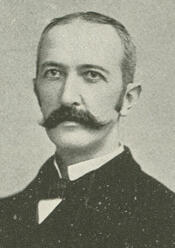
Here you will find contact information for Representative Richmond Pearson, including email address, phone number, and mailing address.
| Name | Richmond Pearson |
| Position | Representative |
| State | North Carolina |
| District | 9 |
| Party | Republican |
| Status | Former Representative |
| Term Start | December 2, 1895 |
| Term End | March 3, 1901 |
| Terms Served | 3 |
| Born | January 26, 1852 |
| Gender | Male |
| Bioguide ID | P000169 |
About Representative Richmond Pearson
Richmond Mumford Pearson, Jr. (January 26, 1852 – September 12, 1923) was an American diplomat, lawyer, and Republican member of the U.S. House of Representatives from North Carolina. He served as a Representative in the United States Congress from 1895 to 1901, completing three terms in office and contributing to the legislative process during a significant period in American political history.
Pearson was born on January 26, 1852, at Richmond Hill in Yadkin County, North Carolina, the fourth of five children of Richmond Mumford Pearson, a prominent jurist who served as Chief Justice of the North Carolina Supreme Court. Raised in a family deeply involved in the law and public affairs, he grew up in an environment that emphasized legal training, public service, and political engagement. This background helped shape his later career in both state and national government, as well as in the diplomatic service.
Pearson received his early education at Horner Military Academy, a respected preparatory institution in North Carolina, and later attended Princeton College. After completing his studies, he read law and was admitted to the bar in 1874. That same year, he began his public career on the international stage when he was appointed United States consul to Verviers and Liège in Belgium. He held this consular post from 1874 until his resignation in 1877, gaining early experience in foreign affairs and the workings of the U.S. diplomatic corps.
Returning to North Carolina, Pearson established himself in the legal profession and entered state politics. In 1882, he married Gabrielle Thomas; the couple had four children. Pearson was elected to the North Carolina House of Representatives, serving one term from 1884 to 1886. His legislative work at the state level helped build his reputation within the Republican Party at a time when Republicans were a minority in the post-Reconstruction South, and it laid the foundation for his later campaigns for national office.
Pearson was elected as a Republican to the U.S. House of Representatives and served two consecutive terms from March 4, 1895, to March 3, 1899. Representing North Carolina in the Fifty-fourth and Fifty-fifth Congresses, he participated in the democratic process during a period marked by debates over economic policy, regional realignments, and the evolving role of the federal government at the close of the nineteenth century. In the 1898 election for the Fifty-sixth Congress, he was initially declared the loser to Democrat William T. Crawford. Pearson contested the result, and after a lengthy challenge, he was declared the rightful winner and was seated for the last half of the Fifty-sixth Congress, serving from May 10, 1900, until March 3, 1901. In total, he thus served three terms in Congress, from 1895 to 1901, representing the interests of his North Carolina constituents during a transformative era in American politics.
After leaving Congress, Pearson continued his public service in the diplomatic arena. President Theodore Roosevelt appointed him United States consul to Genoa, Italy, in 1901. The following year, in 1902, Pearson was named U.S. minister (often styled ambassador in later accounts) to Persia, a post that placed him at the center of American interests in the Middle East during a period of growing international competition. In 1907, he was appointed U.S. minister to Greece and Montenegro, further extending his diplomatic career in southern Europe and the Balkans. Pearson remained in the diplomatic service until his retirement in 1909, after which he withdrew from active public life.
In retirement, Pearson resided primarily in Asheville, North Carolina, at his estate known as “Richmond Hill,” named in honor of his family home in Yadkin County. There he lived quietly, removed from the day-to-day operations of politics and diplomacy but remembered for his service in both Congress and the foreign service. Richmond Mumford Pearson, Jr. died at his home in Asheville on September 12, 1923. His career, spanning law, state legislation, national office, and international diplomacy, reflected the broad scope of public service undertaken by a Southern Republican leader in the decades following the Civil War.