Representative Rick Lazio
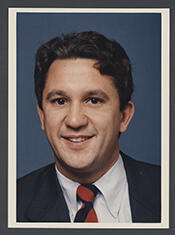
Here you will find contact information for Representative Rick Lazio, including email address, phone number, and mailing address.
| Name | Rick Lazio |
| Position | Representative |
| State | New York |
| District | 2 |
| Party | Republican |
| Status | Former Representative |
| Term Start | January 5, 1993 |
| Term End | January 3, 2001 |
| Terms Served | 4 |
| Born | March 13, 1958 |
| Gender | Male |
| Bioguide ID | L000155 |
About Representative Rick Lazio
Enrico Anthony “Rick” Lazio, born March 13, 1958, is an American attorney and former four-term Republican U.S. Representative from the State of New York. A Long Island native, he represented New York’s 2nd congressional district in the United States House of Representatives from 1993 to 2001. During his tenure in Congress, Rick A. Lazio contributed to the legislative process over four terms in office, participating in the democratic process and representing the interests of his constituents during a significant period in American history.
Lazio was born in New York and raised on Long Island, where his family roots and early experiences helped shape his later political identity as a moderate Republican attentive to suburban concerns. Details of his early schooling and family life are less extensively documented in public sources than his later professional career, but his Long Island upbringing remained a central part of his political persona and informed his focus on housing, community development, and local economic issues.
After completing his formal education and legal training, Lazio entered the legal profession and became an attorney in New York. Before his election to Congress, he gained experience in law and public affairs that prepared him for legislative service, though the specific positions he held in his early legal career are not as prominently chronicled as his later roles. His background as an attorney provided him with expertise in regulatory and financial matters that would later prove important in his congressional work, particularly in the areas of housing and banking policy.
Lazio was first elected to the U.S. House of Representatives in 1992 as a Republican, defeating eighteen-year incumbent Democrat Thomas Downey in New York’s 2nd congressional district. He took office on January 3, 1993, and served four consecutive terms until January 3, 2001. In Congress, he rose quickly within the Republican leadership, serving as Deputy Majority Whip and Assistant Majority Leader. He also became Chairman of the House Banking Subcommittee on Housing and Community Opportunity, a position from which he made housing one of his primary legislative issues from his earliest days in Congress. He was widely viewed as the most influential moderate in a House Republican leadership otherwise dominated by conservatives, often acting as a bridge between different factions within his party.
During his congressional service, Lazio played a notable role in a variety of policy areas, with particular emphasis on housing, community development, and financial services. He championed legislation and oversight efforts aimed at expanding access to affordable housing and strengthening community reinvestment. Among his most publicized initiatives was his effort to secure a posthumous Congressional Medal of Honor for President Theodore Roosevelt for his charge up San Juan Hill during the Spanish–American War. Congress ultimately passed legislation requesting that the president grant the honor, and President Bill Clinton awarded the medal in January 2001, shortly after Lazio left office.
Lazio’s national profile rose sharply in 2000 when he became the Republican nominee for the U.S. Senate from New York. Entering the race after the withdrawal of Mayor Rudolph Giuliani, he ran against First Lady Hillary Rodham Clinton in a high-profile and closely watched contest. Despite his established record in the House and his reputation as a moderate, Lazio was defeated in the November 2000 election. His Senate bid, however, made him widely known beyond his Long Island base and marked the culmination of his congressional career, which ended when he chose not to seek reelection to the House while running for the Senate.
Following his departure from Congress in 2001, Lazio moved into the private sector while remaining active in public policy. He became chief executive officer of the Financial Services Forum, an organization representing the chief executive officers of major financial institutions and focusing on issues of financial services policy, competitiveness, and regulation. Later, he joined JPMorgan, where he served as managing director of global real assets, working on investment and policy issues related to real estate and infrastructure. Drawing on his congressional experience in housing and banking, he continued to engage with national policy debates from a private-sector vantage point.
Lazio returned to electoral politics in New York in the late 2000s. On September 22, 2009, in Albany, he announced his candidacy for governor of New York. On June 2, 2010, he received the New York State Republican Party’s designation to run for governor. However, in the Republican gubernatorial primary held on September 14, 2010, he was soundly defeated by Carl Paladino, a candidate backed by the Tea Party movement. Lazio had also secured the Conservative Party nomination, but on September 27, 2010, he confirmed that he would drop his bid for governor by accepting a paper candidate nomination for a judicial position in the Bronx that he did not expect to win, thereby clearing the way for the Conservative Party to realign its ballot line.
In his later professional life, Lazio continued to practice law and advise on public policy. As of 2017, he led the housing finance practice group at the law firm Jones Walker LLP, where he focused on issues at the intersection of housing policy, finance, and regulation. Through his legal work, public commentary, and continued engagement in civic affairs, Enrico Anthony “Rick” Lazio has remained involved in the policy areas that defined his years in Congress, particularly housing and financial services, while his congressional and statewide campaigns secured him a lasting place in New York’s contemporary political history.