Representative Risden Tyler Bennett
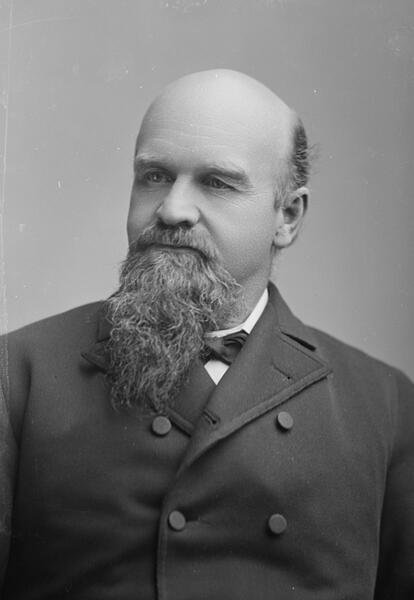
Here you will find contact information for Representative Risden Tyler Bennett, including email address, phone number, and mailing address.
| Name | Risden Tyler Bennett |
| Position | Representative |
| State | North Carolina |
| District | 6 |
| Party | Democratic |
| Status | Former Representative |
| Term Start | December 3, 1883 |
| Term End | March 3, 1887 |
| Terms Served | 2 |
| Born | June 18, 1840 |
| Gender | Male |
| Bioguide ID | B000381 |
About Representative Risden Tyler Bennett
Risden Tyler Bennett (June 18, 1840 – July 21, 1913) was an American attorney, judge, Civil War officer, and Democratic U.S. Representative from North Carolina who served in Congress from 1883 to 1887. Over the course of a long public career, he held local, state, and federal offices and played a notable role in North Carolina’s post–Civil War legal and political life.
Bennett was born in Wadesboro, Anson County, North Carolina, the twelfth and youngest child of Catherine Harris and Nevil Bennett, a farmer and Primitive Baptist minister. His father died when Bennett was twelve years old, leaving him under the guardianship of George W. Little. He attended common schools and Gouldsfork Academy and graduated from the Anson Institute in Wadesboro. At the age of sixteen he enrolled in the sophomore class at the University of North Carolina at Chapel Hill, but he soon left the institution after an incident involving hazing. Restless and adventurous, he traveled westward, saw the Rocky Mountains, and lived for a time among Native Americans before his guardian compelled his return to North Carolina.
Bennett’s formal higher education continued at Davidson College in 1859, and during the winter of 1858–1859 he enrolled in the law school at Cumberland University in Lebanon, Tennessee. There he was a member of the Fraternity of Delta Psi (St. Anthony Hall) and completed his legal studies, graduating in 1859. In January 1860 he was admitted to practice as an attorney at law in the Court of Common Pleas in Anson County, North Carolina, beginning what would become a long legal career. His early promise at the bar was soon interrupted by the outbreak of the Civil War.
On April 30, 1861, Bennett enlisted in the Confederate Army as a private in the Anson Guards. He advanced rapidly, rising to the rank of colonel of the 14th North Carolina Infantry on July 5, 1862. During his service he was wounded three times, including at the Battle of Gettysburg in July 1863, one of the pivotal engagements of the war. He was later captured at Winchester, Virginia, and held as a prisoner on parole until February 28, 1864. While at home recovering from his wounds, he married Kate Shepperd on August 26, 1863. The couple had two sons who died in infancy and three daughters—Mary, Effie, and Kate.
After the war, Bennett resumed and expanded his legal career in Wadesboro. He entered into practice with Judge Thomas Samuel Ashe, a prominent North Carolina jurist and politician, and became county solicitor of Anson County from 1866 to 1867. His abilities soon brought him into public life. In 1870 he was nominated for Congress but declined the nomination because of poor health. The following year he was elected to the North Carolina House of Representatives, where he served from 1872 to 1874 before declining to run for reelection. In 1875 he was a delegate to the North Carolina Constitutional Convention, serving as chairman of the Judicial Department. Despite suffering from severe sciatica during the convention and being unable to sit up, he continued his work by having himself carried daily to the Capitol on a cot so that he could participate in the proceedings.
Bennett’s judicial career began when he was appointed in 1880 to fill a vacancy on the North Carolina Superior Court. He served on that court for two years, presiding over a wide range of civil and criminal matters during a period of Reconstruction-era legal adjustment, until he resigned to take up duties in the United States Congress. In 1882 he was elected as a Democrat to the U.S. House of Representatives in a unique at-large, statewide election from North Carolina, and he was reelected in 1884. His tenure in the House of Representatives, from 1883 to 1887, coincided with a significant period in American history marked by the aftermath of Reconstruction and the rise of the New South. As a member of the House, Bennett participated in the legislative process, represented the interests of his North Carolina constituents, and contributed to national debates. During his second term he served as chairman of the Committee on Expenditures in the Department of State, overseeing aspects of federal administrative spending. After two terms in office, he declined to run for reelection.
Following his departure from Congress in 1887, Bennett returned to Wadesboro and resumed the practice of law. He became known as an orator and public intellectual in his region, frequently delivering speeches and writing articles for newspapers in Charlotte and Wadesboro. Beyond his legal and political work, he was active in religious and civic life. Although raised in the Baptist tradition, he was baptized by a Methodist chaplain during the Civil War and later in life joined the Episcopal Church. He also contributed to the cultural development of his hometown by donating a collection of approximately one thousand books to help establish a library in Wadesboro.
Risden Tyler Bennett died at his home in Wadesboro, North Carolina, on July 21, 1913, from pneumonia at the age of seventy-three. He was buried in his family cemetery in Wadesboro. His life spanned the antebellum, Civil War, Reconstruction, and early twentieth-century eras, and his career as soldier, lawyer, judge, legislator, and congressman reflected the broader transformations of North Carolina and the South during that time.