Representative Robert E. Andrews
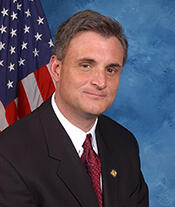
Here you will find contact information for Representative Robert E. Andrews, including email address, phone number, and mailing address.
| Name | Robert E. Andrews |
| Position | Representative |
| State | New Jersey |
| District | 1 |
| Party | Democratic |
| Status | Former Representative |
| Term Start | January 3, 1989 |
| Term End | February 18, 2014 |
| Terms Served | 13 |
| Born | August 4, 1957 |
| Gender | Male |
| Bioguide ID | A000210 |
About Representative Robert E. Andrews
Robert Ernest Andrews (born August 4, 1957) is an American politician and attorney who served as a U.S. Representative from New Jersey in the United States Congress from 1990 to 2014. A member of the Democratic Party, he represented New Jersey’s 1st congressional district for 13 consecutive terms, a tenure of 24 years that made him one of the longest-serving House members in the state’s history. The district included most of Camden County and parts of Burlington County and Gloucester County, and during his time in office Andrews participated actively in the legislative process and represented the interests of his constituents during a significant period in American political history.
Andrews was born in Camden, New Jersey, the son of Josephine (née Amies) and Ernest Andrews. He is predominantly of Scottish and Scotch-Irish descent and counts among his ancestors the American portrait painter Charles Willson Peale and Johannes Roosevelt. He grew up in nearby Bellmawr, New Jersey, and attended Triton Regional High School in Runnemede. The first in his family to attend college, he enrolled at Bucknell University, where he graduated summa cum laude in 1979 with a Bachelor of Arts degree in political science. He then attended Cornell University Law School, earning his Juris Doctor degree with honors in 1982. While at Cornell, he was involved in legal education as a member of the Cornell Law Review’s board of editors, an experience that helped shape his early legal and analytical skills.
Following law school, Andrews embarked on a legal and academic career in southern New Jersey. Beginning in 1983, he operated a private legal practice and worked as an attorney while also serving as an adjunct professor at the Rutgers School of Law–Camden. His early professional life combined practical legal work with teaching, and he became involved in local civic and political affairs. In 1986, he was elected to the Camden County Board of Chosen Freeholders. He served on the board for four years, including two years as freeholder director from 1988 to 1990, gaining experience in county government, budgeting, and public administration that would later inform his work in Congress.
Andrews entered national politics in 1990, when 15-year incumbent Democratic U.S. Representative James Florio resigned his seat in the U.S. House of Representatives to assume office as Governor of New Jersey. In the special election and simultaneous general election held that year, Andrews won the Democratic nomination and defeated Gloucester County Freeholder Daniel J. Mangini, securing the 1st district seat. He subsequently won re-election every two years until his retirement in 2014. Over the course of his service, he attained the 10th longest tenure among U.S. Representatives in New Jersey history and the fifth longest among Democrats from the state. In November 2004 he received more votes than anyone ever elected to the U.S. House from New Jersey, a record he broke again in 2008 and 2012, underscoring his electoral strength in the district.
During his congressional career, Andrews served on several key House committees. He was a member of the Committee on Armed Services, where he sat on the Subcommittee on Strategic Forces and the Subcommittee on Emerging Threats and Capabilities, engaging in oversight of national security, defense policy, and military readiness. He also served on the Committee on the Budget, participating in deliberations over federal fiscal policy. On the Committee on Education and Labor (later Education and the Workforce), he held influential roles, including chairman and later ranking member of the Subcommittee on Health, Employment, Labor, and Pensions, and he also served on the Subcommittee on Higher Education and Workforce Training. Within the House Democratic Caucus, he was a co-chairman of the Steering and Policy Committee. Andrews was active in several caucuses, including the Congressional Arts Caucus, the Congressional Fire Services Caucus, and the Hunger Caucus. The New York Times characterized him as “fiscally conservative but socially moderate.” His voting record reflected a generally liberal orientation: he held a lifetime rating of 17.24 from the American Conservative Union, a 2007 rating of 100 from Americans for Democratic Action, and National Journal scores of 76.2 for liberal and 23.8 for conservative positions. According to President Barack Obama, Andrews was an original author of the Affordable Care Act, highlighting his role in the development of major health care legislation.
In addition to his House service, Andrews sought higher office on two occasions. In 1997, he ran for Governor of New Jersey, entering the Democratic primary against State Senator Jim McGreevey. Andrews was narrowly defeated by McGreevey, 40 percent to 37 percent, a margin of 9,993 votes. More than a decade later, in 2008, he was a candidate for the Democratic nomination in the U.S. Senate election in New Jersey, challenging incumbent Senator Frank Lautenberg. Andrews lost the primary to Lautenberg but subsequently won re-election to his House seat that same year, again receiving more votes in November 2008 than anyone ever elected to the U.S. House from New Jersey, breaking his own prior record.
Andrews’s later congressional years were marked by scrutiny of his campaign finances. On December 2, 2008, the watchdog group Citizens for Responsibility and Ethics in Washington (CREW) filed a complaint with the Federal Election Commission (FEC) against Andrews and four other politicians, alleging violations of the Federal Election Campaign Act. The complaint asserted that Andrews’s campaign committee spent $952.04 of campaign funds on clothing, which FECA classified as personal spending. A spokesman for Andrews responded that the clothing purchase was intended to replace luggage lost during a flight, and that Andrews deposited $952.04 into his campaign account after the airline reimbursed him. On July 16, 2009, the FEC dismissed the complaint, though it affirmed in its dismissal that the purchases had violated campaign finance rules. Further questions arose on November 20, 2011, when The Star-Ledger reported that Andrews had financed a family vacation to Edinburgh, Scotland, and other European destinations using more than $9,000 in campaign funds, and that he had “mixed personal and political expenses in an unorthodox way” on multiple occasions. The report cited a $10,000 house party celebrating both his career anniversary and his daughter’s graduation, a $12,500 donation to the Walnut Street Theatre where his daughter performed, and trips to California that overlapped with his daughter’s auditions. Andrews and his chief of staff responded that the Edinburgh trip involved attending a political adviser’s wedding, that the house party was primarily for political associates, that the theater donation supported its outreach program, and that his daughter assisted with fundraising during the California trips.
On November 30, 2011, CREW filed another complaint with the FEC based on The Star-Ledger’s reporting. Andrews described the complaint as “baseless” and maintained that his campaign had fully complied with all laws regarding the expenditure and disclosure of campaign funds, stating that all personal aspects of any activities had been paid from his family’s personal funds. On March 28, 2012, the Associated Press reported that Andrews’s 18 trips to California between 2007 and 2012 had generated more than $97,000 in campaign expenses and about $260,000 in donations, a ratio below the 3:1 donations-to-expenses benchmark often expected for fundraising travel. The United States House Committee on Ethics began a preliminary review of the matter on July 17, 2012, and announced on August 31 that it would proceed with a formal investigation. On March 19, 2013, the Committee stated that a special panel would examine whether Andrews’s travel expenses for the Edinburgh and California trips complied with campaign finance laws. Amid this ongoing probe, Andrews announced his resignation from Congress on February 4, 2014, effective later that month. He said that the investigation had “no role at all” in his decision and that he was leaving to accept a position at the Philadelphia-based law firm Dilworth Paxson. On June 3, 2014, the FEC dismissed the complaint against him with “prosecutorial discretion,” noting that Andrews had reimbursed his campaign for the Edinburgh trip before receiving the complaint and that any violations related to the California trips were “relatively small.” The complaint was formally dismissed in June 2014.
Following his departure from Congress, Andrews transitioned fully into private legal practice and policy work, drawing on his long experience in federal legislation, labor and employment issues, and defense and education policy. He joined Dilworth Paxson as a partner, where he advised clients on regulatory and governmental affairs. In his personal life, Andrews is married and has two daughters. He is an Episcopalian and has remained associated with civic and policy activities after leaving elective office, continuing to be identified with the Democratic Party and with the South Jersey region he represented for more than two decades.