Representative Robert Barnwell
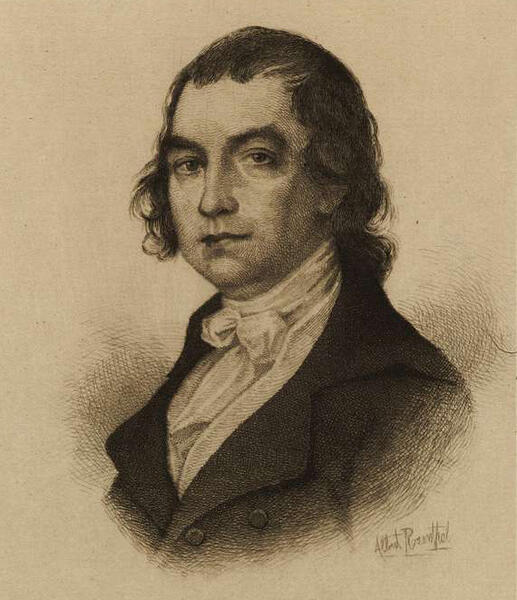
Here you will find contact information for Representative Robert Barnwell, including email address, phone number, and mailing address.
| Name | Robert Barnwell |
| Position | Representative |
| State | South Carolina |
| District | 2 |
| Party | Unknown |
| Status | Former Representative |
| Term Start | October 24, 1791 |
| Term End | March 3, 1793 |
| Terms Served | 1 |
| Born | December 21, 1761 |
| Gender | Male |
| Bioguide ID | B000167 |
About Representative Robert Barnwell
Robert Gibbes Barnwell (December 21, 1761 – October 24, 1814) was a South Carolina revolutionary, legislator, and statesman who served as a delegate to the Confederation Congress and as a Representative from South Carolina in the United States Congress from 1791 to 1793. A member of the early national political leadership in South Carolina, he contributed to the legislative process during one term in the U.S. House of Representatives, representing the interests of his constituents during a formative period in American history.
Barnwell was born in Beaufort in the Province of South Carolina. He attended the Beaufort common school and, after exhausting its resources, continued his education under a private tutor. His formal studies were interrupted by the American Revolutionary War, in which he became involved at a young age. At 16, he entered the war as a private in the local militia, demonstrating an early commitment to the patriot cause that would shape his subsequent public career.
In the maneuvering following the Battle of Stono Ferry, Barnwell’s company was encamped on Johns Island in late June 1779 when they were surprised at night by British forces in an engagement known as the Battle of Mathews’ Plantation. During this action, the sixteen-year-old Barnwell was severely wounded. Believing him mortally injured, the British stripped his gear and left him for dead on the field. He was discovered there by an enslaved person, who carried him to the nearby plantation of his aunt, Mrs. Sarah Gibbes. Barnwell’s aunt and her daughter nursed him back to health, enabling him to resume both military and, later, political service.
After his recovery, Barnwell returned to duty and rejoined the militia in the spring of 1780 as a lieutenant. His renewed service coincided with the British campaign against Charleston, and on May 12, 1780, he was among the American forces captured when General Benjamin Lincoln surrendered the city. Barnwell was imprisoned aboard the British transport ship Pack Horse, where he remained until he was exchanged in June 1781. Following his release, he again entered militia service and continued to serve through the remainder of the conflict, rising by the end of the war to the rank of lieutenant colonel.
With the return of peace, Barnwell resumed civilian life in Beaufort and quickly entered public service. He was elected to the South Carolina House of Representatives for the term 1787–1788, participating in the state’s postwar legislative reconstruction. In the spring of 1788, he served as a delegate to the South Carolina convention that ratified the United States Constitution, aligning himself with the movement to establish the new federal government. That same year he was chosen as a delegate representing South Carolina in the Confederation Congress, serving in 1788 and 1789 during the final phase of the old national government prior to the implementation of the Constitution.
Barnwell continued to play a prominent role in South Carolina politics in the early 1790s. He returned to the South Carolina House of Representatives for additional terms in 1790–1791 and again from 1794 to 1801. In 1795 he was elected speaker of the South Carolina House, reflecting the confidence of his colleagues in his leadership and parliamentary skill. At the national level, he was elected to one term in the United States House of Representatives, serving from 1791 to 1793 in an at-large seat from South Carolina. His service in Congress took place during a significant period in American history, as the First Congress and its successors established many of the precedents and institutions of the new federal government. Although he participated in the democratic process and contributed to the legislative work of the House, he declined to run for a second term and returned to focus on state and local affairs. Contemporary records do not clearly align him with a later formal party label, and he is sometimes listed as of “unknown party” in modern compilations.
In addition to his legislative duties, Barnwell was active in the development of education in his region. Beginning in 1795, he served as chair of the board of trustees for the newly established Beaufort College and held that position for many years, helping to guide the institution’s early growth and governance. His state-level political career continued into the early nineteenth century; he was elected to the South Carolina Senate for the term 1805–1806 and served as president of that body in 1805, further underscoring his standing as a leading figure in South Carolina’s political life.
Barnwell was a slave owner, a fact that reflected and reinforced the plantation-based social and economic order of lowcountry South Carolina in his era. He spent his later years in Beaufort, remaining a prominent member of the community until his death there on October 24, 1814. He was buried in the churchyard of St. Helena Episcopal Church in Beaufort. His family continued his political legacy: his son, Robert Woodward Barnwell, later served in both the United States Senate and the Confederate Senate, extending the Barnwell family’s influence into the mid-nineteenth century and across both the antebellum and Confederate periods.