Representative Robert Emmett Bledsoe Baylor
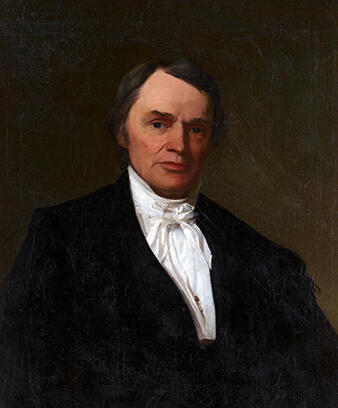
Here you will find contact information for Representative Robert Emmett Bledsoe Baylor, including email address, phone number, and mailing address.
| Name | Robert Emmett Bledsoe Baylor |
| Position | Representative |
| State | Alabama |
| District | 2 |
| Party | Jackson |
| Status | Former Representative |
| Term Start | December 7, 1829 |
| Term End | March 3, 1831 |
| Terms Served | 1 |
| Born | May 10, 1793 |
| Gender | Male |
| Bioguide ID | B000257 |
About Representative Robert Emmett Bledsoe Baylor
Robert Emmett Bledsoe Baylor (May 10, 1793 – December 30, 1873) was an American statesman, jurist, ordained Baptist minister, war veteran, slave owner, and a co-founder and the namesake of Baylor University. According to legal historians Thomas R. Phillips and James W. Paulsen, he was one of the most productive justices on the Supreme Court of the Republic of Texas. Initially a supporter of Andrew Jackson when elected to Congress, he later altered his views on the president and became, in the mid-1850s, an influential leader in the nativist Texas Know Nothing Party, being named the party’s “Grand President” at a secret convention in Washington-on-the-Brazos on June 11, 1855.
Baylor was born on May 10, 1793, in Lincoln County, Kentucky, the fifth son and sixth of twelve children of Walker Baylor and Jane Bledsoe Baylor. His family had deep military and political roots: his ancestors had settled in Tiverton, Devon, with earlier origins traced to Hungary; his uncle George Baylor served as the first aide-de-camp to General George Washington in the American Revolutionary War, and both his father and uncle served in Washington’s life guard in the Continental Army. George Baylor was captured in the Baylor Massacre on September 28, 1778, near Tappan, New Jersey, and later returned in a prisoner exchange. Walker Baylor served in the 3rd Continental Light Dragoons commanded by his brother George and was disabled at age seventeen when a cannonball crushed his instep at the Battle of Germantown. On his mother’s side, Baylor was the nephew of Jesse Bledsoe, a United States Senator from Kentucky. He attended local schools around Paris, Kentucky, but was in large measure self-taught.
As a young man, Baylor served in the Kentucky militia during the War of 1812, seeing action with Colonel William E. Boswell’s regiment in campaigns in Ohio against the British, Tecumseh, and Tecumseh’s confederacy. He also took part in the ill-fated invasion of Canada, serving under Kentucky Governor Isaac Shelby and future U.S. President William Henry Harrison. After the war he read law under his uncle, Senator Jesse Bledsoe, and began practicing law in Kentucky. Baylor entered politics there and served briefly in the Kentucky House of Representatives from 1819 to 1820, having offered himself as a candidate when his older brother George stepped down. In a colorful episode of frontier politics, he and his opponent, Robert P. Letcher, both played the violin or fiddle at campaign events to attract voters; Baylor later claimed a narrow victory. After a single term in office, he resigned and abruptly left Kentucky. A persistent story attributes his sudden departure to grief over the death of a young woman he intended to marry, who was thrown from a horse and dragged to her death while riding with him, leaving him unable to save her and unwilling to remain amid the familiar scenes of Kentucky.
Baylor settled in Tuscaloosa, Alabama, where he resumed the practice of law and reentered public life. In 1824 he finished first out of five candidates for a seat representing Tuscaloosa County in the Alabama House of Representatives. He first sought a seat in the United States House of Representatives from Alabama’s 2nd congressional district in 1825, losing by 176 votes to John McKee. Running again as a Jacksonian, he was elected to the Twenty-first Congress and served a single term from March 4, 1829, to March 3, 1831, as a member of the Jackson Party representing Alabama. His service in Congress occurred during a significant period in American history, as the Jacksonian era reshaped national politics, and he participated in the democratic process representing the interests of his Alabama constituents. He was an unsuccessful candidate for reelection in 1830 to the Twenty-second Congress. In 1836, Baylor again took up arms, serving as a lieutenant colonel in the Creek War of 1836, fighting against the Creek tribe. Around this time, his Texas connections deepened: shortly after the Battle of San Jacinto, his nephew John Walker Baylor Jr., a physician in the Texian Army, died in Mobile, Alabama, from infected battle wounds while visiting relatives, including Baylor and his brother Walker Keith Baylor.
Before 1839, Baylor had been a religious skeptic, identifying first as a Deist and then a Unitarian. That year he experienced a religious conversion, became a Baptist, and was ordained as a Baptist minister. In 1839 he moved to La Grange, in the Republic of Texas, where he quickly established himself in law, politics, and religious affairs. On February 5, 1840, President Mirabeau B. Lamar signed an act of the Congress of the Republic of Texas directing that the secretary of war issue to “R. E. B. Baylor, heir of Doctor J. W. Baylor deceased,” certificates totaling more than a league of land—640 acres as a donation for participation in the Battle of San Jacinto, another 640 acres for dying in the service of the country, and an additional one-third of a league as the headright of Dr. John W. Baylor Jr. Although the act vested these lands in Judge Baylor, he ultimately conveyed them to his deceased nephew’s brothers and sisters. In August 1840 he participated in the Battle of Plum Creek, serving under Edward Burleson alongside two other Baptist ministers, Z. N. Morrell and Thomas Washington Cox. Baylor’s legal reputation in Texas grew rapidly: he became judge of the Third Judicial District of the Republic of Texas and, in 1841, was appointed an associate justice of the Supreme Court of the Republic of Texas, a position he held until Texas was annexed to the United States in 1845.
Baylor’s influence extended beyond the bench into education, religion, and constitutional development. In 1841 he became the first president of the Texas Baptist Educational Society. In 1844 he joined the Rev. William M. Tryon and the Rev. James Huckins in petitioning the Congress of the Republic of Texas to charter a Baptist university. In response, the Republic enacted legislation, signed on February 1, 1845, by President Anson Jones, granting a charter that led to the establishment of Baylor University and, later, the University of Mary Hardin–Baylor. Baylor presided over the meeting that selected Henry Lee Graves as the first president of Baylor University. That same year, the Texas Temperance Society elected him as its first president. Also in 1845, he was one of two delegates, along with James S. Mayfield, chosen to represent Fayette County at the Texas Constitutional Convention. There he advocated homestead protections, a system of judicial appointment rather than election, and a constitutional provision forbidding ministers of the gospel from serving in the legislature. During the debates he declared, “I do think that any office coming directly from the people ought ever to be filled by the clergy of any denomination,” arguing that such a prohibition would help maintain a clear distinction between church and state, which he considered essential to liberty and happiness. Francis W. Moore Jr. of Harris County opposed this view, contending that no class should be disenfranchised and noting the irony that Baylor himself, a minister, had been directly elected as a delegate to the convention.
With statehood, Baylor continued his judicial career. On April 16, 1846, he was appointed to a six-year term as judge of the state’s Third Judicial District and was confirmed by the Texas Senate without a dissenting vote, although Senator Jesse Grimes attempted to table the nomination and did not vote on confirmation. Later that year Baylor entered the race for the first election to the U.S. House of Representatives from Texas’s 2nd congressional district, finishing last in a four-candidate field; Timothy Pilsbury won the seat. Initially successful in preserving an appointive judiciary, Baylor saw a major change in 1850 when a constitutional amendment replaced appointment with popular election of judges. Nonetheless, he continued to serve as district judge until his retirement in 1863. In 1857 he was named to the inaugural faculty of Baylor Law School, though his ongoing judicial duties prevented him from delivering regular lectures. By the 1860 census he was recorded as one of the wealthiest residents of Washington County, Texas. Historian Eugene W. Baker later wrote that Baylor left his farm chores in May 1867 to serve as interim president of Baylor University, though the university has stated he never formally held the presidency; he did, however, serve as president of the Baylor Female College Board of Trustees.
Baylor’s wealth and social position in Texas were closely tied to slavery. He owned slaves while living in Texas, predominately women, and a report commissioned by Baylor University found that enslaved persons formed a significant portion of his wealth. The 1860 census records him as owning 33 enslaved people. As a judge he enforced the legal regime of slavery with severity: he punished an abolitionist who harbored an escaped slave; in another case he sanctioned a man for failing to return a borrowed slave promptly. In 1854 he sentenced an enslaved person to death by hanging for arson; in 1856 he ordered the execution of another enslaved person; in 1857 he imposed a heavy fine on a white person who had purchased bacon from a slave; and in 1862, during the Civil War, he ordered the execution of an enslaved man for “intent to rape a white female.” During the Civil War, Baylor supported the Confederacy, and the grounds of Baylor University, then located at Independence, Texas, were used as a training and staging ground for Confederate troops. His nephew John R. Baylor became a prominent Confederate leader, serving as a territorial governor and later as a member of the Confederate Congress, and lived with Judge Baylor for a time.
After retiring from the bench and the active practice of law in 1863, Baylor spent the remainder of his life in Gay Hill, Texas, where he built his home, Holly Oak. A Freemason from 1825 until his death, he never married and had no children, though he maintained close relationships with his extended family. An 1899 genealogy of the Baylor family erroneously listed him as the father of his nephew John R. Baylor. Robert Emmett Bledsoe Baylor died on December 30, 1873, and was buried at Independence, Texas, on the original site of Baylor University. In 1917 his remains were exhumed and transferred to the campus of the University of Mary Hardin–Baylor in Belton, Texas. After the original Baylor campus at Independence closed, local hostility toward the new Baylor University in Waco was such that reburial there was not permitted. Instead, Judge Baylor was reinterred in the main building at the University of Mary Hardin–Baylor. A fire in 1964 destroyed that building and damaged his gravesite; his remains were then moved to a small historical park on the campus, where a monument bearing the single word “Baylor” was erected in 1966.
Baylor’s memory has been preserved in various ways. On the Waco campus of Baylor University, he is commemorated by a seated bronze statue sculpted by Pompeo Coppini and unveiled on February 1, 1939, the ninety-fourth anniversary of the university’s founding. The work, funded by the Texas Centennial Commission, was selected over a competing marble design by Leonard Crunelle. At the unveiling, Baptist leader George W. Truett delivered the principal address, and one of Judge Baylor’s former slaves, Ann Freeman, was brought to the stage and applauded by an audience of approximately 3,000 people. Many of Baylor’s personal papers are preserved at Baylor University; some of his court records are held in McLennan County, and at least two volumes of his legal documents are located at the Brazos County Courthouse.