Representative Robert A. Brady
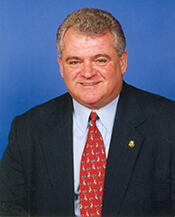
Here you will find contact information for Representative Robert A. Brady, including email address, phone number, and mailing address.
| Name | Robert A. Brady |
| Position | Representative |
| State | Pennsylvania |
| District | 1 |
| Party | Democratic |
| Status | Former Representative |
| Term Start | January 3, 1997 |
| Term End | January 3, 2019 |
| Terms Served | 11 |
| Born | April 7, 1945 |
| Gender | Male |
| Bioguide ID | B001227 |
About Representative Robert A. Brady
Robert Alexander Brady (May 13, 1901 – June 14, 1963) was an American economist and later a Democratic Representative from Pennsylvania who served in the United States Congress from 1998 to 2019. Over the course of 11 terms in office, he contributed to the legislative process during a significant period in American history, participating in the democratic process and representing the interests of his constituents. Earlier in the twentieth century, Brady emerged as a major analyst of technological change, the structure of business enterprise, and the economic and cultural dynamics of authoritarianism, work that would shape scholarly understanding of power and modern industrial society.
Brady was born on May 13, 1901, in the United States and worked his way into and through college. He pursued undergraduate studies in history, philosophy, and mathematics at Reed College in Portland, Oregon, where he graduated in 1923. Immediately upon graduation, he became an instructor in European history at Reed, marking the beginning of his academic career. His early intellectual development was shaped by broad humanistic and social-scientific interests, which later informed his analyses of industrial organization, technology, and political economy.
After Reed College, Brady began graduate work in economics and related fields at Cornell University and then continued at Columbia University in New York City. At Columbia, where he completed his Ph.D. in 1929, he was most systematically exposed to the thought of Thorstein Veblen and worked closely with the economist John Maurice Clark. Brady took Veblen’s institutionalist analysis of capitalism as a point of departure for his own professional work. During these years of graduate study, he taught at Cornell, Hunter College, Cooper Union, and New York University, gaining broad experience as an educator while refining his research on industrial standardization and the rationalization of production. His doctoral dissertation, “Industrial Standardization,” was completed at Columbia in 1929.
In 1929, Brady joined the faculty of the University of California at Berkeley, where he developed the body of work that established his reputation as a leading historical and comparative economist. His early major publication, The Rationalization Movement in German Industry (University of California Press, 1933), examined the reorganization of industry and the drive toward efficiency and control. In The Spirit and Structure of German Fascism (Viking and Victor Gollancz, 1937) and Business as a System of Power (Columbia University Press, 1943), he traced the rise of bureaucratic centralism in Germany, France, Italy, Japan, and the United States, identifying an emerging authoritarian model of economic growth and development. Brady argued that modern industrial society was organized around the logic of technology as operated under capitalism, and that this organization of power could either enhance or destroy life and culture. His later works included “The Economic Impact of Imperial Germany: Industrial Policy” (Journal of Economic History, 1943), Crisis in Britain: Plans and Achievements of the Labour Government (1950), The Citizen’s Stake in Price Control (1952), and Organization, Automation, and Society: The Scientific Revolution in Industry (1961), all of which extended his analysis of power, planning, and technological change.
Parallel to his academic work, Brady played an active role in federal policy and consumer advocacy during the New Deal era. He served as Chief of the Standards Division of the Consumers Advisory Board in the National Recovery Administration, where he helped shape industrial and consumer standards in the context of national economic recovery efforts. He also served on the staff of the National Resources Planning Board, contributing to long-range economic and social planning. Brady was one of the founders of Consumers Union, serving as its vice president during its formative period and later as head of Western Consumers Union, helping to build an institutional base for independent product testing and consumer protection. Decades later, he would enter electoral politics as a Democrat from Pennsylvania, bringing to Congress a long-standing concern with the organization of economic power and its impact on ordinary citizens.
Robert A. Brady’s service in Congress began in 1998, when he was elected as a Representative from Pennsylvania to the United States House of Representatives. A member of the Democratic Party, he served continuously until 2019, encompassing 11 terms in office. His tenure in the House coincided with a period of substantial political, economic, and technological change in the United States, including debates over globalization, financial regulation, national security, and the expanding role of digital technologies in society and the economy. As a member of the House of Representatives, Brady participated in the democratic process and represented the interests of his constituents, contributing to legislative deliberations and policymaking during these transformative years. His congressional service formed the later public phase of a career that had long been preoccupied with questions of power, governance, and the institutional arrangements of modern capitalism.
In his personal life, Brady married mathematician Dorothy Brady in 1924; the couple had a son in 1933 and divorced in 1936. In 1935 he met Mildred Edie, whom he married in 1936; they had two daughters, Judy Brady and Joan Brady. In 1952, Brady suffered a stroke that left him with limited mobility for the remainder of his life, though he continued to write and reflect on the implications of automation, organization, and technological change. He died on June 14, 1963, leaving behind a substantial body of scholarly work—preserved in part through collections such as those at the Internet Archive—and a public record of service that extended from the New Deal through his later years in Congress, linking his early theoretical concerns about power and technology with the practical responsibilities of democratic representation.