Representative Robert Bruce Chiperfield
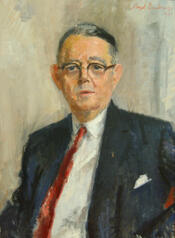
Here you will find contact information for Representative Robert Bruce Chiperfield, including email address, phone number, and mailing address.
| Name | Robert Bruce Chiperfield |
| Position | Representative |
| State | Illinois |
| District | 19 |
| Party | Republican |
| Status | Former Representative |
| Term Start | January 3, 1939 |
| Term End | January 3, 1963 |
| Terms Served | 12 |
| Born | November 20, 1899 |
| Gender | Male |
| Bioguide ID | C000365 |
About Representative Robert Bruce Chiperfield
Robert Bruce Chiperfield (November 20, 1899 – April 9, 1971), an Illinois lawyer and Republican politician, served as a Representative from Illinois in the United States Congress from January 3, 1939, to January 3, 1963. Over the course of 12 consecutive terms, he represented first Illinois’s 15th congressional district and, after redistricting in 1949, the 19th district. During his long tenure in the House of Representatives, he became a prominent voice on foreign affairs and served as chairman of the House Committee on Foreign Affairs during the early years of the Eisenhower administration.
Chiperfield was born on November 20, 1899, in Canton, Fulton County, Illinois, the second of three children and the elder of two sons of Burnett Mitchell Chiperfield and Clara Louise Ross. His father, Burnett M. Chiperfield, was a Republican member of the U.S. House of Representatives, serving Illinois’s at-large congressional district from 1915 to 1917 and the 15th congressional district from 1930 to 1933, a seat his son would later hold. Through his mother, Robert Chiperfield was a great-grandson of Ossian M. Ross, a prominent Illinois pioneer and founder of Lewistown, Illinois. His younger brother, Claude Burnett Chiperfield, entered the diplomatic service and served as a U.S. consul in Athens, Greece, in 1938. Growing up in a politically engaged family with deep Illinois roots, Chiperfield was exposed early to public life and national politics.
Chiperfield received his early education in the public schools of Canton, Illinois, and in Washington, D.C., during periods when his father served in Congress. From 1916 to 1918 he attended Phillips Exeter Academy in Exeter, New Hampshire. During World War I he served as a private in the United States Army. After the war he enrolled at Knox College in Galesburg, Illinois, for one year before transferring to Harvard College in Cambridge, Massachusetts, where he received a bachelor’s degree in 1922. He then studied law, attending Harvard Law School for two years and subsequently earning his law degree from Boston University in 1925. Later, while already a member of Congress, he briefly returned to formal study, enrolling in a freshman-level public speaking course at George Washington University in the fall of 1941, reflecting his continuing interest in honing his skills as a legislator and public advocate.
Admitted to the Illinois bar in 1925, Chiperfield commenced the practice of law in his hometown of Canton. He joined the firm of Chiperfield and Chiperfield, founded by his father and his uncle, Judge Claude E. Chiperfield. The firm’s clients included major corporate interests such as the Chicago, Quincy & Burlington Railroad and the International Harvester Company. In 1926 he served as city attorney of Canton, an early public office that complemented his legal practice and introduced him to the practical workings of local government. Beyond his professional activities, he was active in civic and fraternal organizations, including the American Legion, the Forty and Eight, the Phi Delta Theta and Phi Delta Phi fraternities, the Freemasons, the Benevolent and Protective Order of Elks, the Fraternal Order of Eagles, and the Loyal Order of Moose, associations that broadened his community ties and public profile.
On July 1, 1930, Chiperfield married Katherine “Kitty” Alice Newbern, then 25 years old. The couple had two children: a son, Robert Newbern Chiperfield (1934–2015), and a daughter, Virginia Chiperfield (1942–2016). Kitty Chiperfield died of cancer on April 22, 1955, at a treatment center in Berkeley, California. After several years as a widower, Chiperfield married his second wife, Eunice Kathryn Anderson, an employee of the U.S. Department of Agriculture, on March 21, 1963, in Chevy Chase, Maryland. His family life, intertwined with his legal and political careers, remained centered on Illinois, though his congressional service required extended periods in Washington, D.C.
In 1938, Chiperfield was elected as a Republican to the Seventy-sixth Congress, winning the seat in Illinois’s 15th congressional district that his father had previously held. He took office on January 3, 1939, and was subsequently reelected to the eleven succeeding Congresses, serving continuously until January 3, 1963. Following a reorganization of Illinois’s congressional districts in 1949, he represented the 19th district. Over this 24-year span he participated in the legislative process during a period marked by World War II, the onset of the Cold War, the Korean War, and the early stages of the civil rights movement. In 1962 he chose not to run for reelection, explaining that he wished to “get rid of the heavy responsibilities of Congress” and “lead a normal happy life,” thereby concluding a long career in national office.
Chiperfield’s most significant congressional work was in the field of foreign affairs. Appointed to the House Committee on Foreign Affairs in 1939, he quickly became a key Republican voice on international issues. He served as chairman of the committee in the Eighty-third Congress, from 1953 to 1955, during the early years of President Dwight D. Eisenhower’s administration. He obtained the chairmanship in an unusual fashion, winning a coin toss against Representative John M. Vorys of Ohio, who had entered Congress at the same time and had equal seniority. When Democrats regained control and organized the Eighty-fourth Congress in 1955, Chiperfield lost the chairmanship but continued as the ranking Republican member of the Foreign Affairs Committee until his retirement. In 1953 he published an article outlining the history, composition, and role of the House Committee on Foreign Affairs, emphasizing Congress’s constitutional power over appropriations and arguing for closer collaboration between the executive and legislative branches in shaping foreign policy.
Ideologically, Chiperfield was generally skeptical of extensive U.S. involvement abroad and favored limited spending on military defense. Before and during World War II he opposed several measures that expanded American commitments overseas. He voted against the Lend-Lease bill of 1941 and opposed the establishment of a naval base at Guam in February 1939. In the early Cold War years he was critical of President Harry S. Truman’s foreign policy and foreign spending, voting against the Greek-Turkish aid bill in 1947, opposing economic aid to Korea in February 1950, and resisting proposals for universal military training and extension of the draft in April 1951. A confidential 1943 analysis of the House Foreign Affairs Committee prepared for the British Foreign Office described him as “an out-and-out pre-Pearl Harbour Isolationist,” suspicious of presidential efforts to bypass Congress, closely aligned with the Chicago Tribune, and “a sour and intransigent figure,” while noting his Congregationalist faith and nationalist outlook. In a 1951 article in The Reader’s Digest, he argued that the United States had been “the principal source of supply for Iron Curtain armament” through Lend-Lease, the United Nations Relief and Rehabilitation Administration, and indirectly through Marshall Plan funds, and he urged Congress to declare, “Not one dollar for any country which supplies, directly or indirectly, an iota of military potential to the Kremlin’s arsenal of aggression.”
Despite his reservations about expansive foreign aid and military commitments, Chiperfield remained actively engaged in foreign policy debates into the Kennedy administration. He participated in official events at the White House and State Department, several of which are documented in the digital archives of the John F. Kennedy Presidential Library and Museum. These included a 1961 dinner in honor of the president of Pakistan, congressional coffee hours with President John F. Kennedy in 1961, a 1962 meeting with Vice President Lyndon B. Johnson following Johnson’s return from Southeast Asia, and bill-signing ceremonies for the Foreign Assistance Act and the Philippines War Damage Bill in 1962. On September 4, 1962, he was among seven congressmen who attended a high-level meeting with President Kennedy and congressional leaders on Cuba, at which strategies were discussed for responding to Soviet military activities on the island in the weeks preceding the Cuban Missile Crisis. On domestic issues, he supported key civil rights measures of his era, voting in favor of the Civil Rights Act of 1957 and the Twenty-fourth Amendment to the Constitution, which prohibited poll taxes in federal elections, although he did not vote on the Civil Rights Act of 1960.
Following his retirement from Congress in January 1963, Chiperfield returned to Canton, Illinois, where he resided with his second wife, Eunice Kathryn Anderson Chiperfield. He remained a respected figure in his community, his long service in the House of Representatives and his leadership on foreign affairs marking him as a significant mid-twentieth-century Illinois statesman. He died of a heart attack on April 9, 1971, in Canton. Chiperfield was interred in the family plot in Greenwood Cemetery in Canton, where his memorial stone bears the inscription: “Lawyer-Statesman-U.S. Congress 1938-1962,” reflecting both his legal career and his nearly quarter-century of service in the United States Congress.