Representative Robert E. (Bud) Cramer Jr.
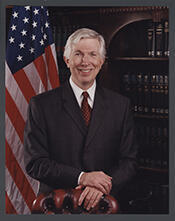
Here you will find contact information for Representative Robert E. (Bud) Cramer Jr., including email address, phone number, and mailing address.
| Name | Robert E. (Bud) Cramer Jr. |
| Position | Representative |
| State | Alabama |
| District | 5 |
| Party | Democratic |
| Status | Former Representative |
| Term Start | January 3, 1991 |
| Term End | January 3, 2009 |
| Terms Served | 9 |
| Born | August 22, 1947 |
| Gender | Male |
| Bioguide ID | C000868 |
About Representative Robert E. (Bud) Cramer Jr.
Robert Edward “Bud” Cramer Jr. (born August 22, 1947) is an American politician and attorney who served as a Democratic member of the United States House of Representatives from 1991 to 2009, representing Alabama’s 5th congressional district. A member of the Democratic Party throughout his congressional tenure, Robert E. Cramer served nine terms in the House of Representatives, contributing to the legislative process during a significant period in American history and representing the interests of his north Alabama constituents. On March 13, 2008, he announced that he would not seek re-election to a tenth term and would retire at the end of the 110th Congress.
Cramer was born and raised in Huntsville, Madison County, Alabama, where he was known as “Bud” by his classmates. He attended public schools in Huntsville before enrolling at the University of Alabama, where he earned a Bachelor of Arts degree in 1969. He continued his studies at the University of Alabama School of Law, receiving his Juris Doctor in 1972. Shortly after completing his legal education, Cramer entered military service, joining the United States Army as a tank officer. He was stationed at Fort Knox, Kentucky, and, following active duty, he remained a member of the Army Reserve from 1976 to 1978.
After law school and military service, Cramer returned to Madison County to begin his legal career. In 1973 he was appointed assistant district attorney for Madison County, Alabama, a position he held until 1975, when he left to enter private practice. He practiced law privately until 1980, when he challenged the incumbent Madison County district attorney. At age 33, Cramer won the election and assumed office as district attorney in 1981. He served as Madison County district attorney from 1981 to 1990, building a reputation for his work on child abuse and victim advocacy. In 1985, he founded the National Children’s Advocacy Center in Huntsville, one of the first child-friendly, multidisciplinary facilities in the nation devoted to the investigation and treatment of child abuse. For this pioneering effort, he was honored at the White House by President Ronald Reagan in 1987.
Cramer’s transition to national office came when Representative Ronnie Flippo, who then held Alabama’s 5th congressional district seat, ran unsuccessfully for governor in 1990, leaving the seat open. Cramer entered the race as a Democrat and won the general election, defeating Republican Al McDonald with 67 percent of the vote. He took his seat in the 102nd Congress on January 3, 1991. He was easily reelected in 1992, but in 1994, amid a strong national Republican tide, he narrowly survived a serious challenge from Republican businessman Wayne Parker, holding his seat by only 1,770 votes—the closest a Republican had come to winning this historically Democratic district, one of the few in the former Confederacy that had never elected a Republican since Reconstruction prior to 2010. Cramer defeated Parker more comfortably in a 1996 rematch and thereafter did not face serious opposition, winning five additional terms with more than 70 percent of the vote and running unopposed in 2006.
During his eighteen years in the House of Representatives, Cramer developed a legislative profile closely tied to the economic and strategic interests of his district, which includes Huntsville, Redstone Arsenal, and NASA’s Marshall Space Flight Center. He was a strong supporter of the International Space Station and a consistent advocate for increased spending on missile defense and aerospace research, reflecting Huntsville’s longstanding role as a center for defense and space development and its status as home to the United States Army Aviation and Missile Command (AMCOM). Child protection remained a central legislative concern for Cramer, building on his earlier work as district attorney and founder of the National Children’s Advocacy Center. He co-founded and co-chaired the Congressional Missing & Exploited Children’s Caucus, using his position to promote policies aimed at protecting vulnerable children nationwide.
Cramer’s voting record evolved over the course of his congressional service. Considered a liberal Democrat in his early terms, he largely supported the party line during his first three terms in office. His near-defeat in 1994, however, prompted him to move toward more conservative positions, particularly on social and fiscal issues. He frequently broke with his party on matters such as abortion, gay rights, gun control, taxation, business regulation, and environmental policy. He was one of only four House Democrats to vote in favor of the 2003 tax cut bill backed by President George W. Bush. At the same time, he did not support any of the articles of impeachment against President Bill Clinton in 1998. His voting record placed him near the ideological center of the House, and he was often described as unpredictable in his floor votes. Reflecting this centrist and conservative tilt, Cramer was a long-time member and co-founder of the Blue Dog Coalition, a group of moderate and conservative House Democrats. Despite encouragement from fellow Alabamian Senator Richard Shelby to switch parties and become a Republican, Cramer remained a Democrat and continued to win reelection in an increasingly conservative district.
Cramer’s committee assignments underscored his focus on defense, intelligence, and appropriations. He served on the powerful House Committee on Appropriations, including the Subcommittee on Defense; the Subcommittee on Transportation, Housing and Urban Development, and Related Agencies; and the Subcommittee on Financial Services and General Government. He also served on the Permanent Select Committee on Intelligence, where he chaired the Subcommittee on Oversight and Investigations and sat on the Subcommittee on Technical and Tactical Intelligence. In addition, he was a member of the Select Intelligence Oversight Panel. Within the broader caucus structure of the House, Cramer co-founded and co-chaired several issue-oriented groups, including the Blue Dog Coalition, the Congressional Missing & Exploited Children’s Caucus, the End the Death Tax Caucus, the House Anti-Terrorism Caucus, and the Tennessee Valley Authority Caucus, reflecting his interests in child protection, tax policy, national security, and regional economic development.
On foreign and national security policy, Cramer often aligned with more hawkish positions. On October 10, 2002, he was among the 81 House Democrats who voted in favor of authorizing the use of military force in Iraq. He subsequently supported several measures favored by the Republican majority, including funding for the continued occupation of Iraq and reauthorization of the USA PATRIOT Act. Nonetheless, he joined many Democrats in opposing President Bush’s 2007 plan to deploy an additional 21,000 troops to Iraq. Various interest-group ratings reflected his centrist and mixed record: National Journal scored him roughly evenly between liberal and conservative positions on economic, social, and foreign policy (Economic: 50% liberal, 49% conservative; Social: 48% liberal, 51% conservative; Foreign: 54% liberal, 45% conservative). He received a 75 rating from Americans for Democratic Action, 25 from the American Civil Liberties Union, 86 from the U.S. Chamber of Commerce, 58 from the Christian Coalition, 50 from the American Conservative Union, 26 from the National Taxpayers Union, and 36 from the League of Conservation Voters.
On March 13, 2008, Cramer surprised many colleagues and observers by announcing that he would not seek re-election in 2008 and would retire from Congress at the conclusion of his ninth term in January 2009. His decision opened a rare competitive seat in north Alabama. In the general election to succeed him, Alabama Democratic State Senator Parker Griffith defeated Republican Wayne Parker, who was making another bid for the seat Cramer had long held. After leaving Congress, Cramer entered the private sector as a lobbyist and government affairs consultant, focusing on clients in the defense and aerospace industries, sectors closely tied to the economy of his former district. His congressional papers and related materials are preserved in the Robert E. (Bud) Cramer Congressional Collection at the University of Alabama in Huntsville Archives and Special Collections, documenting his nearly two decades of service in the House of Representatives.