Representative Robert Vernon Denney
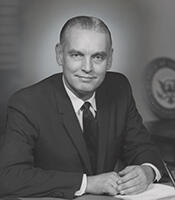
Here you will find contact information for Representative Robert Vernon Denney, including email address, phone number, and mailing address.
| Name | Robert Vernon Denney |
| Position | Representative |
| State | Nebraska |
| District | 1 |
| Party | Republican |
| Status | Former Representative |
| Term Start | January 10, 1967 |
| Term End | January 3, 1971 |
| Terms Served | 2 |
| Born | April 11, 1916 |
| Gender | Male |
| Bioguide ID | D000239 |
About Representative Robert Vernon Denney
Robert Vernon Denney (April 11, 1916 – June 26, 1981) was an American politician and judge who served as a Republican member of the United States House of Representatives for Nebraska’s 1st congressional district and later as a federal judge of the United States District Court for the District of Nebraska. He served in the United States Congress from 1967 to 1971, completing two terms in the House of Representatives, and subsequently held a distinguished judicial career at the federal level.
Denney was born in Council Bluffs, Iowa, on April 11, 1916. He moved to Nebraska as a youth and graduated from Fairbury High School in Fairbury, Nebraska, in 1933. He pursued higher education at Peru State Teachers College and the University of Nebraska from 1933 to 1936, laying the groundwork for a career in law and public service. He then enrolled at Creighton University School of Law in Omaha, Nebraska, where he earned a Bachelor of Laws degree in 1939, preparing him for admission to the bar and the practice of law.
Following his graduation from law school, Denney began practicing law in Fairbury, Nebraska, in 1939. He continued in private practice there until 1940, when he entered federal service as a special agent for the Federal Bureau of Investigation. From 1940 to 1941 he served with the FBI in Washington, D.C., and Chicago, Illinois. With the onset of World War II, Denney enlisted in the United States Marine Corps in October 1942, serving with the First Armored Amphibian Battalion. After the war, he remained active in the United States Marine Corps Reserve until 1960, ultimately retiring with the rank of lieutenant colonel, reflecting a lengthy and committed record of military service.
After his wartime service, Denney returned to Fairbury and resumed the practice of law in 1945, continuing in private practice there until 1967. During this period he also held a series of local public offices and party leadership posts. He served as Jefferson County attorney from 1946 to 1951 and as Fairbury city attorney from 1951 to 1956, roles in which he gained extensive experience in local government and public law. In addition, he became active in Republican Party politics, serving first as Chairman of the Jefferson County Republican Party and later as Chairman of the Nebraska Republican Party, positions that increased his visibility and influence within state and national political circles.
Denney was elected as a Republican to the Ninetieth and Ninety-first United States Congresses, representing Nebraska’s 1st congressional district in the House of Representatives from January 3, 1967, to January 3, 1971. His service in Congress occurred during a significant period in American history marked by the Vietnam War, civil rights struggles, and major social and political change. As a member of the House of Representatives, Robert Vernon Denney participated in the democratic process, contributed to the legislative work of the chamber, and represented the interests of his constituents in Nebraska. After completing two terms, he chose not to run for reelection to the Ninety-second Congress in 1970.
Following his congressional service, Denney was nominated to the federal bench. On January 28, 1971, President Richard Nixon nominated him to a new seat on the United States District Court for the District of Nebraska, created by statute (84 Stat. 294). The United States Senate confirmed his nomination on March 4, 1971, and he received his commission the following day, March 5, 1971. As a United States district judge, Denney presided over a broad range of federal civil and criminal matters, contributing to the administration of justice in Nebraska. He assumed senior status due to a certified disability on April 16, 1981, continuing to serve the court in that capacity until his death.
Denney’s personal and professional affiliations reflected his deep engagement with his community, his profession, and veterans’ organizations. He was a member of the Presbyterian Church and belonged to the American Bar Association. As a veteran, he participated in the American Legion and Veterans of Foreign Wars. He was also active in a number of fraternal and civic organizations, including Phi Sigma Kappa, the Freemasons, Knights Templar (Freemasonry), the Shriners, and the Lions, underscoring his broad involvement in civic and social life beyond elective and judicial office.
Robert Vernon Denney died on June 26, 1981, in Omaha, Nebraska, while serving as a senior judge of the United States District Court for the District of Nebraska. He was buried in Fairbury Cemetery in Fairbury, Nebraska, reflecting his long association with that community. Later that year, on December 23, 1981, President Ronald Reagan approved the naming of the Robert V. Denney Federal Building and Courthouse in Lincoln, Nebraska, in his honor, commemorating his service as a legislator, jurist, veteran, and public servant.