Representative Robert L. Ehrlich Jr.
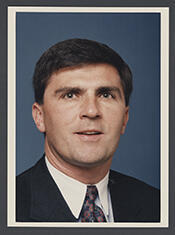
Here you will find contact information for Representative Robert L. Ehrlich Jr., including email address, phone number, and mailing address.
| Name | Robert L. Ehrlich Jr. |
| Position | Representative |
| State | Maryland |
| District | 2 |
| Party | Republican |
| Status | Former Representative |
| Term Start | January 4, 1995 |
| Term End | January 3, 2003 |
| Terms Served | 4 |
| Born | November 25, 1957 |
| Gender | Male |
| Bioguide ID | E000093 |
About Representative Robert L. Ehrlich Jr.
Robert Leroy Ehrlich Jr. (born November 25, 1957) is an American lawyer and Republican politician who served as the 60th governor of Maryland from 2003 to 2007 and as a United States Representative from Maryland from 1995 to 2003. Over four terms in the U.S. House of Representatives, he represented Maryland’s 2nd Congressional District and contributed to the legislative process during a significant period in American history, before becoming the first Republican governor of Maryland since Spiro T. Agnew left office in 1969.
Of German descent, Ehrlich was born in the southwest Baltimore suburb of Arbutus, Maryland, the son of Nancy (Bottorf) Ehrlich, a legal secretary, and Robert Leroy Ehrlich Sr., a commission car salesman. He attended the Gilman School in Baltimore, where he distinguished himself academically and athletically. Ehrlich went on to Princeton University on a partial scholarship, majoring in politics and playing football. He was captain of the Princeton football team and a member of the Cap and Gown Club. He graduated with an A.B. in politics in 1979 after completing a 140-page senior thesis titled “Alexander Solzenitsyn: The Man and His Politics.” He then studied law at Wake Forest University School of Law, receiving his J.D. in 1982.
After law school, Ehrlich returned to Maryland and joined the Baltimore law firm of Ober, Kaler, Grimes & Shriver, where he practiced law and became increasingly active in Republican politics. His early legal career coincided with his emergence as a young party figure in a state long dominated by Democrats. In November 1986, he won election to the Maryland House of Delegates, representing parts of Baltimore County in the 10th legislative district. He served in the House of Delegates from 1987 to 1995, building a reputation as a fiscally conservative, pro-business legislator and positioning himself for higher office. In 1993, he married Kendel Sibiski; the couple would have two sons, Drew Robert Ehrlich and Joshua Taylor Ehrlich.
In 1993, Representative Helen Delich Bentley announced she would vacate her seat in Maryland’s 2nd Congressional District. Ehrlich declared his candidacy for the open seat and, in the 1994 election, won by a comfortable margin, entering the 104th Congress in January 1995. He subsequently won reelection by at least 25 percent in each of his congressional campaigns, serving four terms from January 3, 1995, to January 3, 2003. As a member of the U.S. House of Representatives, Ehrlich participated in the democratic process during a period marked by divided government and significant national debates over budget policy, welfare reform, and impeachment. He served on the influential House Committee on Energy and Commerce, where he sat on the Subcommittees on Health, Telecommunications and the Internet, and Environment and Hazardous Materials. He was co-chairman of the Congressional Biotechnology Caucus and a member of the Congressional Steel Caucus. During his tenure, he introduced legislation aimed at helping people with disabilities maintain employment and supported harsher penalties for gun violence. In 1999, he voted in favor of removing President Bill Clinton from office during the impeachment proceedings. In 2002, he announced that he would forgo reelection to Congress in order to run for governor; he was succeeded in the House by Democrat C. A. Dutch Ruppersberger.
With Democratic Governor Parris Glendening term-limited and leaving office amid a budget deficit and political difficulties, Ehrlich announced his candidacy for governor of Maryland on March 15, 2002. Running with Michael Steele, then chair of the Maryland Republican Party, as his lieutenant governor candidate, Ehrlich campaigned on increasing school funding, balancing the state budget, and protecting the Chesapeake Bay. He tied his Democratic opponent, Lieutenant Governor Kathleen Kennedy Townsend, to the unpopular Glendening administration and criticized her choice of running mate, retired Admiral Charles R. Larson, who had only recently switched parties. Townsend’s campaign was further hurt by controversy over redistricting and reliance on out-of-state donors. In a state that traditionally voted Democratic and had not elected a Republican governor in nearly four decades, Ehrlich won the November 2002 election with 52 percent of the vote to Townsend’s 48 percent, becoming Maryland’s sixth Republican governor and the first since Agnew.
Ehrlich’s gubernatorial administration, which began on January 15, 2003, was organized around what he termed five pillars: fiscal responsibility, education, health and the environment, public safety, and commerce. He opposed increases in sales and income taxes and advocated the legalization of slot machines as a revenue source. Under his tenure, Maryland’s unemployment rate remained at least 0.5 percent below the national average, declining from 4.5 percent in 2003 to 3.9 percent in 2006, with an increase of approximately 98,000 private-sector jobs, aided in part by the state’s proximity to the Washington, D.C., labor market. Ehrlich created a cabinet-level Department of Disabilities, the first such agency in the nation dedicated to people with disabilities. In 2004, he signed the Chesapeake Bay Restoration Act, which funded upgrades to wastewater treatment plants through surcharges on residential and business water and septic bills; the measure was expected to achieve roughly one-third of Maryland’s obligations under the 2000 Chesapeake Bay Agreement and was described by the Chesapeake Bay Foundation as the most significant Bay-related legislation in a generation. He also signed a 2006 law banning police traffic ticket quotas and publicly opposed President George W. Bush’s 2006 approval of a United Arab Emirates firm’s proposed takeover of several U.S. port operations, including the Port of Baltimore, during the Dubai Ports World controversy.
In January 2006, Ehrlich vetoed the “Fair Share Health Care Bill,” widely known as the “Wal-Mart bill,” which required companies with more than 10,000 employees in Maryland to spend at least eight percent of their payroll on employee health care or pay the difference into a state health program for the uninsured. Wal-Mart was the only large employer in the state that did not already meet the eight percent threshold. After consulting legal counsel, Ehrlich argued that the bill would conflict with federal law, specifically the Employee Retirement Income Security Act (ERISA) of 1974, and characterized it as a first step toward government-run health care advanced by “anti-jobs lawmakers.” Supporters of the bill contended that Wal-Mart’s low wages shifted health-care costs to the state and criticized Ehrlich as siding with “big corporate interests rather than Maryland’s working families.” The Democratic-controlled General Assembly overrode his veto, a move that was followed by the cancellation of plans for a Wal-Mart distribution center in one of Maryland’s poorest counties. On July 7, 2006, U.S. District Judge J. Frederick Motz struck down the law, ruling that it violated ERISA and noting that it would impose an undue administrative burden on Wal-Mart by requiring different benefit tracking in Maryland than in other states. Ehrlich sought a second term in 2006 and faced no opposition in the Republican primary, but on November 7, 2006, he was defeated by Democratic nominee Martin O’Malley, then mayor of Baltimore, who received 53 percent of the vote to Ehrlich’s 46 percent. His term as governor concluded at noon on January 17, 2007.
After leaving office, Ehrlich returned to the practice of law and to political advocacy. In February 2007, he and several former aides opened a Baltimore-area office for the North Carolina-based law firm Womble Carlyle Sandridge & Rice. His wife, Kendel, accepted a consulting position as a director of BankAnnapolis. Ehrlich endorsed former New York City Mayor Rudy Giuliani for president in March 2007 and served as chairman of Giuliani’s Mid-Atlantic Campaign Committee. From 2007 to 2010, he and his wife co-hosted a Saturday radio program on WBAL-AM in Baltimore, and he continued a long-standing role as a guest lecturer in political persuasion at Towson University, where he had appeared in Professor Richard Vatz’s class twice a year since 1993. In 2010, Ehrlich announced that he would again challenge Governor O’Malley. He selected Mary Kane, his former secretary of state and earlier deputy secretary of state and chief legal counsel, as his running mate. Backed by prominent Republicans including his former lieutenant governor Michael Steele, then chairman of the Republican National Committee, as well as Mitt Romney and Rudy Giuliani, Ehrlich easily won the Republican primary but lost the general election on November 2, 2010, with O’Malley prevailing 56 percent to 42 percent. In December 2011, Ehrlich’s 2010 campaign manager, Paul E. Schurick, was convicted of fraud and conspiracy for a robocall scheme aimed at suppressing Black voter turnout; political consultant Julius Henson was also convicted on one count in connection with the operation.
In October 2011, Ehrlich was named chair of Mitt Romney’s Maryland campaign for the 2012 Republican presidential nomination. He later supported Ohio Governor John Kasich during the early stages of the 2016 Republican presidential primaries but endorsed the party’s eventual nominee, Donald J. Trump, in May 2016. As of December 2020, Ehrlich was serving as senior counsel in the Washington, D.C., office of the law firm King & Spalding, working on its governmental advocacy and public policy team. In August 2022, the Maryland Republican Party announced that he would lead its “2022 Victory Campaign” to support the party’s statewide and federal nominees, including gubernatorial candidate Dan Cox and attorney general candidate Michael Peroutka; both were defeated by Democrats Wes Moore and Anthony Brown, respectively, in the November 8, 2022, general election. As of the early 2010s, Ehrlich was also noted as a frequent guest on the Washington-area sports radio program “The Sports Junkies,” reflecting his enduring interest in athletics and public commentary alongside his legal and political work.