Representative Robert Brown Elliott
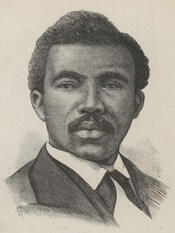
Here you will find contact information for Representative Robert Brown Elliott, including email address, phone number, and mailing address.
| Name | Robert Brown Elliott |
| Position | Representative |
| State | South Carolina |
| District | 3 |
| Party | Republican |
| Status | Former Representative |
| Term Start | March 4, 1871 |
| Term End | March 3, 1875 |
| Terms Served | 2 |
| Born | August 11, 1842 |
| Gender | Male |
| Bioguide ID | E000128 |
About Representative Robert Brown Elliott
Robert Brown Elliott (August 11, 1842 – August 9, 1884) was a British-born American politician of British Afro-Caribbean ethnic background who became one of the most prominent African American officeholders during the Reconstruction era. Born in Liverpool, England, he was of mixed African and West Indian descent. Details of his early youth are sparse, but he was raised and educated in England, where he is believed to have received a solid formal education that later supported his work as a lawyer, editor, and legislator. His background as a British subject of Afro-Caribbean heritage gave him a distinctive perspective on questions of race, citizenship, and civil rights in the post–Civil War United States.
Elliott emigrated to the United States after the Civil War, settling in the South during the period of Reconstruction. He studied law and was admitted to the bar, establishing himself as an attorney at a time when African American lawyers were exceedingly rare. His education and legal training enabled him to participate effectively in the political and constitutional debates of the era, particularly in South Carolina, where he quickly became active in Republican politics. His legal and oratorical skills brought him to the attention of party leaders and helped propel him into public office.
Elliott’s political career in South Carolina developed in tandem with the rise of the Republican Party in the state during Reconstruction. Aligning himself with the party that championed emancipation and civil rights, he became a leading African American Republican figure. He served in the South Carolina constitutional convention and in the state legislature, where he advocated for equal rights and public education. His growing prominence and reputation as a forceful speaker and committed advocate for his constituents led to his election to the United States House of Representatives from South Carolina.
As a member of the United States House of Representatives, Elliott represented South Carolina in Congress from 1871 to 1875, serving two terms in office as a Republican. Some contemporary and later accounts list his service as extending from 1871 to 1874, but he was elected to and served during two consecutive Congresses in this period. His tenure coincided with a critical phase of Reconstruction, when Congress grappled with enforcing the newly adopted Thirteenth, Fourteenth, and Fifteenth Amendments and with protecting the civil and political rights of formerly enslaved people. In the House of Representatives, Elliott participated in the legislative process and represented the interests of his South Carolina constituents, contributing to debates over civil rights and federal authority in the South. He became particularly noted for his eloquence in defending federal civil rights legislation and for his insistence that African Americans be afforded full and equal citizenship.
After leaving Congress, Elliott remained deeply involved in South Carolina politics and law. In 1876 he ran successfully for the office of South Carolina Attorney General, one of the highest statewide posts held by an African American during Reconstruction. However, the state elections of that year marked a turning point: white Democrats regained dominance of the state legislature and moved swiftly to dismantle many of the gains of Reconstruction. In 1877, following the withdrawal of the last federal troops from South Carolina as part of the broader end of Reconstruction, Elliott was forced out of the Attorney General’s office, reflecting the rapid erosion of African American political power in the state.
In the late 1870s and early 1880s, Elliott attempted to rebuild his professional life in the face of mounting racial and political reaction. In 1878 he formed a law partnership with D. Augustus Straker and T. McCants Stewart, both prominent African American attorneys, in an effort to establish a stable legal practice. At the same time, he continued to engage in Republican politics at the national level. In 1879 he was appointed a customs inspector for the Treasury Department in Charleston, South Carolina, a federal position that provided some income and status. While serving in this capacity, he traveled to Florida on official business, where he contracted malaria, an illness that would undermine his health in subsequent years.
Elliott’s political engagement persisted despite his declining fortunes. He worked on then–Treasury Secretary John Sherman’s campaign for the Republican presidential nomination in 1880 and served as a delegate to the 1880 Republican National Convention, maintaining his role in national party affairs. In January 1881 he joined a black delegation that met with President James A. Garfield to protest the lack of civil and political rights for African Americans in the South, underscoring his continued commitment to civil rights advocacy even as Reconstruction had formally ended. Later in 1881 he was transferred by the Treasury Department to New Orleans, Louisiana, and in 1882 he was dismissed from his federal post, a setback that further strained his finances.
In his final years, Elliott attempted once again to practice law in New Orleans, but he found few clients in an environment increasingly hostile to African American professionals. His law practice faltered, and he slipped into poverty despite his earlier prominence as a congressman and state attorney general. Impoverished and in poor health, Robert Brown Elliott died in New Orleans on August 9, 1884, just two days shy of his forty-second birthday. His life and career, spanning from British birth and Afro-Caribbean heritage to high office in Reconstruction-era South Carolina and eventual marginalization in the post-Reconstruction South, reflected both the possibilities and the severe limitations faced by African American leaders in the nineteenth century.