Representative Robert Allen Grant
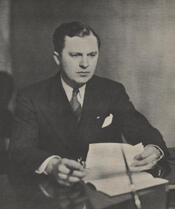
Here you will find contact information for Representative Robert Allen Grant, including email address, phone number, and mailing address.
| Name | Robert Allen Grant |
| Position | Representative |
| State | Indiana |
| District | 3 |
| Party | Republican |
| Status | Former Representative |
| Term Start | January 3, 1939 |
| Term End | January 3, 1949 |
| Terms Served | 5 |
| Born | July 31, 1905 |
| Gender | Male |
| Bioguide ID | G000384 |
About Representative Robert Allen Grant
Robert Allen Grant (July 31, 1905 – March 2, 1998) was an American lawyer, legislator, and federal judge who served five terms as a United States Representative from Indiana and later as a United States District Judge of the United States District Court for the Northern District of Indiana. A member of the Republican Party, he represented his Indiana constituents in Congress from 1939 to 1949 and subsequently held prominent judicial leadership roles, including service as Chief Judge and membership in the Judicial Conference of the United States.
Grant was born near Bourbon, Marshall County, Indiana, on July 31, 1905. In 1912 his family moved to Hamlet, Indiana, and in 1922 they relocated to South Bend, Indiana, where he would establish his long-term professional and political base. He attended the public schools in the communities in which he lived, laying the groundwork for his later academic and professional achievements.
Pursuing higher education at the University of Notre Dame, Grant received an Artium Baccalaureus degree, cum laude, in 1928. He continued at Notre Dame Law School, where he earned a Juris Doctor degree, also cum laude, in 1930. That same year he was admitted to the bar and commenced the practice of law in South Bend. On September 17, 1933, he married Margaret A. McLaren. Early in his legal career, he served as a deputy prosecuting attorney of St. Joseph County, Indiana, in 1935 and 1936, gaining experience in public service and criminal law before returning to private practice in 1936 and continuing there until 1938.
Grant entered national politics as a Republican and was elected to the Seventy-sixth Congress and to the four succeeding Congresses, serving in the United States House of Representatives from January 3, 1939, to January 3, 1949. His ten years in Congress encompassed a pivotal era in American history, including the Great Depression’s aftermath, World War II, and the early years of the postwar period. Throughout his five terms in office, he participated in the legislative process, contributed to national policymaking, and represented the interests of his Indiana constituents in the House of Representatives. In 1948 he was an unsuccessful candidate for reelection to the Eighty-first Congress, after which he resumed the practice of law in South Bend.
Grant’s congressional service was followed by a distinguished judicial career. On August 21, 1957, President Dwight D. Eisenhower nominated him to a seat on the United States District Court for the Northern District of Indiana, filling the vacancy created by the death of Judge W. Lynn Parkinson. The United States Senate confirmed his nomination on August 22, 1957, and he received his commission on August 26, 1957. As a district judge he presided over a broad range of federal civil and criminal matters arising in northern Indiana, bringing to the bench his legislative experience and background as a practicing attorney.
Within a few years of his appointment, Grant assumed key leadership responsibilities in the federal judiciary. He served as Chief Judge of the United States District Court for the Northern District of Indiana from 1961 to 1972, overseeing the administration of the court during a period of significant growth in the federal docket and the expansion of federal jurisdiction in areas such as civil rights and criminal procedure. From 1969 to 1972 he was a member of the Judicial Conference of the United States, the principal policymaking body for the federal court system, where he participated in shaping national judicial administration. He assumed senior status on December 1, 1972, continuing to carry a reduced but active caseload.
Grant’s judicial service extended beyond his home district. In 1976, Chief Justice Warren E. Burger appointed him to the United States Temporary Emergency Court of Appeals, a specialized federal appellate court created to hear cases arising under federal economic stabilization and energy-related legislation. He served on that court until 1993, contributing to the resolution of complex regulatory and constitutional issues. In addition, he served as a visiting judge for twelve terms at the United States District Court for the District of Puerto Rico, reflecting the high regard in which he was held within the federal judiciary and his willingness to assist other courts with heavy caseloads.
Grant remained in senior status on the Northern District of Indiana until his death, continuing to serve the federal judiciary for more than four decades after his initial appointment. He died on March 2, 1998, in Sarasota, Florida. In recognition of his long and distinguished service, on September 25, 1992, the divisional federal courthouse in South Bend was rededicated as the Robert A. Grant Federal Building and U.S. Courthouse, a lasting tribute to his contributions as a legislator, jurist, and public servant from Indiana.