Senator Robert P. Griffin
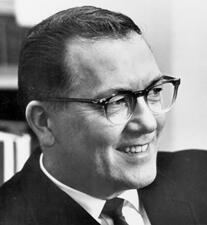
Here you will find contact information for Senator Robert P. Griffin, including email address, phone number, and mailing address.
| Name | Robert P. Griffin |
| Position | Senator |
| State | Michigan |
| Party | Republican |
| Status | Former Representative |
| Term Start | January 3, 1957 |
| Term End | January 3, 1979 |
| Terms Served | 7 |
| Born | November 6, 1923 |
| Gender | Male |
| Bioguide ID | G000465 |
About Senator Robert P. Griffin
Robert Paul Griffin (November 6, 1923 – April 16, 2015) was an American politician and jurist from the state of Michigan who served in both chambers of the United States Congress and later on the Michigan Supreme Court. A member of the Republican Party, he represented Michigan in the U.S. House of Representatives from 1957 to 1966 and in the United States Senate from 1966 to 1979, and subsequently served as a Justice of the Michigan Supreme Court from 1987 to 1995. Over the course of eight terms in Congress, he played a significant role in federal legislative affairs during a transformative period in American history.
Griffin was born on November 6, 1923, in Detroit, Michigan. He grew up in the state he would later represent in Congress, coming of age during the Great Depression and the lead-up to World War II. Like many of his generation, his early adulthood was shaped by wartime service. During World War II he served in the United States Army, an experience that informed his later views on national defense and public service. After the war, he returned to Michigan to pursue higher education and a legal career.
Following his military service, Griffin attended Central Michigan College (now Central Michigan University) and then enrolled in law school. He earned his law degree from the University of Michigan Law School, where he prepared for a career in the legal profession. After admission to the bar, he began practicing law in Traverse City, Michigan. His work as an attorney, combined with his wartime background and engagement in local civic affairs, helped establish his reputation and provided a foundation for his entry into electoral politics.
Griffin was first elected to the United States House of Representatives in 1956 and took office in January 1957, marking the beginning of his congressional career. Representing Michigan as a Republican, he served in the House from 1957 to 1966. During his tenure in the House, he became particularly noted for his work on labor and regulatory issues. He co-sponsored the Labor Management Reporting and Disclosure Act of 1959, landmark legislation that regulates the internal affairs of labor unions, including financial reporting and standards for union officer elections. His House service coincided with the Eisenhower, Kennedy, and Johnson administrations, a period of significant domestic and international change, and he participated actively in the legislative process on behalf of his Michigan constituents.
In 1966 Griffin was appointed to the United States Senate to fill a vacancy and subsequently won election in his own right, serving as a U.S. Senator from Michigan from 1966 to 1979. As a senator, he continued to be involved in major legislative debates of the era, including those related to labor policy, civil rights, and the Vietnam War. He rose within the Republican leadership, becoming the Senate’s deputy minority leader. In that capacity, he played a notable role during the Watergate scandal. Despite being a fellow Republican of President Richard Nixon, Griffin publicly called on Nixon to resign, reflecting his view of the constitutional and ethical responsibilities of public officials. His Senate career spanned the Johnson, Nixon, Ford, and Carter administrations, and he was a prominent participant in the democratic process during a period marked by social upheaval, economic challenges, and shifts in U.S. foreign policy.
After leaving the Senate in 1979, Griffin returned to the practice of law in Michigan and remained active in public and civic affairs. His legal experience and long record in public office led to his selection for judicial service at the state level. In 1986 he was elected to the Michigan Supreme Court, and he served as a Justice from 1987 to 1995. On the state’s highest court, he participated in decisions shaping Michigan’s jurisprudence in areas such as criminal law, civil procedure, and constitutional interpretation, bringing to the bench the perspective of a former legislator and federal officeholder.
Griffin retired from the Michigan Supreme Court in 1995, concluding nearly four decades of combined legislative and judicial service. In his later years he resided in Michigan and remained a respected elder statesman within the state’s political and legal communities. Robert Paul Griffin died on April 16, 2015, in Traverse City, Michigan. His career encompassed military service in World War II, a distinguished tenure in the U.S. House of Representatives and Senate, including eight terms in Congress, and significant judicial service on the Michigan Supreme Court, marking him as a central figure in Michigan’s public life in the second half of the twentieth century.