Senator Robert Hanna
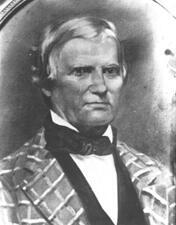
Here you will find contact information for Senator Robert Hanna, including email address, phone number, and mailing address.
| Name | Robert Hanna |
| Position | Senator |
| State | Indiana |
| Party | Anti-Jacksonian |
| Status | Former Representative |
| Term Start | December 5, 1831 |
| Term End | March 3, 1833 |
| Terms Served | 1 |
| Born | April 6, 1786 |
| Gender | Male |
| Bioguide ID | H000165 |
About Senator Robert Hanna
Robert Hanna Jr. (April 6, 1786 – November 16, 1858) was an American public official and legislator who served as a United States Senator from Indiana from 1831 to 1832 and was a member of the Anti-Jacksonian Party. Best known as one of the forty-three delegates to the 1816 Indiana Constitutional Convention and as Indiana’s third U.S. Senator after statehood, he played a significant role in the early political and institutional development of Indiana. His service in Congress occurred during a significant period in American history, and as a member of the Senate he participated in the democratic process and represented the interests of his constituents during one term in office.
Hanna was born on April 6, 1786, near Fountainius in Laurens County, South Carolina. His father, Robert Hanna Sr., was born in Prince Edward County, Virginia, and after his marriage to Mary Parks the couple moved to South Carolina’s Laurens District, where all nine of their children, including Robert Jr., were born. Shortly after the Indiana Territory was established in 1800, the Hanna family migrated west. Between 1802 and 1804 they settled along the east fork of the Great Miami River, approximately three miles north of Brookville in what became Franklin County, Indiana. This frontier setting provided the backdrop for Hanna’s emergence as a local leader and public servant.
Hanna’s formal education is not extensively documented, but his early assumption of public responsibilities suggests he was regarded as capable and trustworthy within the growing territorial community. On March 18, 1813, he married Sarah Mowery (or Mowrey) in Brookville. She was born in Virginia and later died in Indianapolis, Indiana. Robert and Sarah Hanna were the parents of ten children: Valentine Claiborne Hanna, Captain Robert Barlow Hanna, James Fulton Hanna, William Harrison Hanna, Thomas Jefferson Hanna, George Washington Hanna, David Graem Hanna Jr., Catherine Mary Hanna, Captain Joseph Madison Hanna, and Captain Jonathan Littlejohn Hanna. After Sarah’s death, Hanna later married Olive Catherwood, further cementing his family ties in Indiana.
Hanna began his public career under the territorial government. In 1809, William Henry Harrison, then governor of the Indiana Territory, appointed him sheriff of the territory’s eastern district. When Franklin County was created in 1811, Hanna became its first sheriff, a position he held through the formative years of the county. He was elected Franklin County sheriff on August 5, 1818, defeating John Allen by a vote of 426 to 118, and continued to serve as sheriff of Franklin County’s court of common pleas until 1820. On May 13, 1816, he was elected as one of Franklin County’s five delegates to the Indiana Constitutional Convention at Corydon, where the delegation considered statehood for the Indiana Territory and drafted Indiana’s first constitution. Among his fellow Franklin County delegates was James Noble, who became Indiana’s first U.S. Senator after statehood in 1816. When a state militia was organized in 1817, Hanna served as a brigadier general in its Sixth Brigade, Third Division, underscoring his prominence in both civil and military affairs.
In 1820, Hanna became the first registrar of the United States General Land Office at Brookville. The land-office building, later demolished, stood across the street from his residence. When the federal land office was relocated to Indianapolis in 1825, Hanna moved to the new state capital and continued as registrar there until 1830. During this period he also engaged in internal improvements and commercial ventures. He became a contractor for construction on the National Road and was an investor in the steamboat Robert Hanna. On April 11, 1831, that vessel became the first steamboat to successfully navigate the White River from Cincinnati, Ohio, to Indianapolis. The steamboat ran aground on its return trip, effectively ending serious efforts at steamboat navigation of the White River until renewed attempts were made in 1865.
Hanna’s brief service in the United States Senate came as a result of a vacancy. Following the death of Senator James Noble in 1831, Indiana governor Noah Noble appointed Hanna to fill the vacant seat. He thus became Indiana’s third U.S. Senator after statehood, following Noble and Waller Taylor. A member of the Anti-Jacksonian Party, he served in the Senate from August 19, 1831, to January 3, 1832. During this slightly more than four-month tenure, he participated in the legislative process at a time when national politics were dominated by debates over President Andrew Jackson’s policies, banking, and internal improvements. Although his time in Washington was short, it placed him among the early generation of Indiana leaders who helped represent the new state on the national stage.
After leaving the Senate and returning to Indianapolis, Hanna continued a lengthy career in state politics. He represented Marion County in the Indiana House of Representatives during multiple terms, serving in the Seventeenth Regular Session from 1832 to 1833 and again in the Twenty-first, Twenty-second, and Twenty-third Regular Sessions from 1836 to 1839. At the end of his political career he served in the Indiana Senate, representing Marion County in the Twenty-fifth Regular Session from 1840 to 1841 and again from 1842 to 1846. Through these legislative roles he remained closely involved in shaping Indiana’s laws and institutions during a period of rapid growth, internal improvement projects, and evolving party politics.
Hanna’s long life of public service ended tragically. On November 16, 1858, he was struck and instantly killed by a train locomotive while walking along the track of the Peru and Indianapolis Railroad in Indianapolis. He was interred at Crown Hill Cemetery in Indianapolis, where his remains rest in Section 2, Lot 131. Hanna is remembered for his extensive public service as Franklin County’s first sheriff during the final years of Indiana’s territorial government, as a delegate to the 1816 Indiana Constitutional Convention, as a militia brigadier general, as registrar of the federal land office in Brookville and Indianapolis, as an Anti-Jacksonian U.S. Senator from Indiana, and as a long-serving member of both houses of the Indiana General Assembly.