Representative Robert Stell Heflin
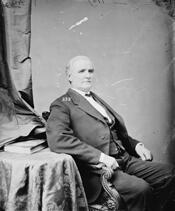
Here you will find contact information for Representative Robert Stell Heflin, including email address, phone number, and mailing address.
| Name | Robert Stell Heflin |
| Position | Representative |
| State | Alabama |
| District | 3 |
| Party | Republican |
| Status | Former Representative |
| Term Start | March 4, 1869 |
| Term End | March 3, 1871 |
| Terms Served | 1 |
| Born | April 15, 1815 |
| Gender | Male |
| Bioguide ID | H000447 |
About Representative Robert Stell Heflin
Robert Stell Heflin (April 15, 1815 – January 24, 1901) was an American politician and lawyer who served in the state legislatures of both Georgia and Alabama and represented Alabama in the United States House of Representatives during the Reconstruction era. A member of the Republican Party in his federal service, he held office in a period of profound political and social upheaval and was noted as one of the relatively few Southern Unionists in the Deep South.
Heflin was born on April 15, 1815, in Morgan County, Georgia, near the city of Madison. In 1832 his parents moved to Fayetteville, Georgia, where he was educated. His father, Wyatt Heflin, became the first elected sheriff of Fayette County, Georgia, placing the family in local public life from an early date. As a young man, Robert Stell Heflin entered military service during the Creek War of 1836. He fought in the Battle of Shepherd’s Plantation on June 9, 1836, a pivotal engagement between Georgia militia forces and Creek warriors resisting forced removal from their lands along the Chattahoochee River. During the battle he was wounded by a musket ball that broke his femur, an injury that left him with a permanent limp and dependent on a cane for the rest of his life.
Heflin’s first formal public position was in the legal field. In the fall of 1836 he became clerk of the Superior Court of Fayette County, Georgia, a post he held until 1840. While serving as clerk he studied law, and in 1840 he was admitted to the bar. He commenced the practice of law in Fayetteville, Georgia, building a professional reputation that quickly led to elective office. That same year he was elected to the Georgia State Senate, in which he served in 1840 and 1841, marking the beginning of a long career in legislative and judicial roles across two states.
In 1844, as new lands in east Alabama were opened to white settlement, Heflin followed his father and siblings across the state line to Louina, on the eastern side of the Tallapoosa River in Randolph County, Alabama. Settling there with his family, he continued his legal practice and became active in Alabama politics. He was elected to the Alabama House of Representatives in 1849 and later to the Alabama State Senate in 1860. During the secession crisis, Heflin distinguished himself as a Southern Unionist, opposing Alabama’s withdrawal from the Union. When the state seceded from the United States in 1861, he resigned his seat in the Alabama Legislature and made his home in north Randolph County, Alabama. His brother, Judge Thomas Heflin, had by then become a wealthy and influential figure in Alabama politics. Because of his Unionist views, Robert Stell Heflin was regarded as a political threat once the Civil War began and was arrested and taken to Andersonville, Georgia. Judge Thomas Heflin used his influence to secure his brother’s release.
During the later stages of the Civil War, Union and Confederate operations again touched Heflin’s life. When Union General William T. Sherman’s forces moved through Georgia, a battle was fought at Brown’s Mill in Coweta County, where Confederate General Joseph Wheeler routed Union troops. Some of the retreating Union soldiers reached the home of Robert Stell Heflin. They confiscated supplies they needed and issued vouchers to him for his remaining cattle and food. After the war, the United States government honored these vouchers, and Heflin was repaid for the property taken by Union forces. In the immediate postwar period, during Presidential and early Congressional Reconstruction, he resumed public service. In 1865 he was appointed judge of probate for Randolph County, Alabama, and in 1866 he was elected to that office. As probate judge he played a central role in adjudicating disputes over property and land that had become contentious in the aftermath of the Civil War, when questions of title, inheritance, and confiscation were widespread.
Heflin entered national politics as Alabama was readmitted to representation in Congress following the Civil War. A member of the Republican Party, he was elected to the United States House of Representatives from Alabama’s 3rd Congressional District and served one term in the Forty-first Congress, from March 4, 1869, to March 3, 1871. His service marked the first time representatives from the former Confederate States were again seated in Congress after the rebellion. During his tenure, Robert Stell Heflin contributed to the legislative process in a period of Reconstruction policymaking and represented the interests of his Alabama constituents in the House of Representatives. He was best known for introducing a bill that was passed by Congress and signed into law, providing an annual pension to wounded survivors and widows of militia members who had served in the Creek Indian Wars, reflecting both his own experience in the Creek War and his concern for veterans and their families.
Shortly after Heflin’s election to Congress, gold discoveries in the region spurred a wave of speculation. Gold was found at Dahlonega, Villa Rica, and Carrollton in Georgia, and at Gold Hill in Cleburne County and Cragford in Clay County, Alabama. Heflin joined other speculators in investing in gold ventures in east Alabama. These investments, however, proved financially disastrous. The speculation ultimately cost him nearly everything he owned, diminishing the material gains he might otherwise have retained from his long public career.
Robert Stell Heflin spent his later years in Randolph County, Alabama. He died on January 24, 1901, near Wedowee, Alabama. His remains were interred in the Masonic Cemetery in Wedowee, where he is buried alongside his first wife, Elizabeth Phillips Heflin, and Mentoria Reeves Heflin. Because of his Unionist political beliefs during the Civil War era, he is not buried with the larger Heflin family group at Concord Church near Wadley, Alabama. Through his extended family, he was connected to later generations of Alabama political leadership: he was the uncle of U.S. Senator James Thomas Heflin and the granduncle of U.S. Senator Howell Heflin, linking his 19th-century career to the state’s 20th-century congressional history.