Representative Robert Roberts Hitt
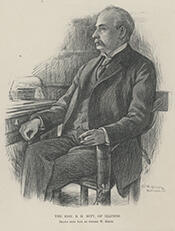
Here you will find contact information for Representative Robert Roberts Hitt, including email address, phone number, and mailing address.
| Name | Robert Roberts Hitt |
| Position | Representative |
| State | Illinois |
| District | 13 |
| Party | Republican |
| Status | Former Representative |
| Term Start | December 5, 1881 |
| Term End | March 3, 1907 |
| Terms Served | 13 |
| Born | January 16, 1834 |
| Gender | Male |
| Bioguide ID | H000649 |
About Representative Robert Roberts Hitt
Robert Roberts Hitt (January 16, 1834 – September 20, 1906) was an American diplomat and Republican politician from Illinois who served as a Representative in the United States Congress from 1881 to 1907. Over the course of 13 terms in office, he represented northwestern Illinois and became one of the leading Republican voices on foreign affairs in the House of Representatives. A prominent figure in national politics during a significant period in American history, he participated actively in the legislative process and in the formulation of U.S. foreign policy.
Hitt was born in Urbana, Ohio, to Reverend Thomas Smith Hitt and Emily John Hitt. In 1837, when he was still a small child, he moved with his parents to Mount Morris, Illinois. He was educated at Rock River Seminary in Mount Morris and later attended De Pauw University in Indiana. This Midwestern upbringing and education placed him in the milieu of emerging Republican politics in Illinois and brought him into contact with many of the figures who would shape the nation in the mid-nineteenth century.
As a young man, Hitt became an expert shorthand writer, a skill that would significantly influence his early career. He became a very close friend of future President Abraham Lincoln and, in 1858, served as a note-taker for Lincoln during the famous Lincoln–Douglas debates. His stenographic work at these debates helped preserve the substance of the historic exchanges and brought him into the inner circle of Illinois Republican leadership. By 1872, Hitt was serving in Washington as a personal secretary to Senator Oliver P. Morton of Indiana, further deepening his experience in national politics and public affairs.
Hitt’s diplomatic career began in December 1874, when President Ulysses S. Grant appointed him First Secretary of the American Legation in Paris. He served in that post from 1874 to 1881 and was Chargé d’Affaires for part of his term, giving him direct responsibility for managing U.S. interests in France during the early years of the Third Republic. In 1881, he returned to Washington to serve as United States Assistant Secretary of State under Secretary of State James G. Blaine during the administration of President James A. Garfield, continuing briefly under President Chester A. Arthur. His tenure as assistant secretary was cut short when he resigned along with Blaine following Garfield’s assassination in 1881, but the experience solidified his reputation as an authority on foreign affairs.
Transitioning from diplomacy to elective office, Hitt was elected as a Republican to the United States House of Representatives in 1882, representing Illinois’s 5th congressional district. His service in Congress extended from 1881 to 1907, and he remained in the House from 1882 until his death, continuously representing northwestern Illinois. After 1885, he was the senior Republican on the House Committee on Foreign Affairs, and he became chairman of that committee at the beginning of the Fifty-first Congress (1889–1891) and again from the Fifty-fourth through the Fifty-ninth Congresses (1895–1906). In these roles, he was a central figure in shaping U.S. foreign policy during an era marked by American expansion overseas and increasing international engagement.
Hitt’s legislative record reflected both his foreign policy expertise and his concern for civil liberties. When the Chinese Exclusion Act of 1882 came up for renewal in 1892, he spoke out against the bill’s alien documentation provisions, condemning the proposed system of registration and identification. He argued that “never before in a free country was there such a system of tagging a man, like a dog to be caught by the police and examined, and if his tag or collar is not all right, taken to the pound or drowned and shot. Never before was it applied by a free people to a human being, with the exception (which we can never refer to with pride) of the sad days of slavery.” His remarks underscored his belief that American law should not subject individuals to degrading forms of official control.
Hitt’s expertise was also called upon in matters of territorial governance and party politics. In July 1898, President William McKinley appointed him as a member of the commission created by the Newlands Resolution to establish a government in the Territory of Hawaii following its annexation by the United States. Within the Republican Party, he was regarded as a statesman of national stature, and he received some support for the vice-presidential nomination at the 1904 Republican National Convention, including backing from President Theodore Roosevelt. Despite this support, the nomination went instead to Charles W. Fairbanks. During the last years of his life, Hitt also served as a Regent of the Smithsonian Institution, contributing to the governance of one of the nation’s leading scientific and cultural institutions.
Robert Roberts Hitt died in office on September 20, 1906, bringing to a close a congressional career that had spanned more than two decades and 13 terms. He was buried in Oakwood Cemetery in Mount Morris, Illinois, alongside his parents, returning in death to the community where he had been raised. His name was later given to the community of Hitt, Missouri, reflecting the esteem in which he was held. His death placed him among the ranks of members of the United States Congress who died in office in the early twentieth century, and his career has been memorialized in congressional addresses and historical records.