Representative Robert Winthrop Kean
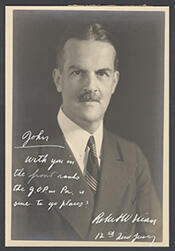
Here you will find contact information for Representative Robert Winthrop Kean, including email address, phone number, and mailing address.
| Name | Robert Winthrop Kean |
| Position | Representative |
| State | New Jersey |
| District | 12 |
| Party | Republican |
| Status | Former Representative |
| Term Start | January 3, 1939 |
| Term End | January 3, 1959 |
| Terms Served | 10 |
| Born | September 28, 1893 |
| Gender | Male |
| Bioguide ID | K000029 |
About Representative Robert Winthrop Kean
Robert Winthrop Kean (September 28, 1893 – September 21, 1980) was an American Republican Party politician from New Jersey who served ten consecutive terms in the United States House of Representatives from 1939 to 1959. Representing parts of Essex County, New Jersey, he became known nationally for his expertise in taxation and Social Security and was sometimes referred to in Washington, D.C., as “Mr. Social Security.” A member of the prominent Kean family, he was the son of United States Senator Hamilton Fish Kean and later the father of New Jersey Governor Thomas Kean, continuing one of the nation’s oldest political family traditions.
Kean was born on September 28, 1893, in Elberon, New Jersey. His father, Hamilton Fish Kean (1862–1941), served as a United States Senator from New Jersey, and the family’s political lineage extended back generations, giving Robert Kean an early and intimate exposure to public life. As a boy, he became involved in politics at a young age. In 1905, through the assistance of his uncle, he was appointed a page in the United States Senate so that he could observe the inauguration of President Theodore Roosevelt. He attended the 1912 Republican National Convention, escorted by his uncle’s secretary, Donald H. McLean, with whom he would later serve in Congress. Although his father and uncle publicly supported President William Howard Taft that year, young Kean favored former President Roosevelt, reflecting an early independence of political judgment within a strongly Republican household.
Kean received his preparatory education at St. Mark’s School, from which he graduated in 1911, and went on to Harvard University, earning his degree in 1915. Following his graduation, he entered military service. He first served in the National Guard and then in the United States Army during World War I, where he rose to the rank of lieutenant. Serving under General John J. Pershing, Kean saw combat and was decorated for bravery, receiving both the Silver Star and the Distinguished Service Cross. His wartime experience and decorations underscored a record of personal courage and public service that would later inform his political career.
After World War I, Kean embarked on a career in finance and business in New Jersey and New York City. He headed an investment banking firm known as Kean, Taylor & Company and was a founder of the Livingston National Bank, reflecting his growing prominence in the financial sector. At the same time, he remained deeply engaged in Republican Party politics, particularly in support of his father. Hamilton Fish Kean served as the Republican National Committeeman from New Jersey from 1918 to 1928, and Robert Kean took on significant campaign responsibilities on his behalf. He was heavily involved in his father’s successful campaign for the United States Senate in 1928 and in the unsuccessful re-election bid in 1934, experiences that further honed his political skills and connections.
On October 18, 1920, Kean married Elizabeth Stuyvesant Howard in New York City. Following the death of his uncle, Alexander Kean, in 1922, he inherited an estate and mansion in Livingston, New Jersey, where he and his wife settled in 1924. They raised six children: three sons—Robert, Hamilton, and Thomas—and three daughters—Elizabeth, Rose, and Katharine. The family’s Livingston estate became both a home and a political base. His son Thomas Kean would go on to serve as speaker of the New Jersey General Assembly, as governor of New Jersey, and later as chairman of the National Commission on Terrorist Attacks Upon the United States (the 9/11 Commission) following the September 11 attacks. His grandchildren include politician Thomas Kean Jr. and author Leslie Kean, further extending the family’s public profile.
Kean entered elective politics in his own right in 1938, becoming a candidate for the U.S. House of Representatives in New Jersey’s 12th congressional district, centered in Essex County. The district had been in Republican hands from 1914 until 1936, when Democrat Frank W. Towey Jr. captured the seat in the wave accompanying President Franklin D. Roosevelt’s re-election. Viewed as likely to return to the Republican column, the seat attracted six Republican contenders in the September 20, 1938, primary. Kean, backed by the “Clean Government” faction of the Essex County GOP, narrowly won the nomination by 713 votes, receiving 13,923 votes to 13,210 for Montclair Town Commissioner Dallas S. Townsend, who was supported by the “Suburban Republican” faction. In the general election, Kean defeated Towey by 12,118 votes, winning 48,854 votes (55 percent) to Towey’s 36,736 (41 percent). He took office in January 1939 and would serve continuously until January 1959, participating in the legislative process during a period that encompassed World War II, the early Cold War, and major domestic policy developments.
During his twenty years in the House of Representatives, Kean represented his Essex County constituents through ten consecutive terms and played an increasingly influential role in economic and social policy. He was re-elected in 1940 (54 percent), 1942 (61 percent), 1944 (51 percent), 1946 (64 percent), 1948 (51 percent), 1950 (53 percent), 1952 (55 percent), 1954 (53 percent), and 1956 (60 percent). Over the course of these terms, he served on the House Banking and Currency Committee and rose to become the ranking minority member of the powerful House Ways and Means Committee. In these roles, he developed a reputation as an authority on tax law and Social Security, contributing significantly to the shaping of federal fiscal and social insurance policy. His expertise in these areas earned him recognition as a leading Republican voice on economic legislation. In the realm of civil rights, he voted in favor of the Civil Rights Act of 1957, aligning himself with efforts to advance federal protections for voting and civil liberties. Throughout his tenure, he participated in the democratic process and represented the interests of his constituents during a transformative era in American history.
Kean considered seeking higher office while still in the House. In 1954, as New Jersey Republican leaders moved to withdraw party support from incumbent U.S. Senator Robert C. Hendrickson, Kean quietly assembled commitments from key party figures for a potential Senate campaign. However, he declined to announce his candidacy until Hendrickson made his intentions known. Hendrickson waited until the day before the filing deadline to declare that he would retire, leaving Kean insufficient time to mount a statewide campaign, and Kean ultimately did not run that year. Four years later, in 1958, when Senator H. Alexander Smith chose not to seek re-election, Kean retired from the House to pursue the open United States Senate seat. He won the Republican primary by 23,894 votes over Bernard M. Shanley, a former Deputy Chief of Staff to President Dwight D. Eisenhower, receiving 152,884 votes (43.00 percent) to Shanley’s 128,990 (36.28 percent), with Robert J. Morris, former chief counsel to the Senate Subcommittee on Internal Security, finishing third with 73,658 votes (20.72 percent). In the general election, however, Kean was defeated by Democrat Harrison A. Williams, who received 966,832 votes (51.39 percent) to Kean’s 882,287 votes (46.90 percent). His 1958 Senate bid marked the end of his congressional career, and he was succeeded in the House by Republican George M. Wallhauser.
Following his departure from Congress, Kean remained active in Republican politics at the county and state levels. In 1959, he staged a political comeback by challenging incumbent William Yeomans for the position of Republican county chairman in Essex County. At the time, county Republicans were divided into rival factions. Kean organized a reform slate opposed to Yeomans, headed by Alfred C. Clapp, a popular former state senator and judge. Yeomans supported Essex County Prosecutor Charles V. Webb Jr. for the State Senate, but Clapp won the nomination decisively by a margin of about 20,000 votes (72 percent to 28 percent). All twelve Assembly candidates running on the Kean–Clapp line also won their primaries, and Yeomans withdrew his bid for re-election as county chairman, clearing the way for Kean to assume party leadership. His tenure as county chairman proved challenging. Democrats performed strongly in the 1959 and 1961 elections, and intra-party divisions persisted. Kean supported Bergen County State Senator Walter H. Jones, who lost the 1961 Republican gubernatorial primary. After Jones’s defeat, a rival, former U.S. Attorney William F. Tompkins, challenged Kean for re-election as county chairman, backed by James P. Mitchell, a former U.S. Secretary of Labor and the Republican gubernatorial nominee. Kean nonetheless retained his post, defeating Tompkins by a vote of 409 to 268 among party leaders. He stepped down as Essex County Republican chairman in 1962.
In his later years, Kean remained a respected elder statesman within New Jersey Republican circles and a figure associated with both public service and the state’s political heritage. He died in Livingston, New Jersey, on September 21, 1980, at the age of 86, at Saint Barnabas Medical Center following a heart attack. His legacy is reflected not only in his own two decades of congressional service and his recognized expertise in taxation and Social Security, but also in the continued public roles of his descendants and the enduring prominence of the Kean family in New Jersey and national affairs. Kean University is named in honor of Robert Kean and the Kean family, and its Liberty Hall Campus preserves the historic property and home of the Kean family, underscoring the long-standing connection between the family and the civic life of the state.